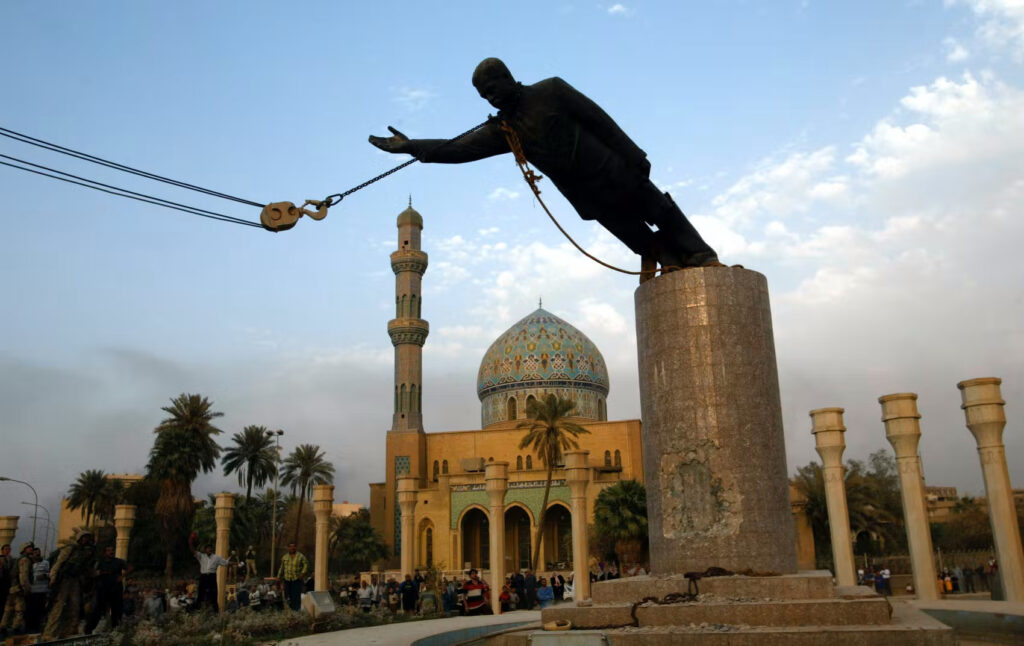
When I tell people I specialise in the ancient Near East, they often assume that my fascination must have something to do with the modern Middle East. It is an understandable assumption. I grew up in the shadow of 9/11 and the War on Terror, with Iraq, Afghanistan, Israel, Syria and Iran rarely far from the headlines. Then, somewhere along the way, I developed a fascination with Assyrians and Babylonians and eventually decided to devote a considerable part of my life to studying them. Surely there must be a connection.
For a long time, I resisted that idea. Whenever someone suggested that studying the ancient Near East must help me understand the modern Middle East, I felt an instinctive urge to point out how different the two are. There are roughly two and a half millennia between the fall of Babylon and the world we see on the evening news. Languages, religions, political institutions and entire peoples have appeared and disappeared in the meantime. You will not understand Saddam Hussein by studying Nebuchadnezzar, nor will an Assyrian royal inscription explain Islamic State.
More importantly, the suggestion seemed to contain an assumption that bothered me: that my interest somehow needed a modern justification. I do not study Babylon because it is useful. I study it because Babylon interests me. Nobody needs to explain why Imperial Rome is worth knowing about by demonstrating its usefulness for understanding today’s Italy. Yet with the ancient Near East, I sometimes feel expected to explain what this rather obscure subject can teach us about the world we live in. “It helps us understand the Middle East today” would provide a convenient answer, but I have never wanted to give it.
And yet I have gradually come to suspect that I was objecting to the wrong thing. There is a difference between studying the past in order to understand the present and acknowledging that the present influences the questions we ask of the past. I may have no interest in turning Assyria into an allegory for American foreign policy, but I am still a child of my time.
The Middle East I grew up with
I was twelve when the September 11 attacks took place. What followed was the invasion of Afghanistan, the Iraq War and years in which places such as Baghdad, Kabul and Fallujah became fixtures of the evening news. Later came the Arab Spring, the Syrian Civil War and the rise of Islamic State.
The Middle East I encountered in the media was overwhelmingly a region of dictators and terrorists, religious fanaticism and ethnic conflict, oil and geopolitics. Its problems were frequently presented as bewilderingly complicated and at the same time explained with remarkable simplicity. Sunnis and Shiites had supposedly been fighting for centuries. Arabs and Jews were ancient enemies. Tribal loyalties prevented modern states from functioning properly. Religion explained behaviour that would have been analysed in political or economic terms elsewhere.
I often found myself wanting to correct people who talked like this. Not because I possessed some comprehensive understanding of the modern Middle East — I certainly did not — but because the explanations seemed too easy. People who would never explain the Thirty Years’ War by saying that Catholics and Protestants simply hated each other seemed perfectly comfortable applying similar explanations to the Middle East.
Looking back, that instinct may have influenced me as a historian more than I realised. Again and again, I find myself attracted to subjects where the obvious story becomes less obvious the closer you look. My favourite historical question may simply be: Was it really that simple?
Empire is messy
Assyria provides the clearest example. It is not difficult to understand how the Assyrians became history’s favourite evil empire. Their kings proudly recorded destroying cities, deporting populations, impaling enemies and flaying rebels. What interests me is not proving that the Assyrians were secretly nice. They weren’t. It is discovering how little the caricature explains.
The Assyrian Empire could not function through terror alone. Its rulers negotiated with local kings, cultivated allies, rewarded loyalty and improvised arrangements that do not fit neatly into our categories of “independent” and “conquered”. Even where Assyria exercised considerable power, local rulers continued pursuing agendas of their own.
Perhaps growing up during the War on Terror made me particularly receptive to this messiness. The United States could overthrow the governments of Afghanistan and Iraq with astonishing speed. Determining what happened afterwards proved much harder. Local politicians, neighbouring states, militias and insurgents had their own objectives. Interventions produced unintended consequences. Policies that look like parts of a coherent strategy in retrospect often emerged as responses to immediate circumstances.
Assyria was not America, and comparing the two directly would tell us little. But watching a superpower discover the limits of its power may have made me suspicious of histories in which ancient empires always seem to know what they are doing.
This also helps explain my fascination with Assyria’s smaller neighbours. Traditional histories inevitably give Assyria the starring role, not least because the Assyrians left us far more evidence. Damascus, Hamath, Arpad, Israel and dozens of smaller states can consequently appear as supporting characters waiting for Assyria to conquer them. But they were not waiting. They formed alliances, fought wars, changed sides and played larger powers against each other. The history of the region changes once we stop asking only what Assyria wanted and start asking what everybody else was trying to achieve.
Ancient feuds?
Something similar applies to identity. The phrase “ancient feuds” has always bothered me when applied to the modern Middle East. It makes conflicts sound simultaneously explicable and incomprehensible: these people have simply been fighting each other forever.
The ancient Near East teaches a rather different lesson. Identities that look solid from a distance become surprisingly slippery up close. People could speak one language, worship gods associated with another community and serve the king of yet another. Populations moved, political loyalties changed and traditions were continually adapted to new circumstances.
Labels such as “Assyrian”, “Babylonian”, “Aramaean” and “Israelite” certainly mattered, but their meanings had histories. Identities were created, maintained and transformed. Studying the distant past has therefore made me more, rather than less, suspicious of claims that today’s conflicts can be explained by identities stretching unchanged into antiquity.
Babylon beyond the symbol
But perhaps the connection goes deeper than geopolitics. The Middle East of the news reports I grew up with was populated disproportionately by presidents, generals, terrorists, insurgents and religious leaders. Ordinary life tended to disappear behind war and politics.
Ancient history can suffer from the same distortion. Babylon becomes a biblical symbol of decadence, the capital of a great empire, or a stage on which Nebuchadnezzar and Cyrus perform. What increasingly fascinates me, however, is Babylon as a place where people actually lived. They bought houses, borrowed money and quarrelled about inheritances. They worried about their families, went to temples, conducted business, cultivated friendships and tried to improve their position in society. When Cyrus conquered Babylon in 539 BC, its inhabitants did not know that they were experiencing one of the dates that would later appear prominently in history books. They were simply living through an uncertain present.
Recovering that world has become one of the things I enjoy most about studying the ancient Near East. Babylon ceases to be a symbol and becomes a city. Perhaps this, too, connects with that old instinct to object when someone reduces the Middle East to fanaticism and conflict. In both its ancient and modern forms, it is a region inhabited not by abstractions but by people.
Looking from somewhere
So yes, I have been influenced by my time. Just not in the way I once resisted. The ancient Near East does not provide me with a secret key to understanding the modern Middle East. Nor does it need to. Assyria and Babylon are worth studying on their own terms. But the world in which I grew up may help explain why certain questions fascinate me. I am interested in the limits of imperial power, in the agency of supposedly minor actors, in identities that turn out to be less timeless than they appear, and in the complicated realities concealed by simple stories. Above all, I seem to have acquired an almost reflexive urge to look at stereotypes about the Middle East and ask what has disappeared from view.
For years, I thought taking the ancient Near East seriously meant insulating it from the present. Now I think that confused two different things. We should resist forcing the past into categories derived from our own world. But we cannot pretend that historians themselves stand outside history. Someone looking at an Assyrian royal inscription in 1926, 1976 and 2026 will not necessarily ask the same questions. The evidence may be the same, but each observer is looking from somewhere else.
The present has not given me my answers about the ancient Near East. But I am beginning to realise that it has given me some of my questions. I study the ancient Near East because I want to understand the ancient Near East. I just happen to be doing so as someone who grew up at the beginning of the twenty-first century. And inevitably, I am a child of my time.