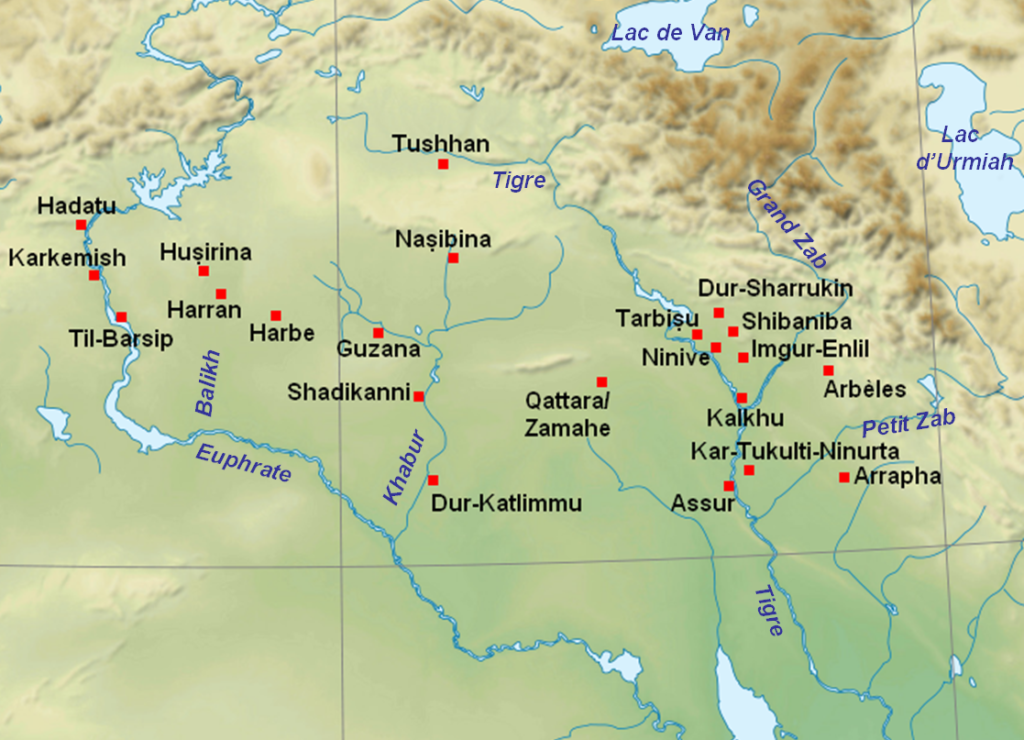
Source: Sémhur (CC BY-SA 3.0)
Chances are you have never heard of Nūr-Adad of Naṣībīna. Yet this obscure Aramean ruler may have been one of Assyria’s most formidable rivals during its early rise to power, when Assyria was still trying to regain its position as the most powerful state in northern Mesopotamia.
Between 901 and 896 BCE, King Adad-nārārī II repeatedly campaigned against Nūr-Adad and other rulers in northern Mesopotamia. Although the Assyrians claimed victory after victory, it took them six years to subdue Naṣībīna. Shortly afterwards, rulers throughout the Khabur and Middle Euphrates valleys acknowledged Assyrian supremacy with little apparent resistance.
Historian Alexander Edmonds has argued that the struggle for Naṣībīna was crucial to Assyria’s emergence as the dominant power in northern Mesopotamia. But why was the defeat of this relatively obscure ruler so important?
Six years of resistance
The struggle began in 901 BCE, when Adad-nārārī marched into Ḫanigalbat, the region encompassing the Upper Khabur Valley. There, Nūr-Adad, a ruler of the Temannu tribe, assembled his forces at Paʾuza, near the Kāšiāru Mountains (Tur Abdin). The Assyrians defeated him and pursued his army towards Naṣībīna (classical Nisibis, modern Nusaybin), but failed to capture the city.
In 900 BCE, Adad-nārārī again defeated Nūr-Adad outside Naṣībīna. He also occupied the nearby settlement of Saraku and seized its harvest, presumably to deprive the city of supplies. Over the next three years, the Assyrians subdued several other rulers in Ḫanigalbat, including Mamlī and Mūquru of the Temannu tribe. Nevertheless, Naṣībīna continued to resist.
Only in 896 BCE did Adad-nārārī finally force the city to surrender, following a prolonged blockade during which seven Assyrian fortifications had been constructed around it. Nūr-Adad was taken prisoner and a replacement ruler installed. Edmonds suggests that Naṣībīna had been the principal objective of these campaigns all along, with the other operations contributing to its eventual defeat.
A battle for hegemony
When Adad-nārārī returned to Ḫanigalbat in 894 BCE, the political situation appeared to have changed dramatically. Instead of fighting his way through the region, he collected tribute from local rulers before proceeding down the Khabur towards the Middle Euphrates. His expedition reached as far as Ḫindānu, near the Babylonian frontier, apparently without significant resistance.
Edmonds interprets this campaign as a demonstration of Assyria’s newly established hegemony. But how could the defeat of one ruler have made such a difference?
The answer may lie in the regional balance of power. Before the fall of Naṣībīna, Assyria was undoubtedly a powerful kingdom, but its position as the dominant state in northern Mesopotamia was not yet secure. Nūr-Adad’s continued resistance suggests that other rulers could still challenge its ambitions. His defeat may have changed that. With Naṣībīna subdued and other opponents already defeated, Assyria had emerged as by far the most powerful state in the region. Other rulers now had to take this new reality into account when conducting their foreign relations.
The benefits of Assyrian supremacy
This did not necessarily mean that they feared an imminent Assyrian invasion. Rather, maintaining good relations with the region’s dominant power may have become increasingly attractive. By offering tribute, rulers could acknowledge Assyria’s superior position, cultivate its favour and perhaps secure its support against their own rivals.
Assyrian supremacy did not require territorial annexation. After capturing Naṣībīna, Adad-nārārī installed another local ruler rather than immediately incorporating the city into Assyria’s administrative structure. Other rulers likewise retained their positions while acknowledging Assyrian superiority through tribute. What emerged may therefore have been a regional hierarchy rather than a territorially unified empire. Local rulers continued to govern their own lands, but Assyria had become the principal power around which their foreign relations increasingly revolved.
The sequence of events suggests that the struggle for Naṣībīna may have been about more than territorial conquest. By defeating Nūr-Adad, Assyria may have settled a contest for regional supremacy. Its subsequent dominance did not depend on conquering every neighbouring kingdom. Once it had become the most powerful state in northern Mesopotamia, other rulers had good reasons to seek its favour. The expedition of 894 BCE may have been the first clear demonstration of this new political order.