The empire that disappeared from memory

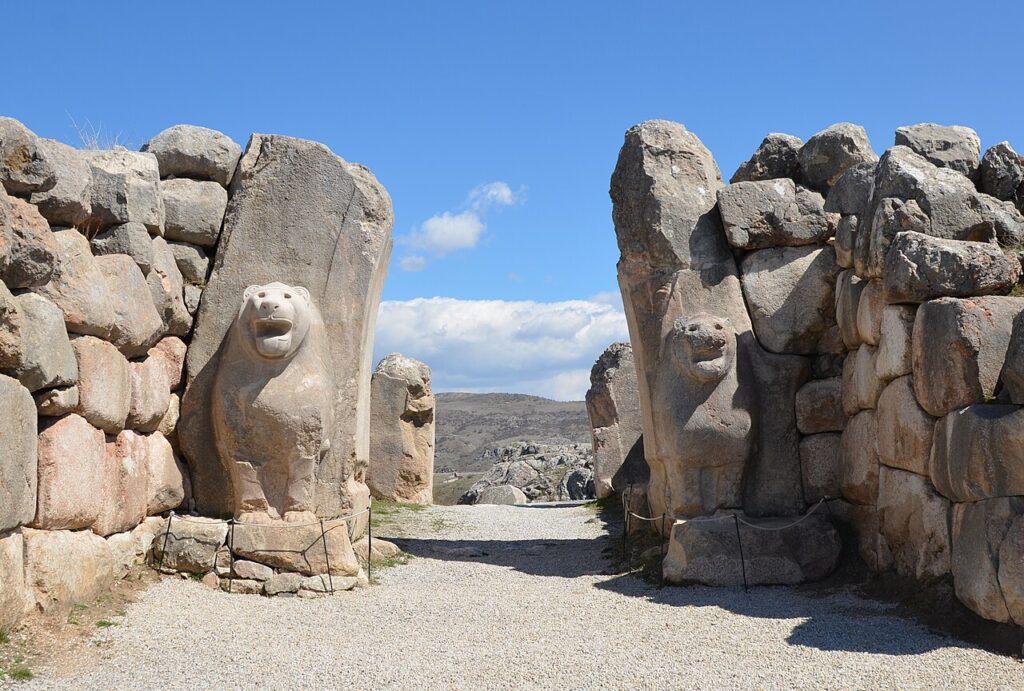
The Lion’s Gate of Hattusa, capital of the Hittite Empire.
Carole Raddato from FRANKFURT, Germany, CC BY-SA 2.0 https://creativecommons.org/licenses/by-sa/2.0, via Wikimedia Commons.

Around 1250 BCE, the Hittite Empire was one of the great powers of the ancient Near East. From their capital at Hattusa in central Anatolia, its “Great Kings” ruled most of Anatolia and Syria. They corresponded with the rulers of Egypt and Assyria as equals, fought Egypt for control of the Levant, and repeatedly intervened in affairs along the Aegean coast. The kingdom of Wilusa, commonly identified with Bronze Age Troy, belonged to their diplomatic sphere.

Only a few centuries later, however, this empire had almost completely disappeared from historical memory. Assyrian kings still knew a land called Hatti, but by then the name referred primarily to Syria, not to the former empire ruled from central Anatolia. The Hebrew Bible also mentions Hittites, or Bĕnê Ḥēt, but presents them mostly as one of the peoples of Canaan. Nothing suggests that its authors knew of a great kingdom once ruled from Hattusa.

The absence is equally striking in Greek tradition. The Homeric epics preserve a story about a war fought at Troy, yet they contain no recognizable memory of the powerful kingdom that had once dominated the lands immediately to its east and regarded Wilusa as part of its political world.

The name of Hatti had survived, as had scattered cultural traditions. But the empire itself — its capital, rulers and place in the international order — had apparently been forgotten. How could one of the greatest powers of the Late Bronze Age disappear so completely from memory?

Continue reading “The empire that disappeared from memory”
Did Neo-Assyrian kings remember the Bronze Age?

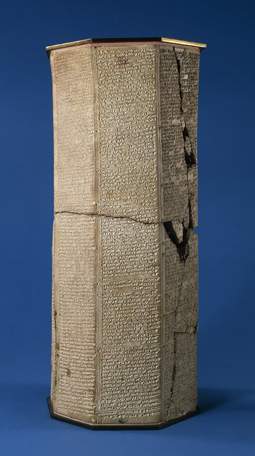
A clay prism of the Middle Assyrian king Tiglath-pileser I (r. 114-1076 BCE) recording the achievements of his reign. Such foundation deposits were placed inside the walls or foundations of important buildings, where later kings might discover them during renovations.
BM 91033. © The Trustees of the British Museum.

During the tenth and ninth centuries BCE, kings such as Aššur-dān II (r. 934–912 BCE), Adad-nārārī II (r. 911–891 BCE), Tukultī-Ninurta II (r. 890–884 BCE), and Ashurnasirpal II (r. 883–859 BCE) restored Assyrian rule over much of northern Mesopotamia, laying the foundations of the Neo-Assyrian Empire. Their inscriptions suggest that they were well aware of following in the footsteps of earlier conquerors. They repeatedly invoked rulers from the Middle Assyrian period, such as Adad-nārārī I (r. 1295–1264 BCE), Shalmaneser I (r. 1263–1234 BCE), Tukultī-Ninurta I (r. 1233–1197 BCE) and Tiglath-pileser I (r. 1114–1076 BCE), who had extended Assyrian power across northern Mesopotamia centuries earlier.

The early Neo-Assyrian kings recalled lands conquered by their predecessors, cities that had once belonged to Assyria and peoples that had subsequently stopped paying tribute, using these precedents to justify their claims. The Assyrian scribes could apparently connect particular kings with particular places and events.

Such references are often taken to show that the early Neo-Assyrian kings knew the full territorial extent of the Middle Assyrian Kingdom and consciously sought to restore it. There is some truth in this interpretation. Their knowledge of earlier Assyrian rule undoubtedly shaped how they presented their campaigns. But knowing that a predecessor conquered a certain land is not the same as understanding the historical circumstances of that conquest. The Assyrians remembered facts about their past. But did they also understand the world in which those events had occurred?

Continue reading “Did Neo-Assyrian kings remember the Bronze Age?”

A child of my time

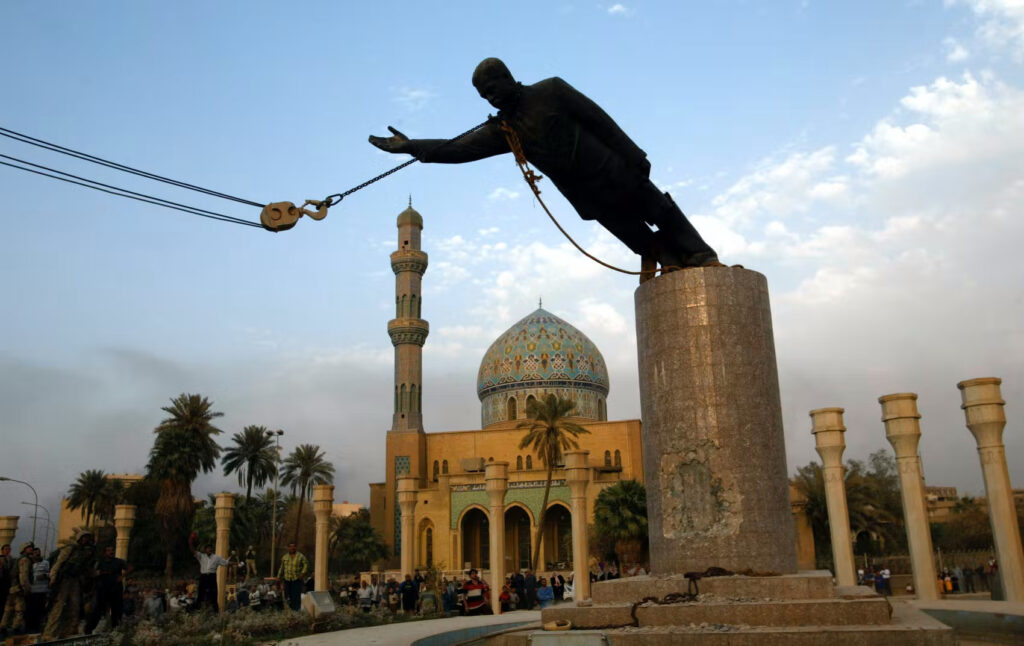
The statue of Saddam Hussein being toppled in Baghdad’s Firdos Square on April 9, 2003. Photo taken by an unknown employee of the U.S. military or Department of Defense.

When I tell people I specialise in the ancient Near East, they often assume that my fascination must have something to do with the modern Middle East. It is an understandable assumption. I grew up in the shadow of 9/11 and the War on Terror, with Iraq, Afghanistan, Israel, Syria and Iran rarely far from the headlines. Then, somewhere along the way, I developed a fascination with Assyrians and Babylonians and eventually decided to devote a considerable part of my life to studying them. Surely there must be a connection.

For a long time, I resisted that idea. Whenever someone suggested that studying the ancient Near East must help me understand the modern Middle East, I felt an instinctive urge to point out how different the two are. There are roughly two and a half millennia between the fall of Babylon and the world we see on the evening news. Languages, religions, political institutions and entire peoples have appeared and disappeared in the meantime. You will not understand Saddam Hussein by studying Nebuchadnezzar, nor will an Assyrian royal inscription explain Islamic State.

More importantly, the suggestion seemed to contain an assumption that bothered me: that my interest somehow needed a modern justification. I do not study Babylon because it is useful. I study it because Babylon interests me. Nobody needs to explain why Imperial Rome is worth knowing about by demonstrating its usefulness for understanding today’s Italy. Yet with the ancient Near East, I sometimes feel expected to explain what this rather obscure subject can teach us about the world we live in. “It helps us understand the Middle East today” would provide a convenient answer, but I have never wanted to give it.

And yet I have gradually come to suspect that I was objecting to the wrong thing. There is a difference between studying the past in order to understand the present and acknowledging that the present influences the questions we ask of the past. I may have no interest in turning Assyria into an allegory for American foreign policy, but I am still a child of my time.

Continue reading “A child of my time”

Does the Odyssey contain memories of the Sea Peoples?

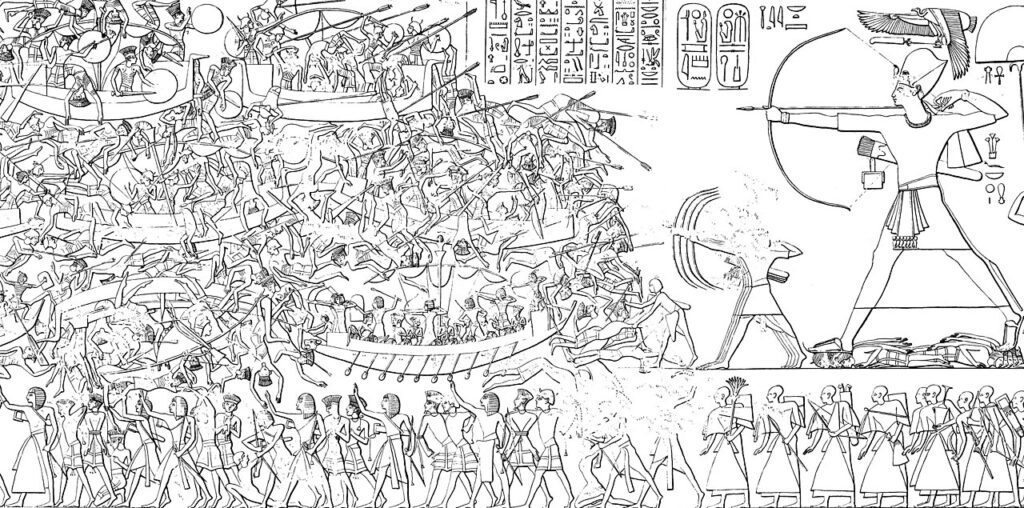
Wall relief at Medinet Habu depicting pharaoh Ramses III defeating the Sea Peoples in the Battle of the Delta

When watching Christopher Nolan’s The Odyssey, I noticed something interesting. Nolan seems to place Odysseus and the other returning heroes of the Trojan War firmly within the world of the Sea Peoples: the mysterious seaborne warriors who swept across the eastern Mediterranean around 1200 BC and even challenged the mighty Egyptian Empire.

It’s an attractive idea. The Trojan War is traditionally dated to roughly the same period as the Bronze Age Collapse, and some of the peoples mentioned in Egyptian inscriptions have even been linked to the Greeks who fought at Troy. Perhaps Odysseus and his crew were themselves among the Sea Peoples. As it turns out, Nolan is far from the first to make that connection.

Continue reading “Does the Odyssey contain memories of the Sea Peoples?”