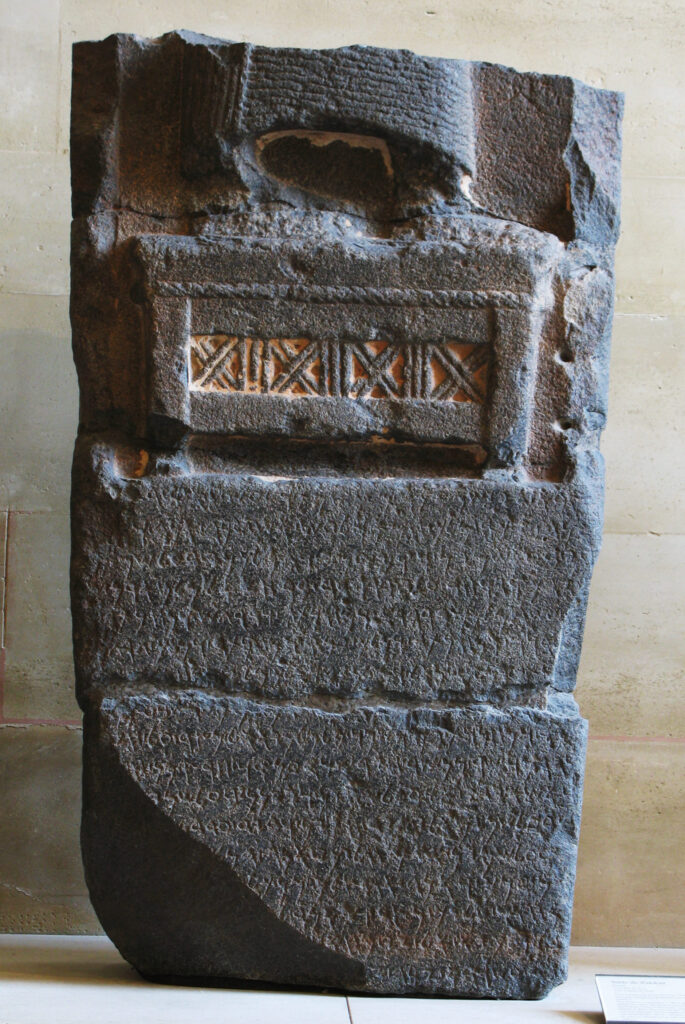
Basalt stele of the king Hazael of Aram-Damascus. Louvre, Paris.
Earlier I argued that during the late ninth and early eighth century BCE a relatively stable regional order existed in the Levant. Before that system emerged, however, one ruler briefly came closer than anyone else to establishing his dominance over all of Syria: Hazael of Damascus.
Hazael is one of the most remarkable figures of the ninth-century Levant. Unlike many contemporary kings, he was probably not born into a royal dynasty. According to the Books of Kings, he served at the court of the former king Ben-Hadad II before seizing the throne around 843 or 842 BCE. The biblical account describes how he assassinated his master after being informed by the prophet Elisha that he would one day become king. Whether or not every detail of this story is historical, few scholars doubt that Hazael was a usurper.
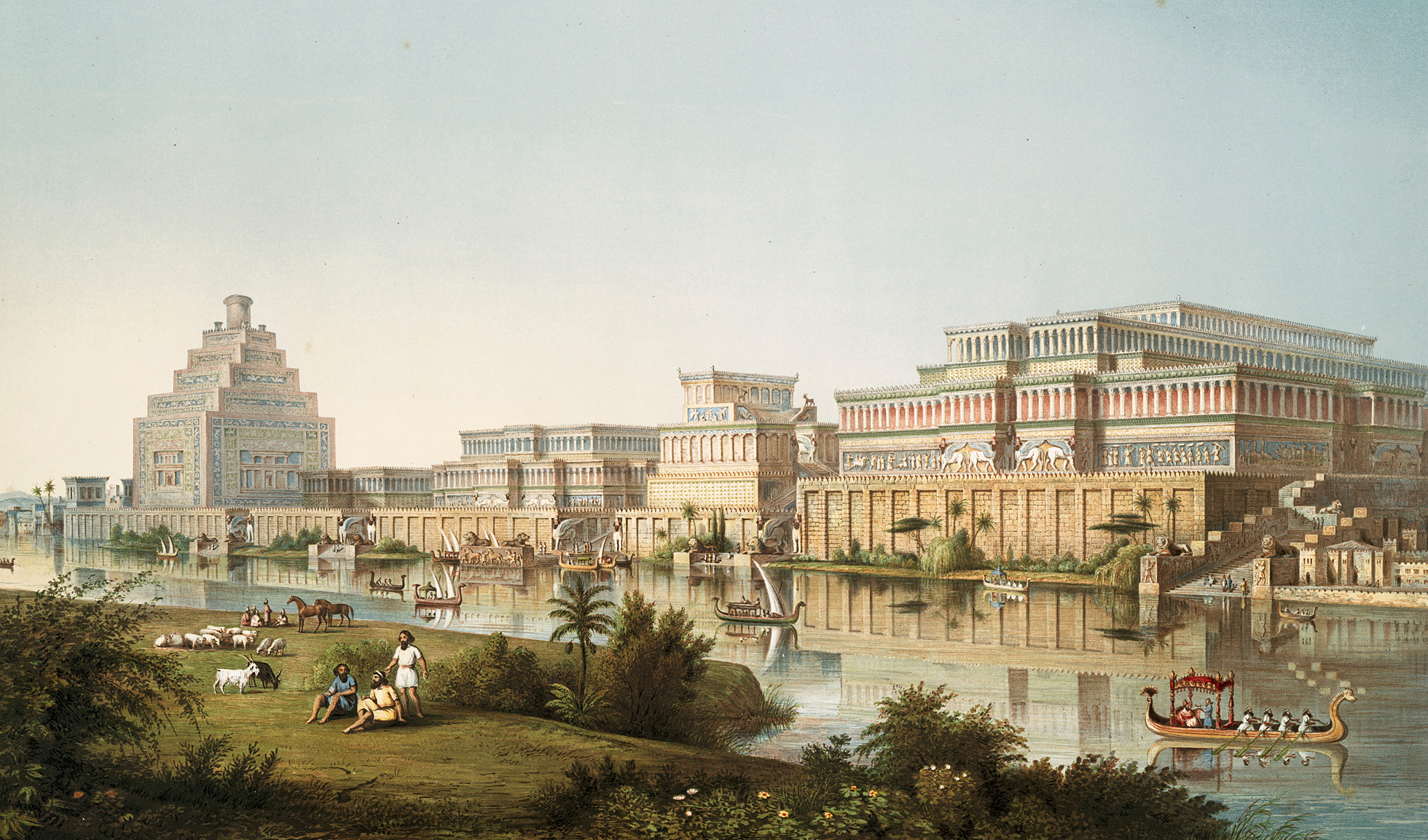
Artist’s impression of Assyrian palaces from The Monuments of Nineveh by Sir Austen Henry Layard, 1853. A more peaceful depiction of Assyria.
The Assyrian Empire has a public relations problem. Watch any documentary or read any popular history website and there is a good chance that within minutes someone will be impaled, flayed, or have their city burned to the ground. Preferably all three. The accompanying narrator will then solemnly inform us that the Assyrians ruled through terror, demanded impossible tributes from their neighbours, sought to conquer the entire known world and eventually suffered a well-deserved downfall.
This image is not entirely without foundation. The Assyrians were perfectly capable of extreme violence and, unlike many rulers throughout history, they were remarkably eager to advertise it. Yet I often find myself frustrated by how predictable these portrayals have become. Not because they are completely wrong, but because they are so incomplete. The Assyrian Empire frequently appears as a stock villain: an ancient equivalent of the Galactic Empire, forever plotting conquest while everyone else waits to be conquered. The real Assyrian Empire was far more interesting than that.
In my previous post, I argued that the low frequency of Assyrian campaigns in the Levant between 841 and 743 BCE does not necessarily indicate stagnation or decline. Rather, it suggests that a relatively stable regional order had emerged in which local powers such as Damascus, Hamath, Luḫuti and Arpad largely managed their own affairs while Assyria focused its attention on developments in the north and east.
One of the clearest glimpses of this world comes from the reign of Zakkur, king of Hamath and Luḫuti. Who exactly Zakkur was remains unclear. In his own inscription, he claims that the god Baʿlshamayn raised him from humble origins and made him king. Scholars have often interpreted this statement as evidence that he was a usurper rather than a legitimate heir.
Zakkur probably originated from Hatarikka (Hazrach), the capital of Luḫuti, which remained his principal residence even after he acquired Hamath. How this happened is uncertain. He may have first become king of Luḫuti and later conquered Hamath, overthrowing its ruling dynasty in the process. Whatever the precise sequence of events, Zakkur succeeded in uniting two previously separate kingdoms and creating a larger and more powerful state than had existed before in central Syria.
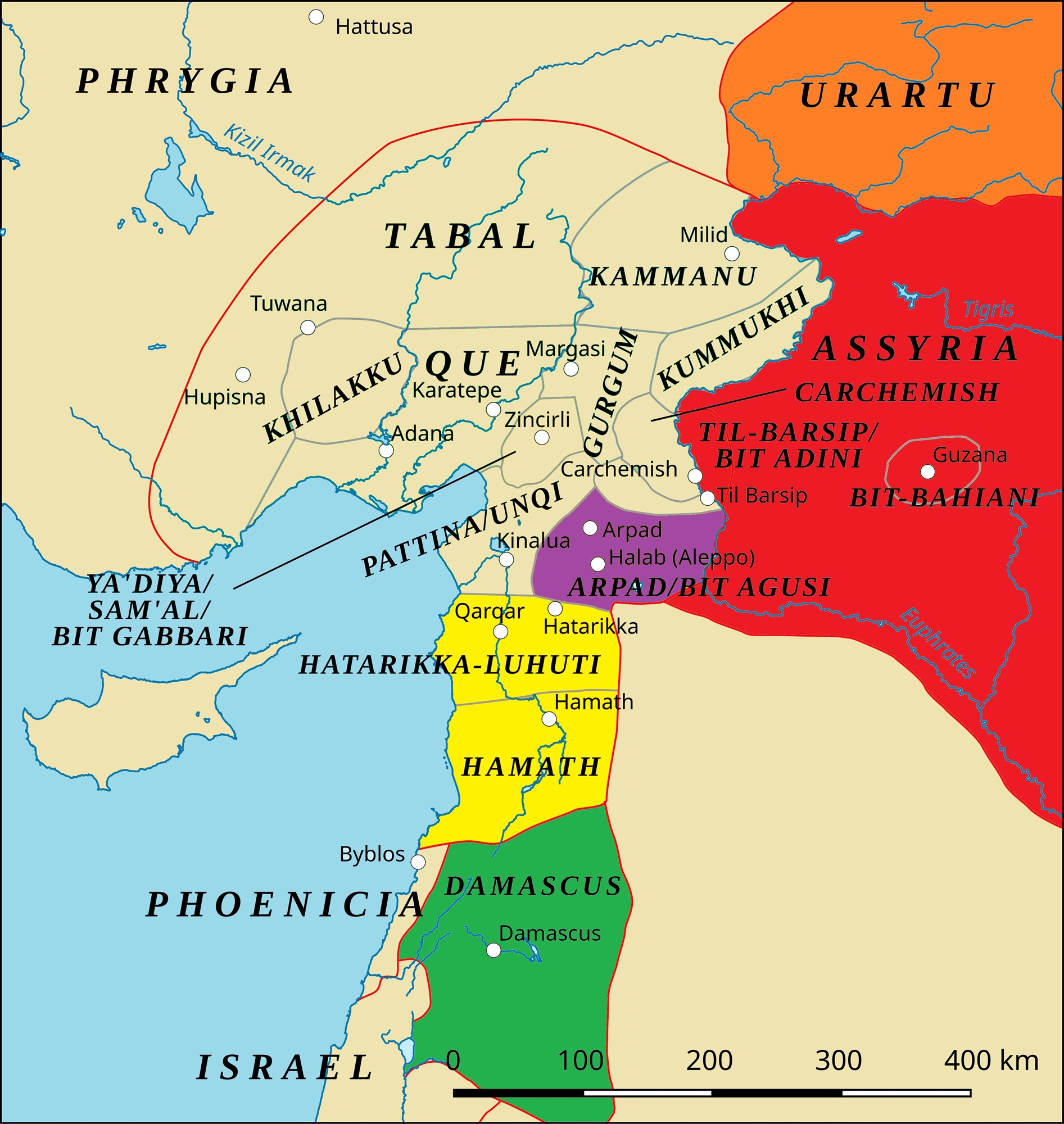
Historical map of the Neo-Hittite states (ca. 800 BCE). Based on data from Tübinger Bibelatlas (Tübinger Bible Atlas), S. Mittmann & G. Schmitt (eds.), maps B IV 13-14, and O.R. Gurney, The Hittites, Harmondsworth: Penguin (Pelican Books), 2nd ed., 1976 (=1954) pp. 39-46. ‘State borders’ are approximate only. Colors adapted by Daan Nijssen. CC BY-SA 3.0
The Levant has played a central role in world history since the earliest beginnings of civilization. This fertile corridor between the Mediterranean Sea and the Arabian Desert, situated between Mesopotamia, Egypt and Anatolia, formed a crossroads of long-distance trade. Caravan routes crossed its valleys and plains, while its ports connected the eastern Mediterranean to wider maritime networks. Much of the wealth of Levantine cities derived from their position as intermediaries in both overland and maritime commerce.
Politically, however, the Levant was highly fragmented. Phoenician city-states, Aramaean tribes and Neo-Hittite kingdoms constantly competed for control of trade routes. Alliances shifted frequently and no single power could easily dominate the region for long. For Assyria, the Levant therefore represented both opportunity and danger: a wealthy gateway to the Mediterranean, but also a frontier capable of producing powerful anti-Assyrian coalitions.
Under Shalmaneser III (r. 858–824 BCE), Assyrian armies campaigned repeatedly in the Levant, confronting anti-Assyrian coalitions led by rulers such as Ahuni of Bīt-Adini, Irhuleni of Hamath and Hazael of Damascus. A century later, the region again became the focus of Assyrian expansion under Tiglath-pileser III (r. 745–727 BCE), who annexed large parts of Syria and Palestine and transformed former client states into Assyrian provinces.
Yet between these two periods lies a striking gap. According to the Assyrian Limmu List — a chronological record in which each year was named after a high official and often accompanied by a brief note about a military campaign — there were hardly any Assyrian campaigns to the Levant between roughly 841 and 743 BCE. This was not because Assyria became inactive. On the contrary, Assyrian kings campaigned almost every year, but mostly toward the north and east: against Urartu in the Armenian Highlands and frontier polities the Zagros and Taurus Mountains. Why, then, was the western frontier comparatively quiet for almost a century?