FaradzhoffEma, CC BY-SA 4.0 https://creativecommons.org/licenses/by-sa/4.0, via Wikimedia Commons
At the end of my previous post, I suggested that members of the Babylonian elite may already have been in contact with Cyrus before he invaded Babylonia in 539 BCE. Hedging their bets, they may have concluded that accepting the victorious warlord as their new king was preferable to risking a prolonged and destructive war. But this raises a more fundamental question. From our perspective, Babylonians deliberately helping Cyrus replace Nabonidus looks like collaboration with a foreign conqueror taking over their country. Yet that perspective is shaped by hindsight: we know what Cyrus’s victory eventually led to.
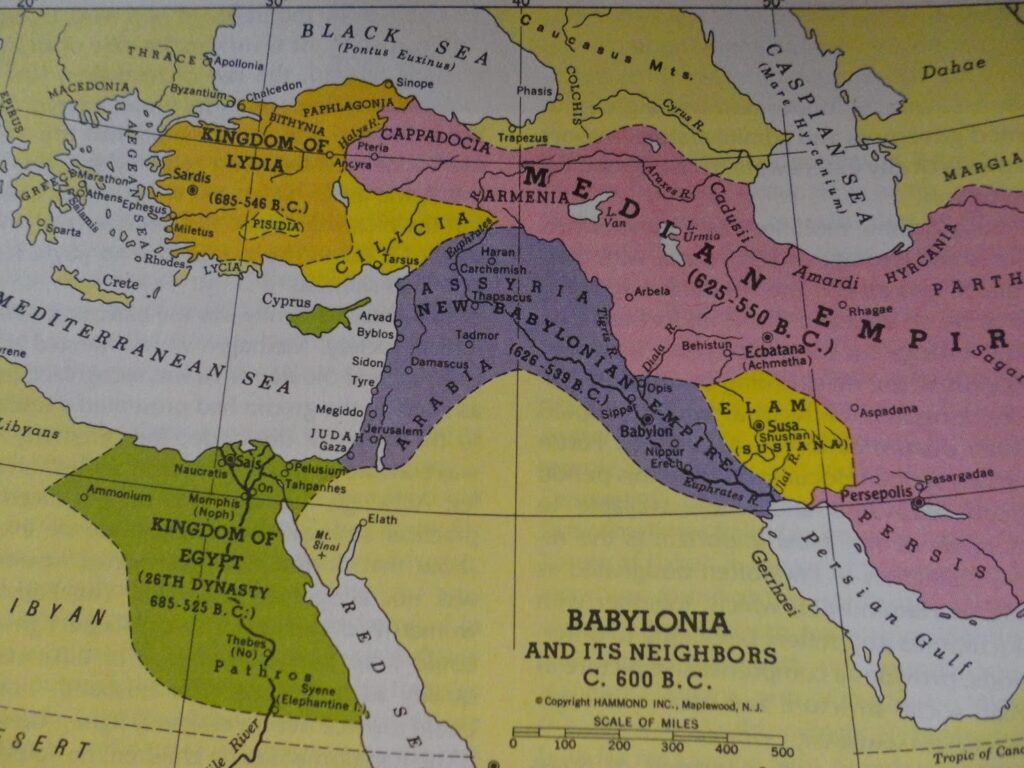
Open a historical atlas and compare the Near East before and after 539 BCE. On the first map, Mesopotamia, the Levant and much of northern Arabia are parts of the Babylonian Empire. To the east and north lies the rapidly expanding dominion of Cyrus. Turn the page and the Babylonian Empire has disappeared. Almost everything is now part of the Persian or Achaemenid Empire.
Maps make the transition wonderfully clear. Perhaps too clear. Nobody living in Babylon in October 539 BCE knew that the colour of their empire had just changed. Nor did they know that historians would divide Near Eastern history into a Neo-Babylonian period ending in 539 BCE and an Achaemenid period beginning immediately afterwards. They experienced a sequence of events: Nabonidus was defeated in battle, upon which Cyrus entered Babylon and became king. Whether this amounted to the destruction of one empire and its incorporation into another is already an interpretation.
Babylon had changed kings before
Babylonian kingship had never depended on membership of a single dynasty or ethnic group. Kassites, Chaldeans and Assyrians had all ruled Babylon. Nabonidus himself was born in Harran and had come to power after a succession of palace coups. Dynasties changed, but Babylon remained.
A foreign ruler becoming king of Babylon therefore did not necessarily mean that Babylonian kingship ceased to exist. Foreign conquerors were usually incorporated into the institution. This was also the case with Cyrus. Babylonian documents began dating events to his reign and Cyrus adopted Babylonian royal titles. He was not merely a Persian ruler governing conquered Babylonians. He became “king of Babylon, king of the lands”. From our perspective, Cyrus had acquired the kingship of Babylon. From theirs, Babylon had acquired a Persian king. That difference may be more important than it seems.
Where was the Persian Empire?
There is another problem with our maps. We tend to imagine the Persian Empire already existing before Cyrus conquered Babylon: a huge territorial state expanding until it swallowed the Babylonian Empire. But we should be careful not to project the empire of Darius and Xerxes backwards onto 539 BCE.
Cyrus certainly controlled an extraordinary amount of territory. Starting from the Iranian highlands, he had defeated the Median king Astyages, conquered Lydia and extended his authority across much of the mountain ranges surrounding Mesopotamia. Yet he had assembled much of this dominion within his own lifetime. His authority depended heavily on his personal success, and it was far from certain that his successors would hold on to his conquests. From a Babylonian perspective, Cyrus may therefore have looked more like an extraordinarily successful warlord than the emperor of a neatly defined foreign state.
What if Babylon annexed Persia?
Imagine the situation from Babylon. Nabonidus rules Babylonia and its western territories. Beyond them, Cyrus controls Persia, Media, Lydia and much of the highland world. Then Nabonidus loses and Cyrus becomes king of Babylon. What has happened to Cyrus’s other territories? We automatically answer that Babylonia has been added to Cyrus’s empire. But a Babylonian observer could conceivably have understood the same development in the opposite direction: Cyrus’s territories had just been added to the dominion of the king of Babylon.
If empire was conceived primarily through the person of the king rather than as a sharply bounded territorial state, the distinction between Cyrus becoming king of Babylon and Babylon becoming part of Cyrus’s empire was not necessarily as obvious as it appears on a modern map.
Accepting Cyrus might even have looked like an excellent bargain. Instead of fighting the most successful warlord in western Asia, the Babylonians could accept him as their own king. Their cities, temples and institutions would remain intact, while their new ruler happened to bring Persia, Media, Lydia and the surrounding highlands with him. From that perspective, 539 BCE need not initially have looked like the end of the Babylonian Empire. It might have looked like its greatest expansion.
William III of Orange (again)
There is a useful parallel with William III of Orange. When William landed in England in 1688 with a Dutch army and replaced James II, the event was not remembered simply as the Dutch conquest of England. England remained England. William’s Dutch possessions did not become English provinces, nor did England become an extension of the Dutch Republic.
The English could also tell the story in a way that made William’s intervention a victory for themselves. Parliament accepted him, James fled, and the new settlement could be presented as the defence of English liberties and Protestant religion. The fact that William arrived at the head of a foreign army did not prevent the “Glorious Revolution” from being understood primarily as an English political event.
Nor was there anything unusual about a ruler with foreign roots sitting on the English throne. Norman, Welsh, Scottish and later German dynasties did not make England progressively less English (with the partial exception of the Normans). A change of dynasty was not the same thing as the disappearance of the kingdom itself. Something similar could initially have been imagined in Babylon. Cyrus might be Persian, just as William was Dutch, without Babylon thereby ceasing to be Babylon. But this is also where the comparison breaks down.
Two sides of the same bargain
Cyrus and his Babylonian supporters did not even need to agree about what had happened. Cyrus could have thought: “I have conquered Babylonia and added it to my dominion.” A Babylonian notable could have thought: “We have replaced Nabonidus with Cyrus, and the lands ruled by Cyrus now belong to our kingdom.” Both interpretations could coexist.
For a time, that ambiguity may genuinely have existed. What makes 539 BCE look so clearly like the Persian conquest of Babylonia is what happened afterwards. Cyrus did not merely rule Babylon for a few years before the two political worlds separated again. His son and successor Cambyses retained Babylonia, and despite the succession crisis that followed his death, the imperial structure endured.
Under Darius in particular, the empire became more clearly articulated as a Persian imperial system. Royal ideology increasingly emphasised the Persian king and his relationship to a vast hierarchy of peoples and lands. Babylonia remained enormously important, but it became one major region within a much larger imperial structure governed by a Persian dynasty.
Had William III founded a durable Dutch dynasty, had England gradually been incorporated into a larger state centred on the Netherlands, and had later rulers increasingly presented themselves through a specifically Dutch imperial identity, historians might remember 1688 very differently. Instead, England remained recognisably England. Babylon’s later history took another course.
Significance of the Cyrus Cylinder
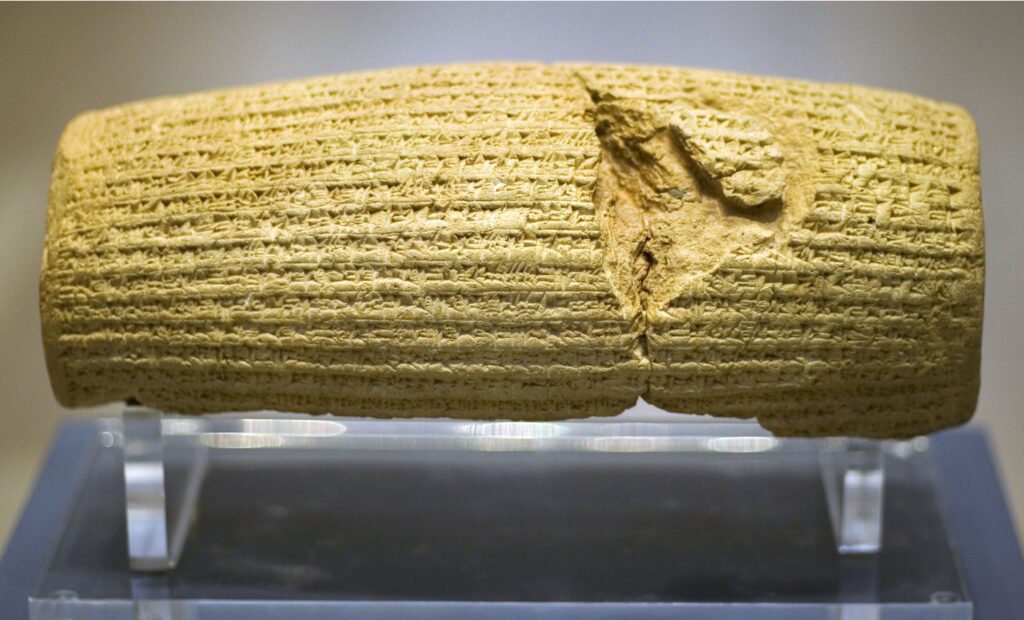
This also changes how we might read the Cyrus Cylinder. The text presents Nabonidus as an impious ruler, leading Marduk to search the lands for a suitable replacement. Marduk finds Cyrus, takes him by the hand, and makes him enter Babylon peacefully, presenting himself as the legitimate ruler chosen by Babylon’s supreme god.
Prioryman, CC BY-SA 3.0 https://creativecommons.org/licenses/by-sa/3.0, via Wikimedia Commons
It is tempting to call this Persian propaganda. But the Cylinder is deeply embedded in Babylonian traditions of kingship. Babylonian scribes and intellectuals helped translate Cyrus’s victory into a form that made sense within their political and religious world.
Usually we assume this narrative emerged after the conquest: Cyrus had won and Babylonian scholars subsequently explained why he had won. But if the hypothesis explored in Part II is correct, another possibility arises. Some of the people who created Cyrus’s Babylonian legitimacy may already have regarded him as an acceptable replacement for Nabonidus. Put provocatively: perhaps Marduk chose Cyrus because influential Babylonians had already chosen him.
The agency of the conquered
This is ultimately why 539 BCE interests me. Histories of empire naturally follow the people doing the expanding: Cyrus invades, defeats Nabonidus, captures Babylon and incorporates Babylonia. The Babylonians merely react: they resist, surrender or collaborate. But those categories already assume that Cyrus is the protagonist.
Babylonian elites could assess the geopolitical situation, maintain contacts beyond their borders, abandon one king and accept another. Their goals need not fit neatly into either “resistance” or “collaboration”. If they helped Cyrus take the Babylonian throne, they may have believed they were preserving the political system that mattered to them: Babylon, its temples, its cities, its elite families and its kingship. They may even have believed they were strengthening it. In that case, the people we describe as conquered were not merely deciding how to respond to conquest. They may have been actively trying to shape the political order that came next.
The irony is that the bargain may initially have worked much as they hoped. Babylon survived, its institutions continued, and Cyrus became a recognisably Babylonian king. Only over the following generations did it become clear that 539 BCE had not merely given Babylon another foreign ruler. It had placed Babylon inside an empire whose political centre increasingly came to lie elsewhere.