I’ve recently been reading Mediterranean Anarchy, Interstate War, and the Rise of Rome (2006) by historian Arthur Eckstein as part of my PhD research. The book examines the rise of Rome through the lens of International Relations theory. Rather than simply describing how Rome conquered the Mediterranean, Eckstein tries to explain why it happened. His main argument is that we cannot understand the rise of Rome’s without looking at the wider political environment in which it operated.
This is quite similar to what I’m doing in my own research. I try to explain how the Near East developed from a fragmented landscape of competing states and other political entities in the tenth century BCE into a region dominated by the Neo-Assyrian Empire, before Assyrian power suddenly collapsed in the late seventh century BCE. Although Rome and Assyria existed in different periods and regions, the underlying question is much the same: how does one power come to dominate a world full of competing states?
Why did Rome conquer its neighbours?
Eckstein challenges the commonly held idea that Rome conquered the Mediterranean because the Romans were more aggressive or expansionist than their neighbours. Instead, he argues that all states in the ancient Mediterranean were constantly competing for power. To explain why, he draws on realism, a theory of international politics that emphasises how the political environment influences the behaviour of states.
One of the central ideas of realism is that the international system is inherently anarchic. This means that there is no overarching authority capable of enforcing rules among states. There were certainly treaties and diplomatic conventions, but if another state violated them, there was no higher authority you could turn to for protection. States ultimately had to look after themselves.
This created a dangerous environment. Rulers could never be entirely certain about their neighbours’ intentions, so they had good reasons to strengthen their armies and expand their influence. Even a ruler who was primarily concerned with defending his own territory could decide that conquering a neighbouring region would make his kingdom safer. His neighbours, in turn, could see this expansion as a threat and respond in kind.
By Megistias. Public Domain.
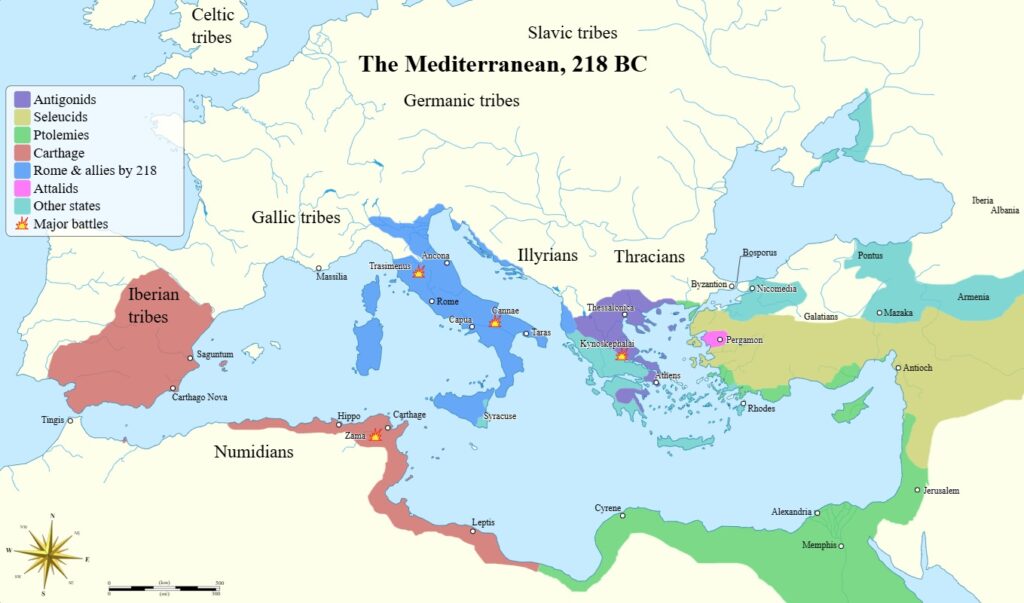
Sometimes a balance of power emerged, with several major states keeping each other in check. But such balances were rarely stable. If one state suddenly became weaker, others would try to take advantage of the situation. This, according to Eckstein, is what happened around 200 BCE, when the Seleucid and Antigonid kingdoms sought to exploit the weakness of Ptolemaic Egypt. Other powers, alarmed by their ambitions, subsequently turned to Rome for help, encouraging the Republic to intervene on Greek soil.
Rome was not particularly unusual in its willingness to wage war and expand its power. What made it different, according to Eckstein, was its remarkable ability to incorporate conquered peoples and integrate allies into its political and military system. In other words, realism helps explain why Mediterranean states were constantly competing, while Rome’s particular characteristics help explain why it eventually came out on top.
A familiar story in the Near East
Much of this sounds familiar when looking at the ancient Near East. In the first half of the first millennium BCE, there was likewise no overarching authority capable of consistently enforcing rules among competing powers. Treaties and diplomatic conventions certainly existed, but rulers ultimately had to rely on their own resources and alliances to protect their interests. Warfare was common and nobody could afford to ignore what their neighbours were doing.
Like Rome, Assyria was hardly the only ambitious or aggressive power around. Its rulers had to deal with neighbours who had their own interests, ambitions and plans for expansion. This means that the rise of Assyria was not simply a story of powerful kings conquering one helpless neighbour after another. Other rulers could resist Assyria, cooperate with it or even use its military power to advance their own interests. They were active participants in the political developments of their time.
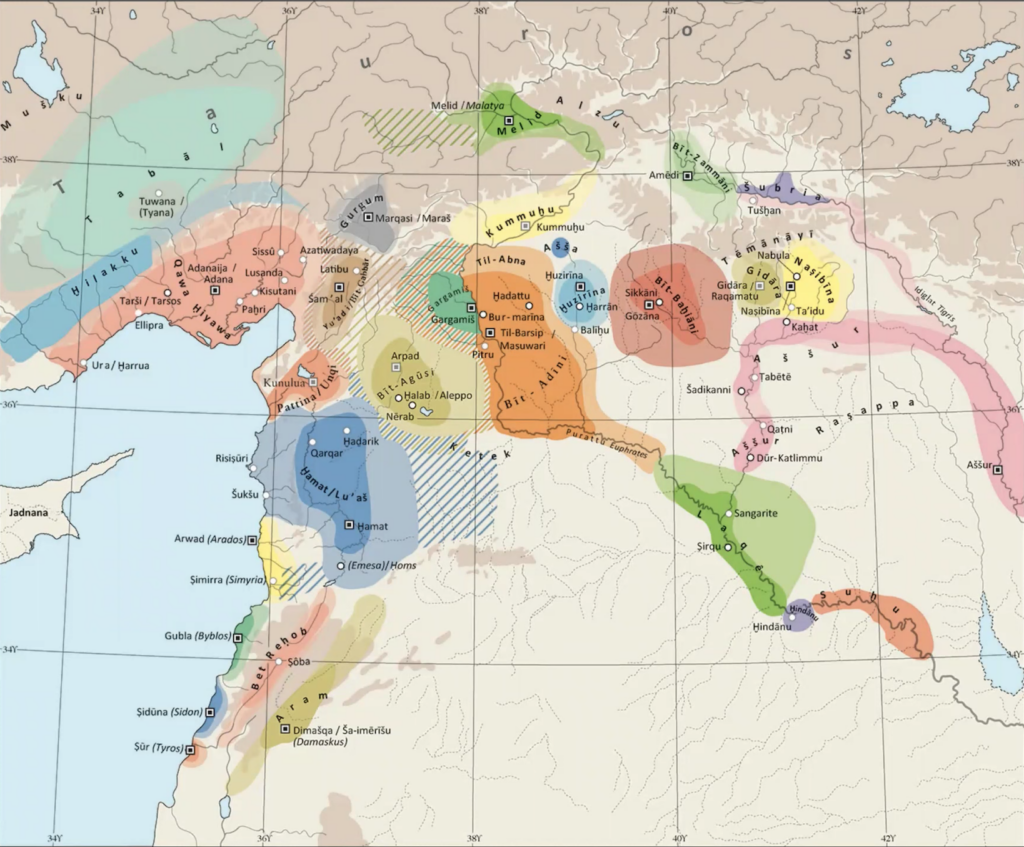
There is another similarity between Eckstein’s approach and mine. Rather than treating the Mediterranean as a single political system from the outset, he examines several regional systems and explains how they gradually became interconnected under Roman dominance. I’m taking a similar approach by dividing the Near East into several geopolitical ‘theatres’, such as the Northern and Southern Levant, the Zagros region and the Urartu frontier. Each had its own collection of political actors, rivalries and alliances. By studying these theatres separately, and then looking at how they interacted, I hope to understand how Assyrian expansion transformed the wider political landscape.
Source: M. Novák, in Brill’s New Pauly Supplements I Online – Volume 3
How Assyria turned power into authority
There are, however, some important differences between the Mediterranean world and the Near Eastern world. Eckstein devotes considerable attention to the relatively similar city-states of Classical Greece and, later, the powerful kingdoms that emerged after Alexander the Great. The Near East, meanwhile, was home to political entities of enormously different sizes and forms: city-states, tribes, regional kingdoms, tribal federations and empires. Such differences existed in the Mediterranean as well, but they played a particularly important role in the Near East.
This made political relationships rather complicated. A small kingdom threatened by a powerful neighbour might seek allies to oppose it, a strategy known as balancing. Alternatively, it might decide that resistance was too dangerous and side with the stronger power instead, hoping to gain protection or other benefits. This is known as bandwagoning. Such relationships were often unequal, but that did not mean they were entirely one-sided. A powerful kingdom might offer protection to a smaller neighbour in exchange for tribute, military support or loyalty. Both sides could benefit, even if the stronger party had much more influence over the terms of their relationship. In international relations theory, this is known as asymmetric interdependence.
This brings me to one of the most interesting aspects of Assyrian expansion: its system of vassalage. Assyrian kings did not simply conquer territories. They also established relationships with local rulers, who were allowed to retain their thrones in exchange for tribute and loyalty. These agreements were often formalised through treaties and oaths. In this way, Assyria tried to establish a kind of political hierarchy, with the Assyrian king at the top and subordinate rulers beneath him.
But this hierarchy was never absolute. Assyria had to be powerful enough to enforce its demands, while its vassals had to be willing, or at least sufficiently motivated, to cooperate. They could negotiate their position, resist particular demands or abandon their allegiance when circumstances changed. This is something I find particularly interesting: political hierarchy is not simply something that a powerful ruler imposes on everyone else. It is also something that other actors have to participate in, even if they do so under considerable pressure.
There is also an important difference in how the two stories end. Rome managed to establish a political order that endured for centuries. Assyria, despite its enormous military power and extensive network of subordinate rulers, saw its empire collapse in the late seventh century BCE. Why did Roman dominance prove so much more durable? This is another reason to look beyond military strength and examine how relationships between rulers were established, maintained and eventually undermined.
Why military power isn’t everything
Eckstein’s use of realism has given me plenty of ideas for my own research. However, I think there is something important missing from a purely realist explanation. This is why I want to combine realism with another approach to international politics: constructivism.
Constructivism emphasises that political behaviour is shaped not only by material circumstances, such as military strength and economic resources, but also by ideas, identities, norms and perceptions. For example, two rulers facing a similar military threat might react very differently. One might see a powerful neighbour as a dangerous enemy that must be resisted, while another might regard the same power as a potential ally. Their decisions depend not only on the actual distribution of power, but also on how they understand their situation, what they hope to achieve and what they believe others expect of them.
Constructivism is especially useful when studying unequal political relationships. Assyrian kings presented themselves as superior rulers who were entitled to the loyalty and obedience of their vassals. But did their vassals see things the same way? Did they regard themselves as loyal subjects, junior partners or independent rulers who had simply made an agreement with a stronger neighbour? And how did these different understandings influence their behaviour?
Eckstein briefly addresses constructivist criticisms of realism, arguing that changing ideas or political discourse cannot simply make the realities of military power disappear. I agree with him on that point. A small kingdom could not make the Assyrian army disappear simply by refusing to recognise Assyrian authority. But that does not mean ideas were irrelevant. The way rulers understood their relationships could influence how they cooperated, negotiated or resisted.
This is ultimately why I want to combine realism and constructivism. Realism helps us understand the pressures that encouraged states to compete and expand, while constructivism helps us understand how rulers interpreted those pressures and how they established, maintained or challenged political relationships. By bringing these approaches together, I hope to explain not only how Assyria became the dominant power in the Near East, but also how that dominance actually worked, and why it eventually fell apart.
Reading Eckstein has made me think differently about the rise of Assyria. Rather than seeing its expansion primarily as the achievement of a succession of ambitious kings, I want to understand how it emerged from the interactions of many different political actors, each pursuing their own interests. The comparison with Rome is particularly interesting because, despite some striking similarities, the two empires followed very different paths. I don’t expect to find a single explanation that answers all these questions. But Eckstein has convinced me that looking at the ancient Near East through the lens of International Relations theory is a promising way to approach them.