Public domain, via Wikimedia Commons.
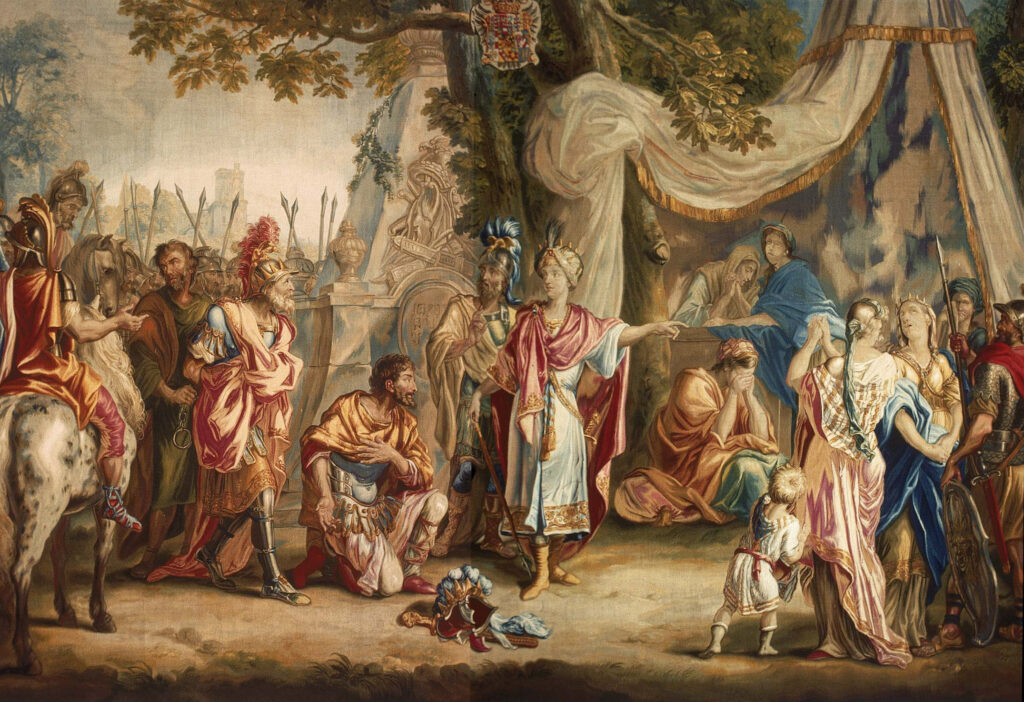
According to the Greek historian Herodotus (Histories 1.107–130), Astyages, king of the Medes, was haunted by a unsettling prophecy. He had dreamed that his daughter Mandane would give birth to a child who would overthrow him and take his throne. Determined to prevent this, he ordered his trusted servant Harpagus to kill the baby, named Cyrus. Harpagus, however, could not bring himself to kill the child and instead handed him over to a shepherd, who raised him as his own son.
Years later, Astyages discovered that Cyrus was still alive. Furious that Harpagus had disobeyed him, he came up with a terrible punishment. He invited Harpagus to a feast, secretly served him the flesh of his own son, and revealed the awful truth only after the meal. Harpagus hid his anger but never forgot what Astyages had done. When Cyrus eventually rebelled against his grandfather, Astyages put Harpagus in command of the Median army. Harpagus took the opportunity to get his revenge, turning against his former master and helping Cyrus win the war. In the end, the very prophecy that Astyages had tried so hard to prevent came true, largely because of his own actions.
Herodotus presents Astyages as a cruel and paranoid ruler who brought about his own downfall. Yet this well-known story tells us surprisingly little about the historical Astyages. Herodotus also tells us that Astyages succeeded his father Cyaxares, ruled for 35 years, and was connected to the Lydian royal family through marriage. But apart from these details, almost everything he tells us about Astyages concerns how he lost his throne.
Three versions of Astyages
Not all ancient Greek authors described Astyages as a cruel ruler. Ctesias, a Greek doctor who worked at the Persian court in the late fifth and early fourth centuries BCE and wrote a history of the Persian Empire, told a different story. According to him, Cyrus was not Astyages’ grandson, but a man from a humble background who rose to power through his own abilities. After several battles, Cyrus eventually defeated Astyages and took his throne.
An even more positive picture appears in Xenophon’s Cyropaedia, a largely fictional account of Cyrus’ childhood and rise to power. Here, Astyages is a loving grandfather who welcomes the young Cyrus to his court and enjoys spoiling him. There is no violent overthrow: Astyages dies peacefully and is succeeded by his son Cyaxares, who eventually hands over power to Cyrus.
We therefore have three very different pictures of Astyages: Herodotus’ cruel ruler, Ctesias’ defeated king, and Xenophon’s loving grandfather. These stories tell us more about their authors’ aims than about the historical Astyages. But what do contemporary sources tell us?
What the Babylonians tell us
To learn more about the historical Astyages, we must turn to contemporary Babylonian sources. The most important is the Nabonidus Chronicle, which records the major events of the reign of Nabonidus, the last king of Babylon (r. 556–539 BCE). According to the chronicle, Astyages, king of the Medes, marched against Cyrus, king of Anshan (Persia). However, his own army rebelled, captured him, and handed him over to Cyrus. The victorious Persian king subsequently marched to Ecbatana, the Median capital, and carried off its treasures to Anshan.
Despite its brevity, this account raises several questions. Why did Astyages march against Cyrus? Why did his own army turn against him? And what happened to the Median kingdom after his capture? The chronicle provides few answers. The chronicle does confirm one important element of Herodotus’ story: Astyages was betrayed by his own army. It does not, however, mention Harpagus, or suggest that the betrayal was motivated by a personal vendetta. The dramatic explanation supplied by Herodotus remains uncorroborated.
The Median threat to Harran
Another Babylonian source offers a rare glimpse of Median power before Astyages’ downfall. In the Sippar Cylinder, Nabonidus describes his efforts to rebuild Ehulhul, the temple of the moon god Sîn in Harran, a city in northern Mesopotamia. According to Nabonidus, the temple had been destroyed by the Medes in 610 BCE, and their continued presence in the region had prevented its reconstruction.
Nabonidus claims that the gods Marduk and Sîn appeared to him in a dream and ordered him to rebuild the temple. He objected that the Medes surrounded Harran and were too powerful to confront, but Marduk reassured him that the Medes, their country, and ‘the kings who march at his side’ would soon disappear. Shortly afterwards, Cyrus, king of Anshan, defeated the Median army and captured Astyages, fulfilling the divine promise.
The reference to ‘the kings who march at his side’ is particularly intriguing. It suggests that Astyages was not acting alone, but enjoyed the support of other rulers who accompanied him on military campaigns. Were these subordinate kings, or independent allies? Their presence raises the possibility that Median power rested on a network of political relationships rather than direct territorial control, although the inscription does not explain their relationship to Astyages.
This uncertainty about the nature of Median power also extends to its geographical reach. The inscription suggests that Median influence extended far enough west to pose a threat to Harran, but does this mean that the Medes actually controlled the city, or merely that their military presence in the region made Babylonian activities there potentially dangerous? Alternatively, could Nabonidus have exaggerated the Median threat to portray his restoration of the Ehulhul temple as an achievement made possible by divine intervention?
Second, Nabonidus evidently welcomed Cyrus’ victory over Astyages. Perhaps Babylonian and Persian interests already coincided, although there is no evidence that Nabonidus encouraged Cyrus to challenge Astyages. Moreover, Nabonidus was hardly an impartial observer. His account was intended to glorify his restoration of Ehulhul, presenting Cyrus’ victory as an act of divine intervention that cleared the way for the rebuilding of the temple.
Finally, there is a chronological complication. The inscription dates Cyrus’ victory to 553 BCE, rather than 550 BCE as recorded in the Nabonidus Chronicle. The reason for this discrepancy remains uncertain.
Ultimately, the Sippar Cylinder portrays Astyages as the ruler of a formidable regional power whose influence extended into northern Mesopotamia. Yet it leaves the precise nature and extent of that power, as well as Astyages’ own ambitions, frustratingly uncertain.
Reconstructing a forgotten reign
What, then, can we conclude about Astyages’ reign? The surviving evidence allows for several interpretations, although none can be established with certainty.
One possibility is that Astyages was mainly concerned with preserving the powerful kingdom he had inherited from his father Cyaxares. The Medes had helped destroy the Assyrian Empire and gained influence over parts of its former territory. Astyages may have spent much of his reign maintaining this position rather than seeking new conquests.
Alternatively, Astyages may have been a more ambitious ruler. The Median threat to Harran and his campaign against Cyrus might suggest that he was actively trying to strengthen or expand Median power.
A third possibility is that Astyages ruled over a loose network of kings and local elites whose loyalty could not always be taken for granted. The Sippar Cylinder‘s reference to other kings supporting him may point in this direction. If so, his defeat may have resulted not simply from military weakness, but from Cyrus’ success in winning over influential rulers and commanders.
Unfortunately, the surviving sources do not allow us to determine which of these interpretations comes closest to historical reality. More importantly, they reveal almost nothing about the decades preceding Astyages’ downfall. To reconstruct his entire reign from the circumstances of his defeat would therefore risk repeating the very mistake made by the Greek authors: interpreting Astyages primarily through the lens of Cyrus’ rise to power, rather than attempting to understand his reign on its own terms.
Beyond the legend
Ultimately, we know remarkably little about Astyages himself. There is no good reason to accept Herodotus’ portrayal of him as a cruel tyrant, but neither can we confidently rehabilitate him. The Babylonian sources suggest that he ruled a powerful kingdom whose defeat dramatically changed the balance of power in the ancient Near East.
Yet almost everything else remains uncertain. We know virtually nothing about his personality, his ambitions, or the political relationships that sustained his rule. Even the circumstances of his downfall remain open to interpretation. Perhaps he didn’t lose his kingdom because he was a tyrant, but became a tyrant in the historical tradition because he lost his kingdom.