The inward turn in Mesopotamian literature

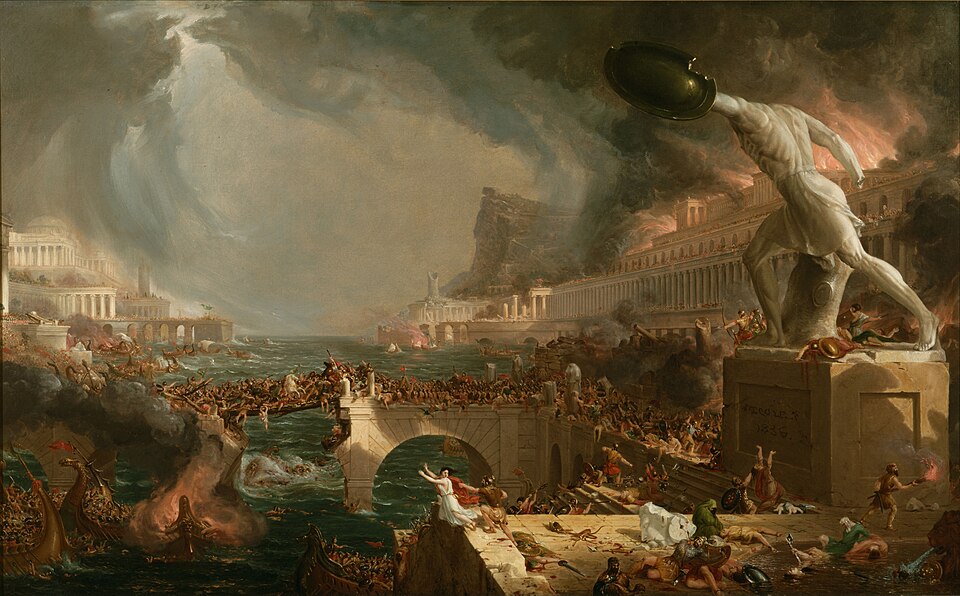
‘Destruction’ from the ‘The Course of Empire’ series, Thomas Cole, 1836. Now in New York Historical.

In the previous post, I argued that Mesopotamian divination reflects a particular, externally framed way of thinking. Meaning was located in the world — in the stars, in the entrails of sheep, in unusual events — and the task of the human mind was to interpret these signs within an increasingly sophisticated internal logic. But what about literature? Does this outward orientation also shape how Mesopotamians represented themselves?

The absence — and emergence — of an inner life

For much of Mesopotamian literature, the answer seems to be yes. Characters act, speak, and interact with gods and kings, but their inner lives — their doubts, emotions, or reflections — are rarely foregrounded. The focus lies instead on maintaining divine and political order. The individual is present, but not introspective in a way that feels familiar to a modern reader.

This observation led Julian Jaynes to a radical conclusion: early humans, including the Mesopotamians, did not possess an “inner life” at all. Consciousness, in his view, emerged only in the late second millennium BCE, when the “voices of the gods” went quiet following the turmoil of the Late Bronze Age collapse. This shift can be detected in texts such as the Epic of Gilgamesh, Ludlul bēl nēmeqi, and the Erra Epic, where characters reflect on their suffering and question the divine order.

As I have argued before, Jaynes’ conclusion goes too far. Mesopotamians clearly thought, interpreted, and made decisions. Yet the pattern he identified is real. Something changes in the literature: a growing interest in the experience of the individual, in suffering, uncertainty, and the limits of human understanding. Even in prayers, we find devotees lamenting the silence of the gods.

Continue reading “The inward turn in Mesopotamian literature”
Reading the gods in uncertain times

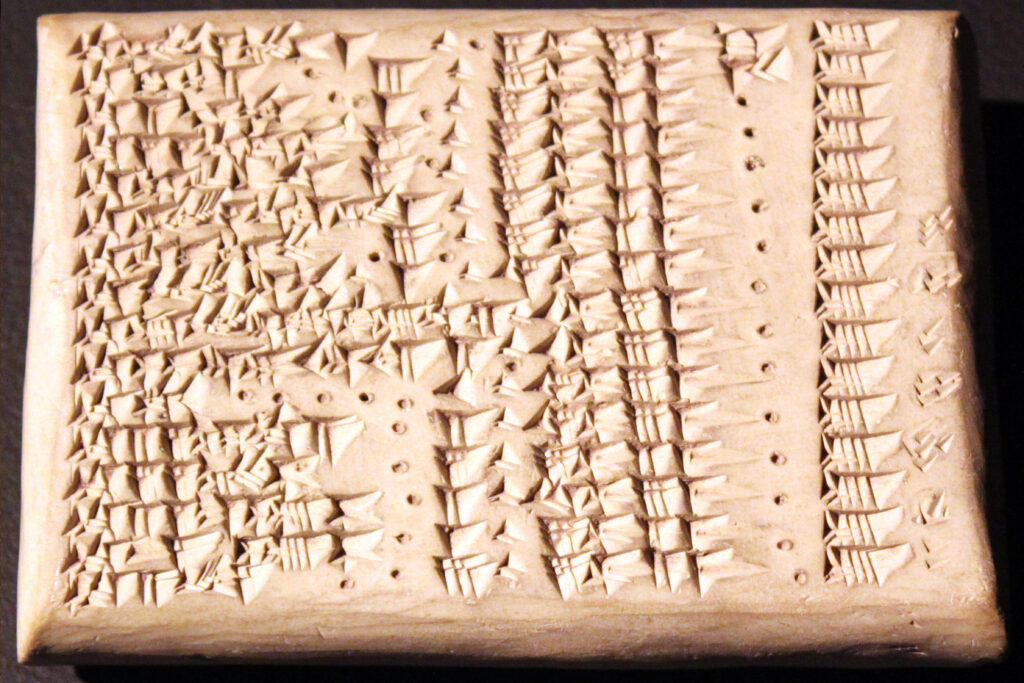
This clay tablet from Uruk lists each constellation, the number of stars, and the distance information to the next constellation in ells.
Anagoria, CC BY 3.0 https://creativecommons.org/licenses/by/3.0, via Wikimedia Commons

In the previous post, I argued that the difference between ancient and modern thought is not a matter of capacity, but of orientation: a shift from an externally framed experience of thought to a more internalized one. But what does such a shift look like in practice? One place where we can see this process unfold is Mesopotamia, where the relationship between humans, gods, and thought itself was worked out in strikingly concrete ways.

Ancient Mesopotamians believed they could “read” the world around them like a book. Nothing happened in isolation. The movement of the stars, the shape of a sheep’s liver, a sudden storm, an unusual birth, a dream in the night: each of these could reveal something about what lay ahead. The universe was seen as a dense web of connections in which the will of the gods was always present.

To modern readers, this may look like a system of “messages” sent by the gods. But that is slightly misleading. These signs were not so much messages as they were symptoms: visible expressions of deeper processes in a world where everything was connected. The task of the diviner was not to receive a message, but to interpret a pattern.

Continue reading “Reading the gods in uncertain times”

Genius or rubbish? Jaynes revisited

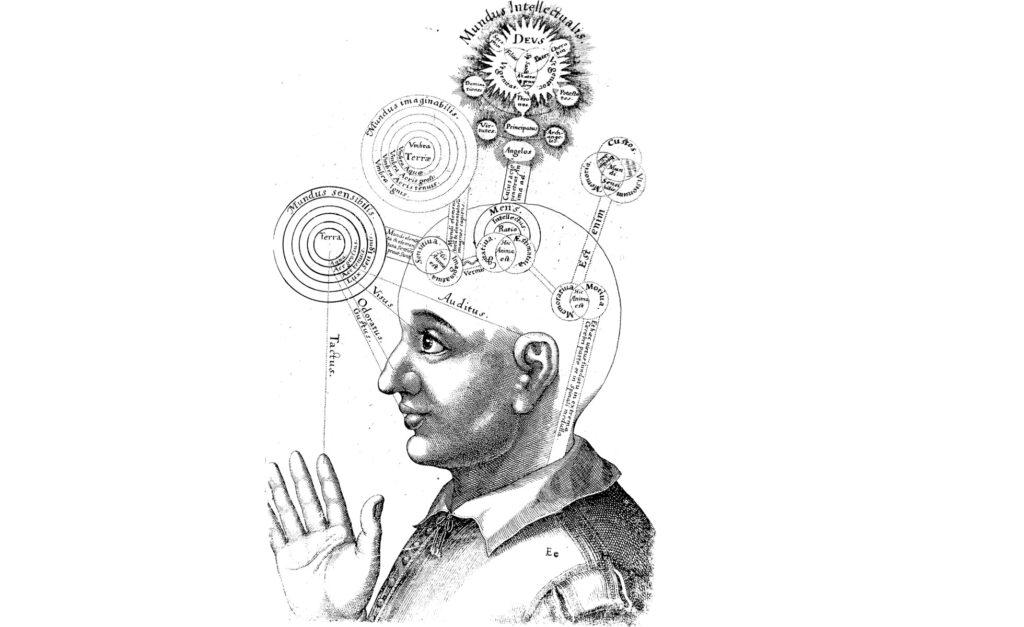
Robert Fludd, Utriusque cosmi maioris scilicet et minoris […] historia, tomus II (1619), tractatus I, sectio I, liber X, De triplici animae in corpore visione.

In my previous post, I explored Julian Jaynes’ bicameral mind hypothesis on its own terms. Taken seriously, it offers a strikingly coherent picture: ancient humans did not experience their thoughts as their own, but as the voices of gods. Seen through that lens, a wide range of otherwise puzzling features of ancient literature fall neatly into place. Divine commands, the absence of introspection, and the suspicion of acting “on one’s own” all begin to look less like metaphor and more like a fundamentally different way of experiencing thought.

That explanatory power is precisely what makes the hypothesis so attractive. But it is also a reason for caution. A theory that seems to explain everything risks explaining too much. Once adopted, it becomes easy to reinterpret any piece of evidence — any text, silence, or ambiguity — as confirmation. In that sense, it bears a resemblance to the ancient aliens “theory”, where the framework is so flexible that it becomes difficult to falsify.

Continue reading “Genius or rubbish? Jaynes revisited”

When the gods spoke to us

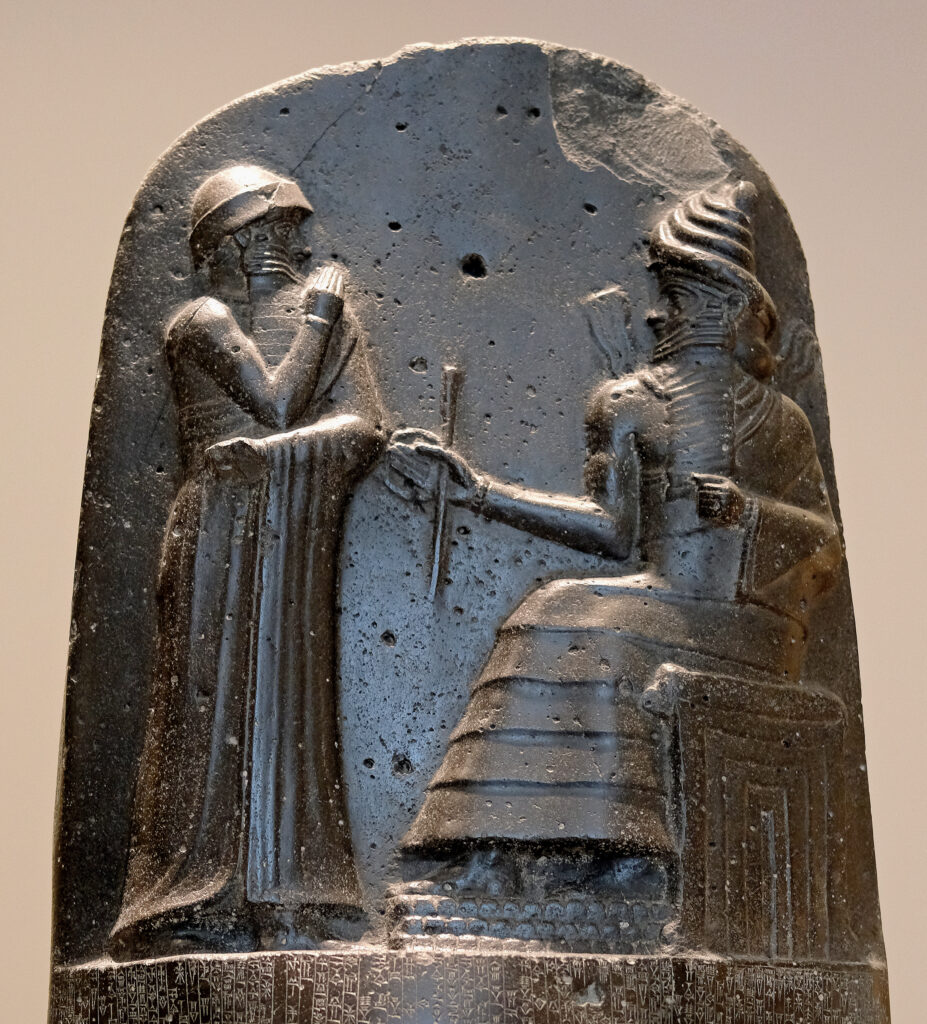
The Babylonian king Hammurabi (r. 1784-1742 BCE) receiving laws from the sun god Shamash. More than just symbolic imagery?
Louvre, Paris. Credits: Hammurabi, CC BY 3.0 https://creativecommons.org/licenses/by/3.0, via Wikimedia Commons

When reading ancient Mesopotamian literature, one is struck by a remarkable feature: the gods are not merely distant or hypothetical beings, they constantly appear to humans and speak to them directly. Mesopotamian texts abound with accounts of gods commanding kings to go on campaign, warning of impending disasters, prescribing in detail how temples should be built, dictating laws, or appearing in dreams. Likewise, when kings reflect on their achievements, they do not attribute them to their own judgment or skill, but to the will of a deity who guided them. To act “of one’s own design,” without consulting the gods, is not portrayed as admirable independence, but as a dangerous deviation.

Modern readers tend to treat such passages as rhetorical. Of course the king did not literally hear a god, he merely expressed his decision in religious language. Yet the consistency and seriousness of these accounts raise a more unsettling possibility: what if this was not just a way of speaking, but a way of experiencing? More specifically, what if the thoughts behind these decisions were not experienced as belonging to the individual in the way we assume our own thoughts belong to us?

Continue reading “When the gods spoke to us”

Tomb of Gilgamesh discovered

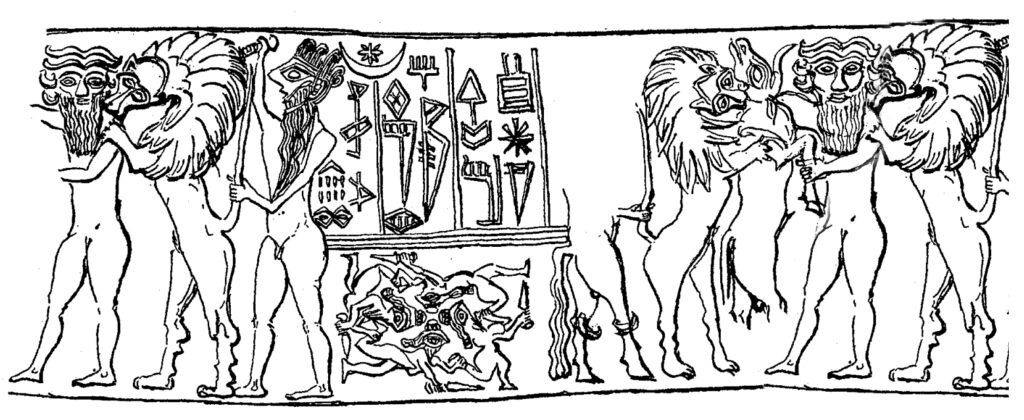
Mesannepada seal drawing depicting Gilgamesh fighting lions.
Source: Legrain, L. (1936): Ur Excavations Archaic Seal-Impressions.

It is by now almost a cliché to say that climate change is one of the defining challenges of our time. Rising sea levels threaten coastal communities, increasingly frequent heatwaves place pressure on public health systems, prolonged droughts devastate agricultural output, melting glaciers destabilize mountain ecosystems, coral bleaching undermines marine biodiversity, shifting weather patterns disrupt global supply chains, wildfires consume forests at unprecedented rates, permafrost thaw releases methane into the atmosphere, vector-borne diseases expand into new regions, and even the humble European beech tree now finds itself under existential stress in soils that are just slightly too dry, just slightly too warm, and just slightly too unpredictable to sustain its centuries-old rhythms.

And yet — if one may be permitted a moment of deeply irresponsible optimism — climate change has at least one unexpected advantage: as rivers dry up, they occasionally give back what they have hidden for millennia. Such is the case with the Euphrates. Over the past months, an unusually severe drop in water levels has exposed large stretches of the riverbed in southern Iraq. While this in itself is alarming for both ecological and humanitarian reasons, it has also allowed archaeologists to access areas that have long been considered unreachable. And it is here — beneath layers of silt, clay, and the slow accumulation of time — that a discovery has been made which, if confirmed, may fundamentally reshape our understanding of Mesopotamian history. A tomb. Not just any tomb, but one that archaeologists are now cautiously — but increasingly confidently — attributing to the semi-legendary king of Uruk: Gilgamesh.

Continue reading “Tomb of Gilgamesh discovered”