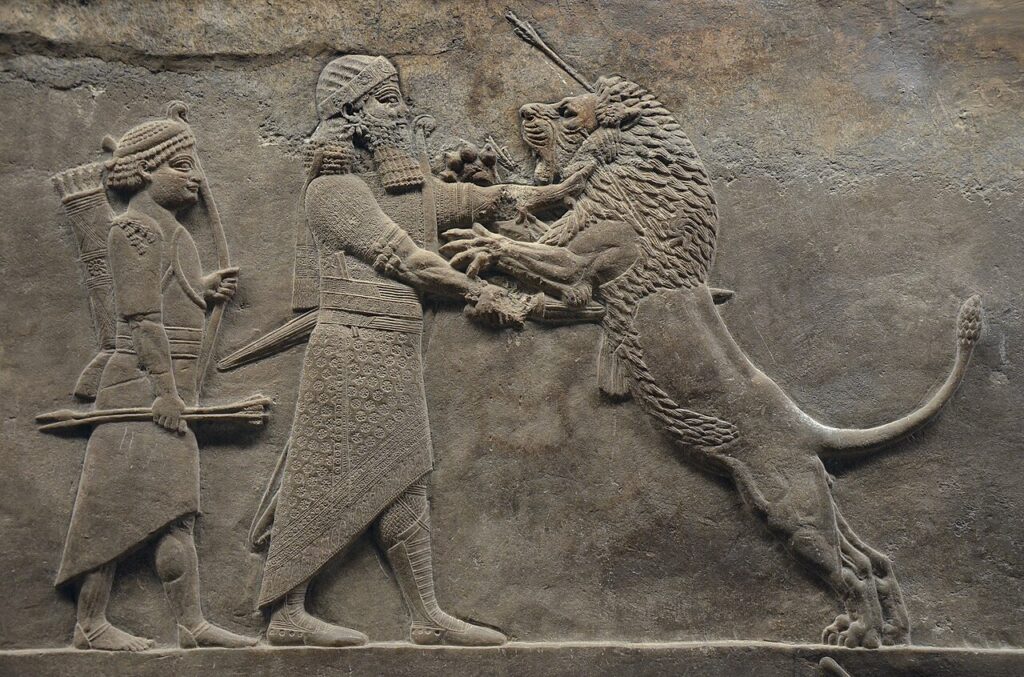
Carole Raddato from Frankfurt, Germany, CC BY-SA 2.0 https://creativecommons.org/licenses/by-sa/2.0, via Wikimedia Commons
In the previous post, I argued that Mesopotamian literature of the late second millennium BCE shows signs of an “inward turn”. Characters gradually become more than just pawns: they begin to reflect, doubt, and speak in ways that reveal a rich inner life. This development has been framed as part of a shift in human self-consciousness. Julian Jaynes famously pushed this idea to its extreme, arguing that humans only started developing self-consciousness by the late second millennium BCE.
The fact that, in Neo-Assyrian royal inscriptions from the first millennium BCE, kings continuously boast, emphasize their own achievements, and present themselves as decisive actors, seems to confirm this hypothesis. At times, Neo-Assyrian kings sound almost modern. It is tempting to see this as the political counterpart to the literary inward turn: the emergence of something like an “ego” and a growing awareness of the self as an autonomous agent.
And yet, that interpretation is too simple. What changes in the first millennium BCE is not the sudden birth of the self, but the way agency is expressed and recorded.
Kingship as a role, not a personality
For most of Mesopotamian history, the king was not an individual in the modern sense. He was the shepherd appointed by the gods, the caretaker of temples, the protector of order. His inscriptions emphasize royal duties rather than personal qualities. Even powerful rulers rarely foreground themselves as unique individuals. Instead, they speak through roles and formulas: “servant of [deity],” “chosen by [god],” “beloved of [goddess].” The authority they wield is real, but it is carefully framed as coming from above.
This does not mean that kings lacked ambition or character. It means that their public voice was constrained by a particular model of order. The king was a node in a cosmic system, and his legitimacy depended on maintaining that system, not on redefining it. In this sense, early royal inscriptions are strikingly impersonal. They tell us what the king did, but rarely who he was.
A dead end: the divine king
There were, however, moments when this balance tipped. In the late third millennium BCE, rulers such as Naram-Sin and Shulgi presented themselves not merely as chosen by the gods, but as divine themselves. Naram-Sin adopted the divine determinative before his name, and Shulgi cultivated a fully developed cult.
At first glance, this might seem like a precursor to later royal self-assertion. But in fact, it represents a different path: one that was ultimately abandoned. By the second and first millennia BCE, Mesopotamian kings were no longer gods. The boundary between human and divine was reasserted and maintained.
This is crucial. When Neo-Assyrian kings later speak in increasingly assertive tones, they do not claim divinity. Instead, they operate within a framework that insists they are human, albeit uniquely empowered. The shift, then, is not from “non-divine” to “divine,” but from “divine tool” to “conscious agent.”
The Assyrian amplification of the royal voice
It is in the Neo-Assyrian period, especially from the reign of Tiglath-pileser III (r. 745–727 BCE) onward, that the royal voice becomes markedly more pronounced. Assyrian inscriptions had always narrated campaigns and building projects, but now the king increasingly stood at the center of these narratives. Instead of merely reporting actions, he performs them. He plans, decides, conquers. He emphasizes his intelligence, his courage, his strategic insight. His enemies are not only defeated, but outwitted, overwhelmed, and judged. The tone is confident, sometimes even triumphant.
And yet, the gods have not disappeared. Victories are still granted by Aššur, Ištar, or Marduk. Campaigns are still undertaken at divine command. The king remains embedded in a sacred framework. But within that framework, his own voice becomes louder, more detailed, and more personal. The king becomes the visible carrier of action.
When self-assertion looks like hubris
Not everyone accepted this development at face value. A striking counterpoint can be found in the Book of Isaiah, particularly chapter 10. There, the Assyrian king is described as an instrument of divine wrath — “the rod of my anger” — sent by God to punish other nations. But the passage does not end there. The king, Isaiah insists, does not understand his own role. He boasts of his conquests as if they were achieved by his own power:
“By the strength of my hand I have done it, and by my wisdom, because I have understanding. I removed the boundaries of nations, I plundered their treasures; like a mighty one I subdued their kings. As one reaches into a nest, so my hand reached for the wealth of the nations; as people gather abandoned eggs, so I gathered all the countries; not one flapped a wing, or opened its mouth to chirp.’”
This claim is precisely what Isaiah rejects. The king is powerful, but he is not autonomous. His failure lies in mistaking delegated power for independent agency.
Does the ax raise itself above the person who swings it, or the saw boast against the one who uses it? As if a rod were to wield the person who lifts it up, or a club brandish the one who is not wood!”
What is remarkable about this passage is not just its theology, but its perception. Isaiah recognizes the shift in Assyrian royal rhetoric — the increased emphasis on the king’s own abilities — and interprets it as a moral problem. From the outside, the amplification of the royal voice looks like overreach.
The illusion of the solitary king
It is tempting to conclude from this that the first millennium BCE witnessed the rise of a uniquely self-aware ruler. But this would be misleading. The apparent centrality of the king is, to a large extent, an effect of the sources. Royal inscriptions survive in large numbers and are explicitly designed to foreground the ruler. They create a world in which the king appears as the sole agent of history.
But when we look beyond these texts, a more complex picture emerges. As I have repeatedly demonstrated in earlier posts, local rulers, vassal kings, governors, and high officials all pursued their own agendas. They negotiated, resisted, collaborated, and adapted. Their actions shaped events just as much as royal decisions did. Even within the Assyrian system, power was distributed and contested. The king depended on networks of loyalty and coercion that he did not fully control. His authority was real, but not absolute. In other words, the “ego” was never confined to the king. It is simply that the king’s voice is the one most consistently preserved.
A new dimension: the moral king
Under the Achaemenid Empire, this development takes a further turn. Persian kings such as Darius I and Xerxes I continue to present themselves as chosen by a supreme deity: Ahuramazda. They are protectors of order, restorers of stability, rulers by divine favor. But they also introduce a more explicit moral dimension. In the Behistun inscription of Darius, the king presents himself as a defender of truth (arta) against the Lie (drauga). His rule is not only effective, it is just. His victories are not only successful, they are righteous.
On Darius’s tomb in Naqš-e Rustam, he left the following inscription:
The right, that is my desire. To the man who is a follower of the lie I am no friend. I am not hot-tempered. What things develop in my anger, I hold firmly under control by my thinking power. I am firmly ruling over my own impulses.
The man who is cooperative, according to his cooperation thus I reward him. Who does harm, him according to the harm I punish. It is not my wish that a man should do harm; nor indeed is it my wish that if he does harm he should not be punished.
Crucially, the king is portrayed as making choices. He aligns himself with truth and rejects falsehood. This introduces a new layer of responsibility. The king is no longer merely the executor of divine will. He is also accountable for how he embodies it. This signals a shift in how kingship is conceptualized. Authority is no longer only about power and favor, but also about ethical alignment.
Rethinking the “rise of the self”
How, then, should we understand these developments? It is tempting to read them as evidence for the emergence of a modern kind of selfhood: a growing awareness of the individual as an independent center of thought and action. This is, in essence, the direction taken by Julian Jaynes.
But the evidence points to something more nuanced. The gods do not fall silent in the first millennium BCE. Divine authority remains central, but the human agents within it grow increasingly prominent. Kings speak more, act more visibly, and are held more explicitly responsible. Their voices become louder, their roles more defined. But they do not step outside the system that legitimizes them.
Rather than a sudden “birth of the ego,” we are looking at a shift in how agency is represented. The king becomes the primary narrator of action, even as that action remains embedded in a larger cosmic order. In that sense, the first millennium BCE marks the moment when the voice of power becomes unmistakably human.
Closing thought
If earlier Mesopotamian culture located meaning in the world — in signs, omens, and divine messages — then the first millennium adds a new layer. Meaning is still given, but it is increasingly spoken by human agents who present themselves as its interpreters and executors. The king does not replace the gods. But he becomes their most articulate mouthpiece. And in doing so, he begins to sound, for the first time, a little like us.
Kings begin to sound like us because we have all partaken of the hubris of kings? Now we all take our thoughts not as the products of our divine creators or precursors (re-envisaged as billions of years of evolution from some inconceivable quantum fluctuation) and of our communal life, but as all our own work.