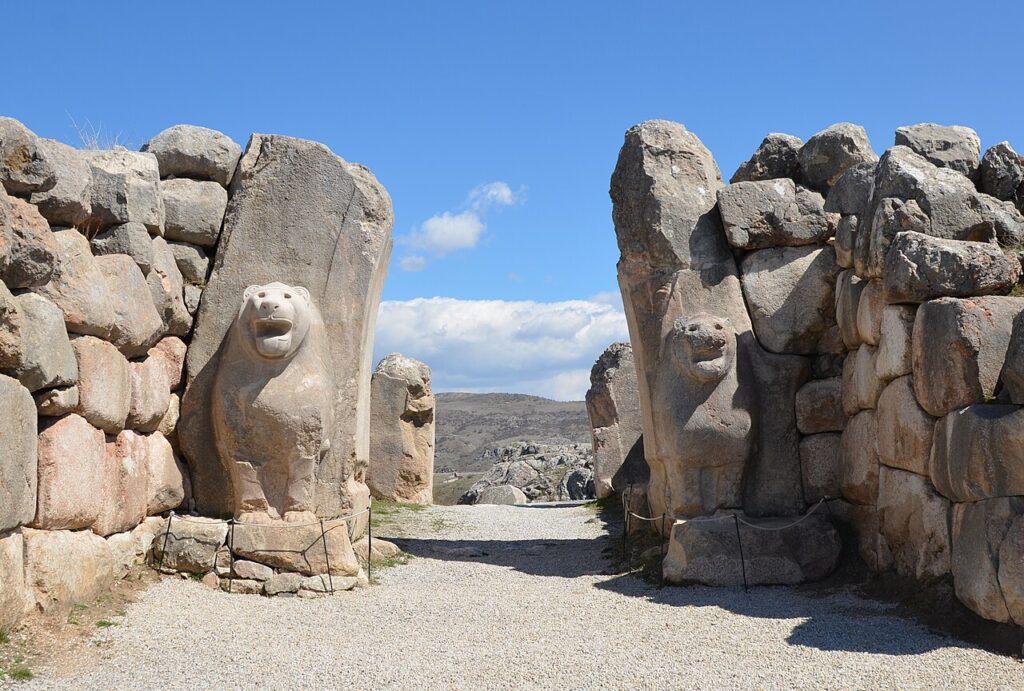
Carole Raddato from FRANKFURT, Germany, CC BY-SA 2.0 https://creativecommons.org/licenses/by-sa/2.0, via Wikimedia Commons.
Around 1250 BCE, the Hittite Empire was one of the great powers of the ancient Near East. From their capital at Hattusa in central Anatolia, its “Great Kings” ruled most of Anatolia and Syria. They corresponded with the rulers of Egypt and Assyria as equals, fought Egypt for control of the Levant, and repeatedly intervened in affairs along the Aegean coast. The kingdom of Wilusa, commonly identified with Bronze Age Troy, belonged to their diplomatic sphere.
Only a few centuries later, however, this empire had almost completely disappeared from historical memory. Assyrian kings still knew a land called Hatti, but by then the name referred primarily to Syria, not to the former empire ruled from central Anatolia. The Hebrew Bible also mentions Hittites, or Bĕnê Ḥēt, but presents them mostly as one of the peoples of Canaan. Nothing suggests that its authors knew of a great kingdom once ruled from Hattusa.
The absence is equally striking in Greek tradition. The Homeric epics preserve a story about a war fought at Troy, yet they contain no recognizable memory of the powerful kingdom that had once dominated the lands immediately to its east and regarded Wilusa as part of its political world.
The name of Hatti had survived, as had scattered cultural traditions. But the empire itself — its capital, rulers and place in the international order — had apparently been forgotten. How could one of the greatest powers of the Late Bronze Age disappear so completely from memory?
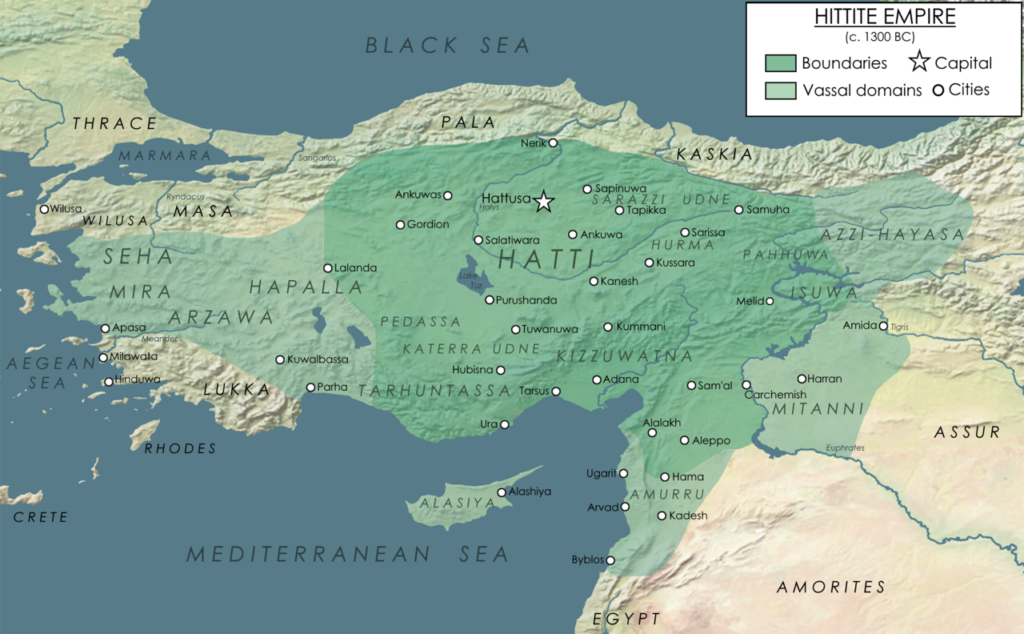
Ennomus, CC BY-SA 4.0 https://creativecommons.org/licenses/by-sa/4.0, via Wikimedia Commons
Hittites after the collapse
The collapse of central authority at Hattusa around 1200 BCE did not immediately erase everything Hittite. Several kingdoms in southeastern Anatolia and northern Syria continued to use Hieroglyphic Luwian, worship familiar gods and depict their rulers in styles inherited from the Late Bronze Age. Their kings also retained titles such as “Great King”, “Hero” and “My Sun”. Modern scholars therefore conventionally call them the “Neo-Hittite” kingdoms, although they never formed a single political community.
Initially, there was even direct dynastic continuity. At Carchemish, a junior branch of the Hittite royal family remained in power. Kuzi-Teššub, the son of the last imperial viceroy, adopted the title “Great King”, while later rulers of Malatya commemorated him as their ancestor. In the first generations after the collapse, knowledge of the former empire probably remained alive.
As time passed, however, Hittite traditions became increasingly detached from their original context. Later rulers continued using ancient titles, names and images, but their inscriptions do not mention Hattusa, the conquests of the Hittite kings, or territories that had once belonged to the empire. This does not prove that such knowledge had disappeared: their inscriptions were not intended as histories, and much may simply have been left unsaid. Nevertheless, the surviving evidence suggests that the language of Hittite kingship endured more clearly than the history behind it. A ruler could know that “Great King” was a prestigious title without remembering the empire in which it had originated.
Fragments of a forgotten empire
The name Hatti nevertheless continued to circulate. Assyrian sources used it long after Hattusa had been abandoned, but its geography gradually shifted. Instead of the central Anatolian kingdom known to the Late Bronze Age, “Hatti” came to denote the smaller kingdoms of southeastern Anatolia and northern Syria that had emerged in its aftermath. Eventually, Assyrian kings could use the term more broadly for Syria and the lands further south along the Mediterranean coast. They preserved an ancient geographical name while detaching it from its former centre.
Something similar happened in the Hebrew tradition. The Bible frequently mentions Hittites, or Bĕnê Ḥēt, but usually presents them as one of the peoples inhabiting Canaan. Abraham buys the cave of Machpelah from the “sons of Heth”, while Uriah the Hittite serves in the army of King David. References to “the kings of the Hittites” may reflect some awareness of the kingdoms of Syria and Anatolia. Yet the biblical authors show no recognizable knowledge of Hattusa, its dynasty or the empire that had once contested Syria with Egypt. An ancient name survived, but it had acquired new associations.
The Homeric epics offer a different kind of afterlife. They preserve traditions about a conflict at Troy and possibly contain Anatolian names, stories and cultural motifs. But the political geography of the Iliad bears little resemblance to that of Late Bronze Age Anatolia. Whatever historical realities lie behind the Trojan War, Homer knows of no great kingdom centred east of Troy, even though Hittite kings had repeatedly intervened in western Anatolia and treated Wilusa as part of their diplomatic world.
These traditions may preserve genuine fragments of the Hittite age. But fragments are not the same as a historical framework. A name could migrate southwards. A story could be adapted to new audiences. Memories of particular peoples and places could survive while the political relationships connecting them were forgotten.
When memory loses its meaning
Historical forgetting rarely occurs at a single moment. It is better understood as a gradual process in which information loses its context.
The first generation may possess living political knowledge. People remember the former capital, its rulers and the institutions through which they governed. Later generations preserve dynastic memory: they know the names of prestigious ancestors but less about the political world those ancestors inhabited. Eventually, titles, images and stories become traditions whose authority no longer depends on detailed knowledge of their origins. Finally, even the surviving names acquire new meanings.
Oral tradition does not automatically prevent this process. It is not an archive that preserves everything it receives. Communities continue telling stories because those stories remain meaningful, entertaining or useful. Details that no longer matter disappear, while unfamiliar realities are reshaped into forms later audiences understand. Homeric poetry could preserve the memory of a great war at Troy while replacing the international system of the Late Bronze Age with a heroic world familiar to its listeners.
Written records offer no guarantee either. Texts preserve knowledge only when people continue to read, copy and interpret them. Thousands of tablets remained at Hattusa after its abandonment, but buried documents cannot sustain a historical tradition. Once knowledge of cuneiform Hittite and the institutions supporting it disappeared, the archives became silent.
Memory therefore requires more than surviving stories or inscriptions. It requires communities with reasons to keep relating the past to the present. Assyrian kings remembered earlier conquests because they still ruled Assyria and wished to reclaim those territories. The rulers of Carchemish, Malatya, Tabal and other successor states were constructing different political communities. Their interests increasingly lay in their own dynasties, gods, cities and rivalries, not in preserving the history of a vanished empire as a whole.
Oblivion is the rule
The disappearance of the Hittite Empire from memory seems astonishing because we know that it existed. Modern excavations at Hattusa recovered royal archives, treaties, letters, rituals and historical narratives. These sources allow us to reconstruct a world that later Greeks, Hebrews and Assyrians apparently no longer recognized. We can measure the scale of ancient forgetting because archaeologists eventually recovered what had been forgotten.
Without that rediscovery, the Hittites might still be known primarily as a mysterious people mentioned in the Bible. No one would suspect that kings ruling from central Anatolia had once exchanged letters with pharaohs, fought for Syria and intervened in the affairs of Troy.
The fate of Hatti was probably not exceptional. Countless kingdoms must have flourished before the beginning of continuous written history. They fought wars, founded dynasties, worshipped gods and created identities that once appeared permanent. After their political institutions disappeared, their histories survived for a few generations, then contracted into legends, displaced names or unexplained ruins. Eventually, even those traces vanished.
The Hittite Empire was not erased from memory in a single moment. It gradually dissolved: first into successor dynasties, then into inherited titles and traditions, and finally into names whose original meaning had been forgotten. That was the normal fate of the past when no continuing community or institution had reason to preserve it. We know what they forgot only because, three thousand years later, archaeologists found it again.
This is a fascinating exploration of how entire empires can gradually fade from public memory despite leaving behind important cultural and historical legacies. It also shows why preserving and studying the past matters. Topics like forgotten civilizations and historical memory can be particularly valuable for students pursuing an MA History course and developing a deeper understanding of the forces that shape our view of history.