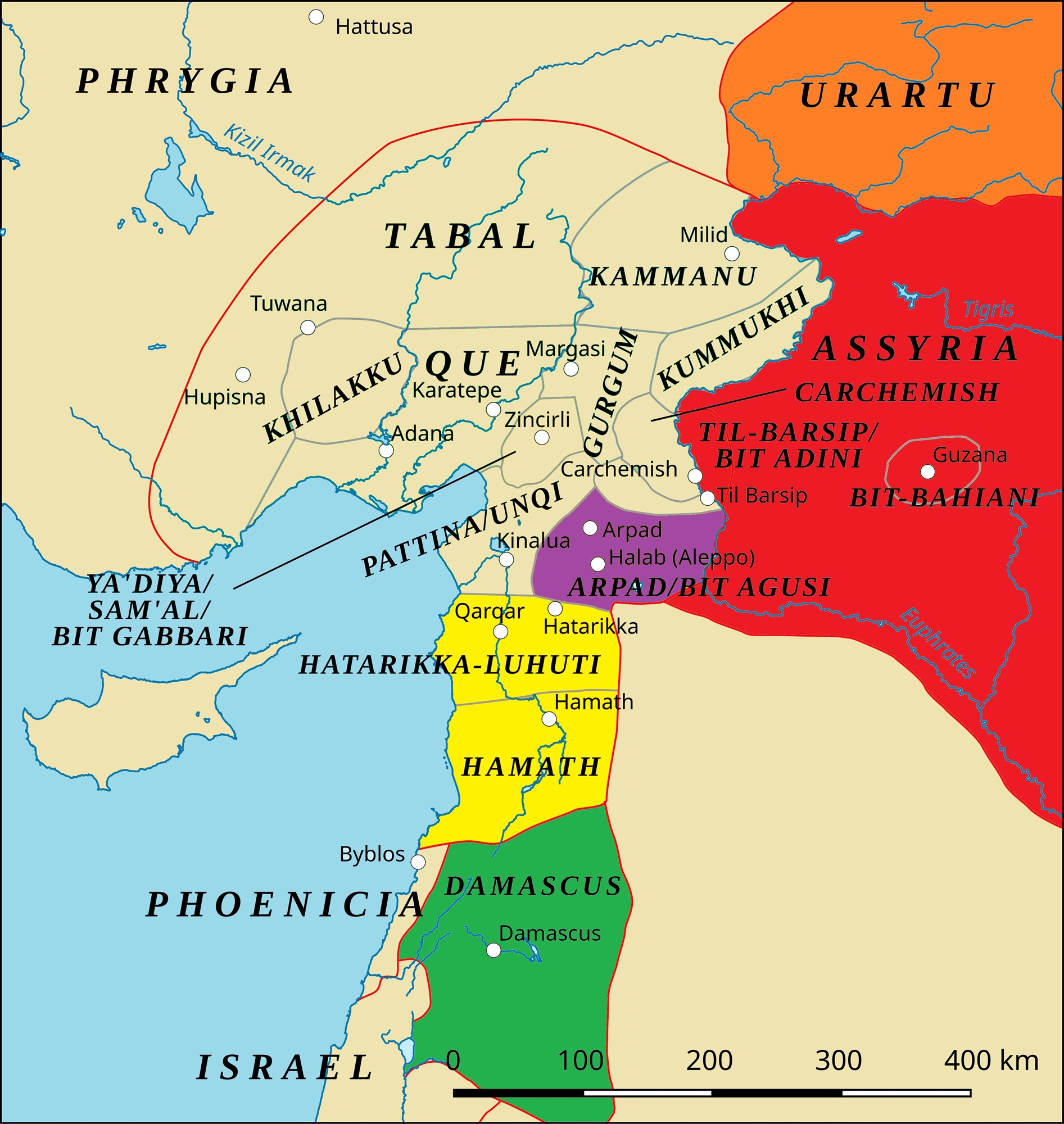
The Levant has played a central role in world history since the earliest beginnings of civilization. This fertile corridor between the Mediterranean Sea and the Arabian Desert, situated between Mesopotamia, Egypt and Anatolia, formed a crossroads of long-distance trade. Caravan routes crossed its valleys and plains, while its ports connected the eastern Mediterranean to wider maritime networks. Much of the wealth of Levantine cities derived from their position as intermediaries in both overland and maritime commerce.
Politically, however, the Levant was highly fragmented. Phoenician city-states, Aramaean tribes and Neo-Hittite kingdoms constantly competed for control of trade routes. Alliances shifted frequently and no single power could easily dominate the region for long. For Assyria, the Levant therefore represented both opportunity and danger: a wealthy gateway to the Mediterranean, but also a frontier capable of producing powerful anti-Assyrian coalitions.
Under Shalmaneser III (r. 858–824 BCE), Assyrian armies campaigned repeatedly in the Levant, confronting anti-Assyrian coalitions led by rulers such as Ahuni of Bīt-Adini, Irhuleni of Hamath and Hazael of Damascus. A century later, the region again became the focus of Assyrian expansion under Tiglath-pileser III (r. 745–727 BCE), who annexed large parts of Syria and Palestine and transformed former client states into Assyrian provinces.
Yet between these two periods lies a striking gap. According to the Assyrian Limmu List — a chronological record in which each year was named after a high official and often accompanied by a brief note about a military campaign — there were hardly any Assyrian campaigns to the Levant between roughly 841 and 743 BCE. This was not because Assyria became inactive. On the contrary, Assyrian kings campaigned almost every year, but mostly toward the north and east: against Urartu in the Armenian Highlands and frontier polities the Zagros and Taurus Mountains. Why, then, was the western frontier comparatively quiet for almost a century?
A western understanding?
The period between 841 and 743 BCE has often been described as an era of stagnation for Assyria. Yet the Limmu List paints a different picture. Assyrian armies campaigned almost every year, primarily in the north and east. These expeditions, however, reveal an important pattern. Unlike the conquests of Tiglath-pileser III a century later, they rarely resulted in major territorial annexations. Assyria did not steadily absorb the regions it attacked, nor did it establish permanent control over most of them.
This suggests that many of these campaigns were not aimed at territorial conquest. Instead, they may have been aimed at protecting vulnerable frontier zones, maintaining influence over local rulers, securing trade routes, and obtaining strategic resources such as horses. In other words, Assyria appears to have been managing a sphere of influence rather than pursuing systematic expansion.
The rise of Urartu helps explain this pattern. During the late ninth and early eighth centuries BCE, the kingdom of Urartu emerged as Assyria’s principal rival in the north. Control over the foothills of the Zagros and Taurus Mountains became increasingly contested. Many of the small polities in these regions functioned as buffer states whose loyalties could shift between the two powers. Assyrian intervention was therefore often less about conquest than about preventing rival influence from taking root.
Yet this explanation only deepens the original puzzle. If Assyria regarded powerful neighbours as threats that had to be contained, why did it not adopt a similar approach in the Levant? Damascus, Hamath, Arpad and other western kingdoms remained wealthy, militarily capable and politically ambitious. Nevertheless, Assyria intervened only rarely during the late ninth and early eighth centuries BCE.
This raises the possibility that the western frontier was governed by a different logic. The absence of frequent campaigns suggests that Assyria did not perceive the states west of the Euphrates as posing the same kind of threat to its security or economic interests as the powers on its northern frontier. Rather than seeking direct control, Assyria may have been content to tolerate powerful western neighbours so long as they did not threaten its interests or unite the region against it. In such a system, neighbouring kingdoms were not necessarily enemies to be conquered. They could also function as partners within a broader geopolitical order.
Zakkur of Hamath
The inscription of Zakkur, king of Hamath, offers a glimpse of this world. It describes how a coalition led by Damascus and Arpad besieged Zakkur at Hatarikka. Significantly, Assyria is not mentioned. The western states appear to have operated largely within their own interstate system, pursuing rivalries that did not require constant Assyrian involvement.
Yet the outcome is suggestive. Zakkur survived, while the coalition failed to impose its will. Whether through direct support, diplomatic pressure, or simply the deterrent effect of its presence, Assyria may have played a role in preventing any single western power from establishing regional dominance.
The few campaigns to Damascus and Hatarikka recorded in the Limmu List during this period may well be connected to these events. Rather than representing attempts at conquest, such interventions may have been intended to preserve an existing balance of power. Although the evidence remains limited, this interpretation would help explain both the rarity of western campaigns and their apparent timing. Assyria did not necessarily withdraw from Levantine affairs. It may simply have intervened selectively when the regional equilibrium appeared threatened.
If this interpretation is correct, the relative peace on Assyria’s western frontier was not the result of weakness or neglect, but a product of an order that served Assyrian interests well enough to leave the region largely undisturbed.
The collapse of the old order
This relatively stable western order began to break down in the mid-eighth century BCE. The decisive factor was probably the growing involvement of Urartu in northern Syria. Under Sarduri II (r. 764–735 BCE), Urartu expanded far beyond the Armenian Highlands and began competing directly with Assyria for influence over the Euphrates corridor and the Neo-Hittite states of northern Syria.
This changed the geopolitical balance fundamentally. As long as western states remained independent yet broadly compatible with Assyrian interests, coexistence had been possible. But once Urartu started building alliances in the region, western autonomy became a strategic threat. The danger was no longer isolated resistance, but the emergence of a rival hegemonic network capable of excluding Assyria from northern Syria and the routes leading to the Mediterranean.
The coalition centered around Arpad appears to have been the turning point. In 743 BCE, Tiglath-pileser III confronted a coalition involving Arpad, the Neo-Hittite kingdoms of Gurgum, Kammanu and Kummuhi, and Sarduri II. Urartian sources even suggest that Urartu had earlier defeated Assyria in battle, perhaps explaining the years of relative Assyrian inactivity beforehand.
Seen in this light, Tiglath-pileser’s western campaigns were initially less about conquering the entire Levant than about restoring Assyrian access to the Mediterranean and breaking Urartian influence in northern Syria. The later annexations may therefore have resulted not from a sudden desire for endless expansion, but from the collapse of the older geopolitical order that had previously stabilized the western frontier.
From hegemony to empire
The quiet western frontier between Shalmaneser III and Tiglath-pileser III may reveal something fundamental about early Neo-Assyrian power. Rather than pursuing constant territorial expansion, Assyria appears to have relied during much of the ninth and early eighth centuries BCE on a more flexible form of hegemony. Influence was maintained through diplomacy, deterrence, and selective intervention, while local rulers retained considerable autonomy.
This system functioned as long as neighboring states accepted Assyrian predominance and no rival great power reorganized the political landscape. In the Levant, it produced a relatively stable order in which states such as Damascus and Arpad remained independent without provoking sustained Assyrian intervention.
The rise of Urartu disrupted this balance. Once western states became part of a rival geopolitical network, indirect hegemony no longer seemed sufficient. Under Tiglath-pileser III, Assyria increasingly turned toward annexation, provincialization, permanent garrisons and large-scale deportation policies. The empire became more centralized, interventionist and territorially integrated than before.
In this sense, the Neo-Assyrian Empire of the late eighth and seventh centuries BCE may not simply represent the culmination of an eternal Assyrian drive for conquest. Rather, it may have emerged partly because an older and more flexible hegemonic order had failed.
vi är som Assyrier Arameer Kaldeer en av de få ursprungs folket som har förlorat allt och kaoset i de områden där våra imperier fanns har aldrig blivit lugn .