In my previous post, I explored an alternate timeline in which Assyria and Babylonia remained allies rather than descending into centuries of rivalry. I also speculated that, in the long run, Assyria might eventually come to be ruled by an Iranian dynasty, while Babylonia could fall under Arab rule. At first glance, such a scenario may sound implausible. Why would an empire hand power to outsiders? Why would foreign peoples become the military and political elite of states they once served? Yet history shows that this kind of thing happens surprisingly often.
Perhaps the best-known example is the Mamluk Sultanate in Egypt, where Turkic slave soldiers overthrew the ruling Ayyubids and founded a dynasty of their own. Similarly, in the late Roman Empire, Germanic generals evolved from imperial servants into kingmakers, and eventually rulers in their own right. In the Neo-Assyrian Empire, the Medes first appeared as suppliers of horses, later as military auxiliaries, and eventually even as royal bodyguards. During Assyria’s final struggle for survival, the peoples of the Zagros played a crucial role: Mannaean contingents still fought alongside the Assyrians, while the Medes ultimately turned against their former masters. And centuries earlier, the Mitanni kingdom seems to have been dominated by an Indo-Aryan military aristocracy ruling over a predominantly Hurrian population.
These examples differ enormously in scale and context, yet they reveal a recurring historical pattern. Again and again, empires elevated foreign warrior groups into positions of military importance, only for those groups to gradually evolve into political elites, and sometimes even inherit the empire itself.
Why empires trust outsiders
So why do empires trust outsiders with military and political power? Part of the answer lies in the nature of empires themselves. Contrary to the neat ethnic maps we often imagine today, empires were rarely homogeneous nation-states. They were sprawling and often fragile coalitions of semi-autonomous cities, tribes, client kingdoms, aristocratic families and military networks. Rulers constantly had to balance competing interests at court while simultaneously securing unstable frontiers and suppressing internal rivals. In such an environment, outsiders could actually become highly attractive allies.
Foreign warrior groups often possessed specialized military skills that the imperial core lacked. Steppe peoples, for example, frequently excelled in cavalry warfare and horse breeding. The Medes became renowned horse suppliers within the Assyrian world, while Turkic peoples played similar roles in many Islamic empires. Indo-Aryan elites in Mitanni may likewise have owed their initial rise to expertise in chariot warfare, which at the time represented one of the most advanced forms of military technology in the Near East.
Outsiders also possessed an important political advantage: they were outsiders. A ruler could not always trust native aristocracies, who had their own regional power bases, family connections and political ambitions. Foreign military elites, by contrast, often depended almost entirely on royal patronage for their status and influence. Because they lacked deep roots within the empire itself, they initially appeared more loyal to the ruler personally than local elites ever could be.
From servants to kingmakers
This logic can be seen very clearly in the Mamluk system. Young slave soldiers were deliberately taken from outside the Islamic world, converted, trained and integrated into elite military structures precisely because they lacked local ties. The Ottoman Janissaries operated according to a similar principle. And Roman emperors increasingly relied on Germanic generals and federate troops because the empire struggled to maintain sufficient manpower and military cohesion on its own.
But therein lay the paradox. The more successful these foreign elites became, the more indispensable they became. Over time, they accumulated prestige, wealth, land, military experience and political influence. They formed networks of patronage and developed strong corporate identities. Eventually, emperors and kings no longer controlled them completely. Instead, rulers became dependent on them.
At that point, the line between servant and master could become dangerously thin. The late Roman Empire provides perhaps the clearest example. Germanic generals such as Stilicho and Ricimer became central political actors who effectively determined imperial policy. By the fifth century, figures like Odoacer no longer bothered ruling through Roman emperors at all.
Something similar happened in the Islamic world. The Mamluks were originally military slaves, yet they eventually deposed their masters and established a sultanate of their own. The Janissaries likewise evolved from elite household troops into a powerful political force capable of influencing succession and removing sultans.
Alexander and the Persian world
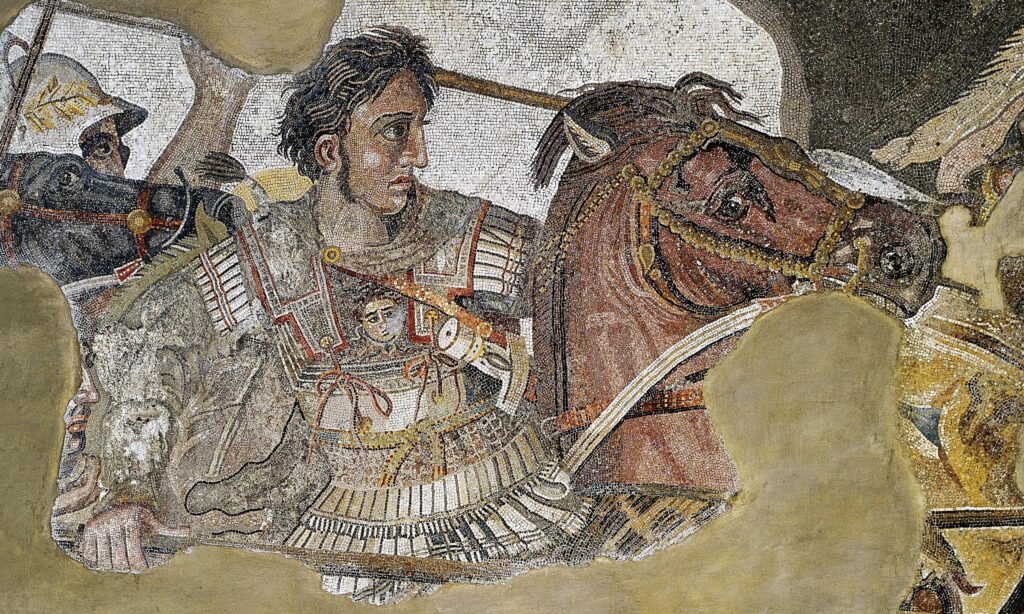
Even Alexander the Great can partly be understood in this light. Macedon had long existed on the fringes of the Persian sphere, while Greek mercenaries served extensively within Achaemenid armies. By the fourth century BCE, the Greek world and the Persian Empire were already deeply interconnected through warfare, diplomacy, trade and military service.
The Persian kings regularly intervened in Greek politics, financing rival city-states and influencing the balance of power in the Aegean world. At the same time, thousands of Greeks sought employment in Persian service. Greek mercenaries fought in Persian armies from Egypt to Mesopotamia, while Greek cities along the western coast of Anatolia had been part of the Achaemenid Empire for generations. Xenophon’s famous account of the Ten Thousand vividly illustrates just how deeply Greek soldiers had already become involved in Persian dynastic struggles long before Alexander’s campaigns began.
Macedon itself also occupied an ambiguous position between the Greek and Persian worlds. Alexander’s father, Philip II, rose to power in a geopolitical environment heavily shaped by Persian influence, while the Macedonian kingdom had long interacted diplomatically and militarily with the Achaemenid Empire. In many respects, Macedon functioned as a militarized frontier state on the edge of the Persian imperial system: close enough to be influenced by it, but distant enough to preserve its political independence.
Seen from this perspective, Alexander’s conquest did not represent the sudden intrusion of a completely foreign civilization into the Near East. In many ways, it resembled the takeover of the Persian imperial system by a frontier elite that had already been deeply entangled with it for generations. Alexander himself quickly adopted elements of Persian kingship and court culture, while many local elites were incorporated into the new regime rather than swept aside entirely.
The Seleucid Empire that emerged afterward preserved much of the old Achaemenid administrative structure, including the satrapal system and large parts of the imperial bureaucracy. Greek and Macedonian elites gradually became the new ruling class of the Near East, but they did so by integrating themselves into an already existing imperial framework rather than creating an entirely new order from scratch. In that sense, the Macedonian conquest fits a broader historical pattern in which empires are not simply destroyed by outsiders, but gradually inherited by groups that had long operated along their frontiers and within their military networks.
Assyria and the frontier peoples
The Neo-Assyrian Empire may reveal an earlier version of the same dynamic. As Assyria expanded, it drew more and more frontier peoples into its political and military orbit. Iranian and Anatolian groups that had once existed largely beyond Assyrian influence gradually became tributaries, allies, trading partners or military auxiliaries. Some supplied horses and livestock to the empire, others guarded mountain passes and trade routes, and still others served directly within the Assyrian military apparatus itself.
The Medes are perhaps the clearest example. Early Assyrian sources often portray them as distant mountain tribes living beyond the northeastern frontier, but over time they became increasingly integrated into the imperial system. Assyrian kings extracted tribute from Median rulers, recruited horses from the Zagros region and established diplomatic as well as military ties with local elites. By the seventh century BCE, Median individuals even appear at the Assyrian court, while Iranian contingents may have served within the imperial army itself. Similar processes unfolded among Mannaean and other Zagros polities, which occupied an ambiguous position somewhere between subject, ally and partner.
This is one reason why the final collapse of Assyria was probably far more complicated than the traditional image of “barbarians destroying civilization”. Many of the groups involved in Assyria’s downfall had interacted with the empire for generations as allies, clients, tributaries, military specialists or trading partners. They were not complete outsiders descending upon a foreign world. In many ways, they had already become part of the imperial system itself.
Indeed, the final decades of the empire reveal just how blurred these boundaries had become. Some frontier groups continued fighting alongside the Assyrians almost until the very end. The Mannaeans, for example, appear to have remained loyal during Assyria’s death struggle, whereas the Medes seem to have concluded that the empire was no longer capable of maintaining the political order from which they themselves had once benefited. Former auxiliaries and frontier allies may then have turned against the imperial center that had helped empower them in the first place.
Empires are changed by the peoples they rule
Perhaps the broader lesson is that empires are transformed by the people they conquer. The Roman Empire could not survive without Germanic manpower. Islamic rulers increasingly depended on Turkic military elites. Persia integrated Greek military manpower and frontier dynasts. Assyria relied on frontier peoples for horses, military support and regional stability. Again and again, empires empowered outsiders precisely because outsiders seemed useful, loyal and politically manageable.
But military power rarely remains politically neutral forever. The men who guard the empire often end up inheriting it. Seen from this perspective, an Assyria ruled by an Iranian dynasty or a Babylonia ruled by Arabs no longer appears especially implausible. History repeatedly shows that empires do not merely dominate surrounding peoples, they gradually absorb them, empower them and, in time, are often transformed by them.