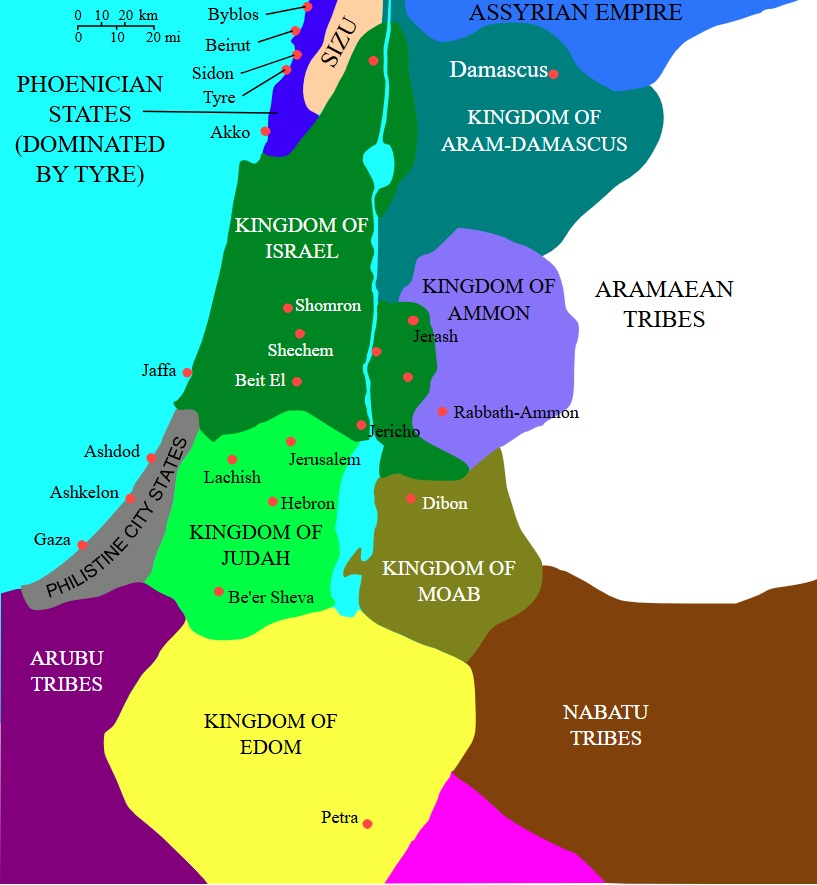
Briangotts on en.wikipedia and Slashme on en.wikipedia, CC BY-SA 3.0 http://creativecommons.org/licenses/by-sa/3.0/, via Wikimedia Commons
For many readers familiar with the Bible, Ahab (r. 874–853 BCE) is remembered primarily as the wicked king who opposed the prophet Elijah and allowed the worship of Ba’al in Israel. Yet this image reflects the concerns of later biblical authors rather than the geopolitical realities of the ninth century BCE.
Viewed through the lens of contemporary Near Eastern politics, Ahab appears as a remarkably capable ruler. During his reign, Israel became one of the strongest kingdoms in the Levant, capable of challenging Damascus, projecting power over its neighbours, and contributing one of the largest contingents to the coalition that confronted Assyria at the Battle of Qarqar.
Omri and the foundations of power
The rise of Israel began with Ahab’s father Omri (r. 885-874 BCE). The circumstances of his accession are poorly documented. According to the Bible, he emerged victorious from a civil war and established a new ruling dynasty. Archaeological and extra-biblical evidence confirms that his dynasty became famous throughout the region. Even a century-and-a-half later the Assyrians still referred to Israel as the House of Omri.
Omri’s most important achievement was probably the creation of a stable kingdom. He established Samaria as a royal capital, strategically located and easier to defend than earlier political centres. The foundation of a purpose-built capital reflects a ruler with ambitions extending beyond those of a traditional tribal leader.
The scale of Omri’s achievements is difficult to reconstruct, but the fact that later Assyrian kings remembered Israel as the land of Omri suggests that he was regarded as the true founder of the kingdom’s power.
A royal alliance with Tyre
Ahab inherited a stronger kingdom than any previous Israelite king. One of his most significant political moves was his marriage to Jezebel, daughter of the Tyrian king Ethbaal. Biblical authors portray this marriage as a religious catastrophe, as Jezebel introduced the cult of Ba’al at the Israelite court, but from a geopolitical perspective it was a highly logical alliance.
Tyre was one of the wealthiest cities of the Levant. Through Jezebel, Israel gained access to the maritime trade networks of the Mediterranean. The alliance also secured Israel’s northern flank, allowing Ahab to focus his attention on inland rivals.
The marriage reflects the growing sophistication of Israelite diplomacy. Ahab was behaving not as a tribal chief but as a Near Eastern monarch participating in the dynastic politics of the age.
Wars with Damascus
The principal threat to Israel came from Damascus under Ben-Hadad II. The Bible preserves accounts of several wars between the two kings. While the details remain debated, they indicate a prolonged struggle for influence in southern Syria and Transjordan.
These conflicts should not be understood as simple border disputes. Control over trade routes and vassal states was at stake. Both kingdoms were competing for regional leadership in the southern Levant. The biblical narratives surprisingly portray Ahab as militarily successful. In several encounters he defeated Ben-Hadad and was eventually able to negotiate from a position of strength.
Whether every detail is historical is impossible to determine, but the broader picture is plausible: Ahab’s Israel was capable of standing toe-to-toe with Damascus, then one of the strongest Aramean states in the region.
An emerging regional kingdom
Ahab’s influence may have extended far beyond Israel’s traditional borders. The famous Mesha Stele, erected by king Mesha of Moab, states that Omri and his son had subjugated Moab. According to Mesha, Israel dominated his kingdom for decades before he successfully revolted.
Judah may also have fallen within Israel’s sphere of influence. The close cooperation between the two kingdoms during Ahab’s reign, including military cooperation and dynastic marriages, suggests a relationship in which Israel was the senior partner.
If so, Ahab presided over a regional kingdom extending from Joppa to the Golan Heights and from Tyre to the Arnon River, and exercising influence over neighbouring states.
The builder king?
For much of the twentieth century archaeologists attributed impressive monumental remains at sites such as Megiddo, Hazor and Gezer to Solomon. More recently, some scholars have argued that these constructions belong instead to the Omride period. If this revised chronology is correct, many of the structures traditionally associated with Solomon may actually reflect the wealth and administrative capacity of Omri and Ahab.
The famous stables at Megiddo are particularly relevant. Although their function remains debated, they indicate substantial state resources and an interest in maintaining large numbers of horses and chariots. This would fit remarkably well with the evidence from Qarqar, where Ahab fielded one of the largest chariot contingents in the Levant.
Qarqar and the Assyrian threat
The defining moment of Ahab’s international career came in 853 BCE. That year the Assyrian king Shalmaneser III advanced westward and confronted a coalition of Levantine rulers at the Battle of Qarqar. Among the coalition members were both Ahab and Ben-Hadad II.
The alliance is striking. Two rulers who had spent years fighting each other suddenly joined forces. Yet this makes perfect sense within the logic of balance-of-power politics. The Assyrian advance posed a threat far greater than their local rivalry.
Shalmaneser claims that Ahab contributed 2,000 chariots and 10,000 infantry. The exact numbers may be exaggerated, but even a reduced figure would make Israel one of the strongest members of the coalition. For a kingdom that had emerged only a few generations earlier, this was a remarkable achievement.
The decline of Omride power
Shortly after Qarqar, Ahab disappeared from the historical record. According to the Bible, he died in battle at Ramoth-Gilead. Whatever the circumstances, his death marked the beginning of a gradual decline. His sons Ahaziah and Joram inherited a powerful kingdom but proved unable to maintain their father’s position. Moab rebelled. Damascus remained a formidable rival. The regional balance that Ahab had managed began to unravel.
The decisive break came with the coup of Jehu in 841 BCE. Jehu overthrew the Omride dynasty and established a new ruling house. Yet the Assyrians viewed events differently. On the famous Black Obelisk, Shalmaneser III depicts Jehu paying tribute and identifies him as “Jehu, son of Omri”.
The description was genealogically incorrect. Jehu had exterminated the Omride family. But the phrase reveals something important: to foreign observers, Israel was still the kingdom founded by Omri. The dynasty’s founder had become synonymous with the state itself.
The real legacy of Ahab
The biblical authors remembered Ahab as a religious failure. His contemporaries would likely have seen something different. Under Omri and Ahab, Israel evolved from a relatively loose highland kingdom into one of the principal powers of the southern Levant. It forged alliances with Tyre, dominated Moab, influenced Judah, fought Damascus as an equal, and helped lead the coalition that resisted Assyria at Qarqar.
Ahab ultimately failed to establish a lasting regional empire. Yet for a brief moment, Israel stood among the great powers of the western Near East. The fact that Assyria continued to call the kingdom the “House of Omri” a century after the dynasty’s destruction suggests that contemporaries understood where this achievement began.