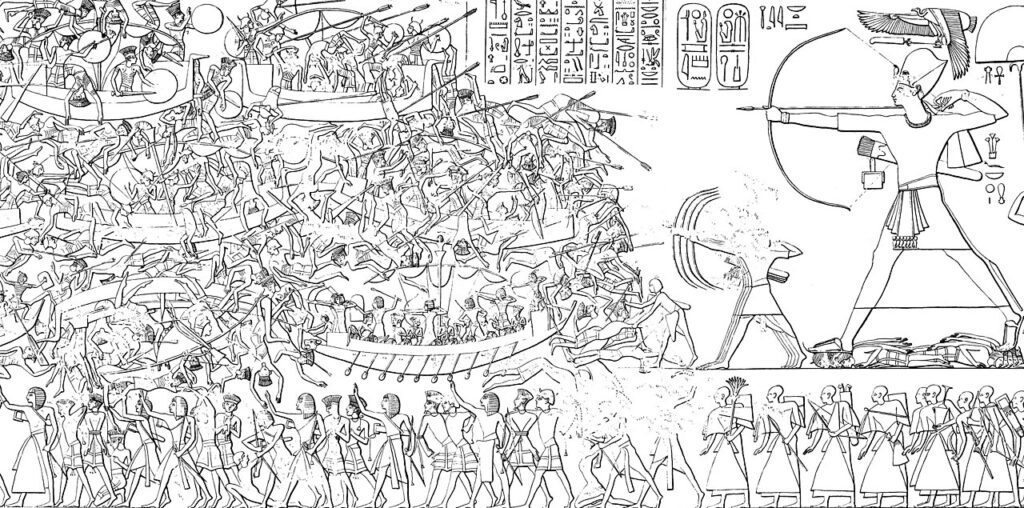
When watching Christopher Nolan’s The Odyssey, I noticed something interesting. Nolan seems to place Odysseus and the other returning heroes of the Trojan War firmly within the world of the Sea Peoples: the mysterious seaborne warriors who swept across the eastern Mediterranean around 1200 BC and even challenged the mighty Egyptian Empire.
It’s an attractive idea. The Trojan War is traditionally dated to roughly the same period as the Bronze Age Collapse, and some of the peoples mentioned in Egyptian inscriptions have even been linked to the Greeks who fought at Troy. Perhaps Odysseus and his crew were themselves among the Sea Peoples. As it turns out, Nolan is far from the first to make that connection.
Greeks among the Sea Peoples?
Around 1200 BC, much of the eastern Mediterranean descended into crisis. The great palace kingdoms of Mycenaean Greece, the Hittite Empire and many Levantine cities collapsed or were destroyed. Egypt narrowly survived.
The inscriptions of Pharaoh Merneptah and, later, Ramesses III describe invasions by coalitions of foreign peoples arriving by sea. Among the names they record are the Ekwesh and the Denyen. Although the identifications remain debated, many scholars have suggested that these names correspond to the Achaeans and Danaans familiar from Homer. If that is correct, at least some Mycenaean Greeks may indeed have participated in the movements we now call the Sea Peoples. That possibility becomes even more intriguing when we turn to the Odyssey itself.
Odysseus’ Egyptian adventure
After finally reaching Ithaca, Odysseus cannot immediately reveal his identity to the swineheard Eumaeus. Instead, he invents an elaborate false biography – also know as the “Cretan lie” – in which he claims to be a Cretan nobleman.
This invented life includes a remarkable episode. After the fall of Troy, the supposed Cretan sails with his companions to Egypt. He orders his men to remain by the ships while he scouts the situation. Instead, they ignore his instructions and begin plundering the countryside. The Egyptians respond swiftly. They gather an army, overwhelm the raiders, kill many of them and carry the survivors off into slavery. Only through the mercy of the Egyptian king does Odysseus’ alter ego eventually escape.
At first sight, the similarities are striking. Greek warriors arrive by sea. They attack Egypt. Their expedition ends in disaster. Could Homer have preserved a genuine memory of the Sea Peoples?
A memory of the Late Bronze Age Collapse?
There are certainly reasons to take the idea seriously. The chronology fits remarkably well. If the Trojan War belongs somewhere around the end of the Late Bronze Age, it overlaps with the period in which the Sea Peoples appeared in Egyptian sources.
The possible identification of the Ekwesh with the Achaeans and the Denyen with the Danaans strengthens the connection further. If some of the Sea Peoples really were Mycenaean Greeks, it would hardly be surprising if Greek oral traditions retained memories of their adventures. Nor is Homer completely detached from the Bronze Age. Archaeologists have long pointed out that the epics preserve details that had disappeared centuries before Homer lived, such as boar’s tusk helmets. Oral traditions are capable of preserving surprisingly ancient material. Taken together, these observations make the theory an appealing one.
The problems
Yet the closer we look, the less convincing the comparison becomes. The Egyptian inscriptions describe enormous coalitions threatening the Egyptian state itself. The expedition in the Odyssey consists of little more than a handful of ships engaged in opportunistic plunder. There is no hint of a mass migration, no coalition of different peoples, and no attempt to invade Egypt. It is simply a raid that goes badly wrong.
There is also the problem of transmission. Why would this relatively minor incident, rather than the great invasions themselves, survive in oral tradition for five centuries? None of this disproves the theory. But it does suggest we should look for another explanation.
Homer’s own Mediterranean
Perhaps we have been looking in the wrong century. By Homer’s own time, in the eighth and seventh centuries BC, Greek sailors had once again become a familiar presence throughout the eastern Mediterranean. Some traded, others raided, still others hired themselves out as mercenaries.
Neo-Assyrian texts mention Greek seaborne raiders – usually called Ionians – in the eastern Mediterranean, while Egyptian sources tell us that pharaoh Psamtik I employed large numbers of Ionian and Carian mercenaries in the seventh century BC. Before long, Greeks would even establish the trading settlement of Naukratis in the Nile Delta. In other words, stories of Greeks sailing to Egypt were no longer legendary, but rather contemporary reality.
Against that background, the Cretan lie suddenly becomes much easier to understand: a Greek adventurer lands in Egypt, his undisciplined companions begin looting, local forces mobilize, the expedition is crushed. This is exactly the sort of story an eighth-century Greek audience would have found believable. Not because it recalled a catastrophe five hundred years earlier, but because similar events could still happen in their own world.
A story for Homer’s audience
Christopher Nolan is probably right to place Odysseus in the turbulent world that followed the collapse of the Bronze Age. The heroes of the Odyssey belong to that legendary age. But the Egyptian episode in the Cretan lie was probably not preserved because it was an eyewitness memory of the Sea Peoples. It was preserved because it sounded plausible.
Like much of Homeric poetry, it combines a distant heroic past with details drawn from the world familiar to its audience. Rather than preserving a forgotten episode from the Bronze Age Collapse, the Cretan lie may instead reflect the Mediterranean of Homer himself: a world of merchants, pirates and mercenaries, where Greek ships regularly sailed to the coasts of Egypt and where not every expedition ended in glory. In that sense, the story tells us less about the Sea Peoples than about Homer’s extraordinary gift for making an ancient past feel real to the people listening to his songs.