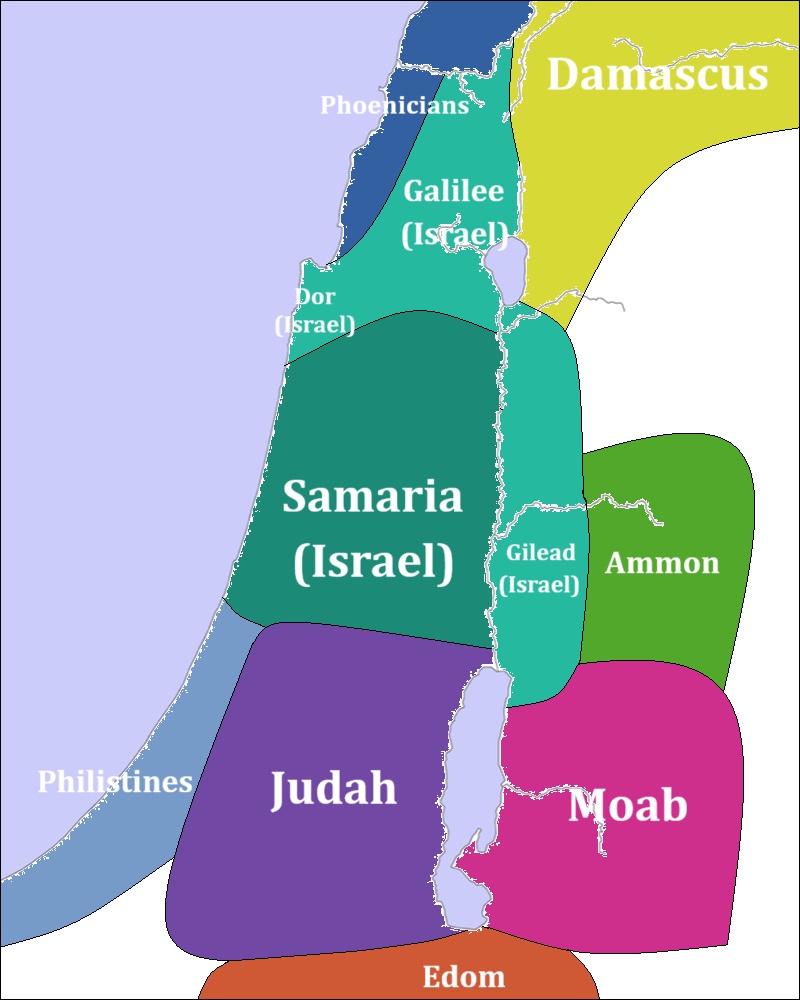
By Daan Nijssen (CC BY 3.0)
When studying Assyrian imperialism, one encounters a striking paradox: the phenomenon is unusually well documented, yet unusually difficult to view from any other perspective than an Assyrian one. Royal inscriptions describe military campaigns and diplomatic exchanges in considerable detail, but they do so through the highly ideological voice of the Assyrian king. Sources produced by the kingdoms confronted with Assyrian imperial ambitions, by contrast, are far scarcer. This makes the biblical book of 2 Kings exceptionally valuable: it preserves something we rarely possess for the Neo-Assyrian period: a sustained account of how smaller states actually dealt with Assyrian power.
Its value lies especially in the practical details. The text shows rulers paying tribute, building alliances, invoking external support, and choosing between resistance or accommodation, as well as the domestic political struggles that could shape those decisions. These are precisely the kinds of processes that Assyrian royal inscriptions tend to reduce to formulaic categories such as loyalty, submission and rebellion.
Read alongside the Assyrian evidence and through an international-relations lens, 2 Kings therefore offers a rare opportunity to examine imperialism as an interactive political process: not simply as the advance of an overwhelmingly powerful empire imposing its will, but as the product of repeated encounters between Assyria and local actors pursuing their own strategies of survival and autonomy.
Accommodation with benefits
In 738 BCE, King Menahem of Israel paid tribute to Tiglath-pileser III of Assyria (RINAP I 35 iii 5). He was one of many Levantine rulers to do so that year, alongside the kings of Damascus, Tyre and Byblos. There is no indication that Tiglath-pileser had first defeated all these kingdoms in battle, or even directly threatened each of them. What he had done, however, was defeat and annex Arpad in 740 BCE, providing a clear demonstration of the potential cost of resistance. Submission could therefore be a rational form of accommodation. By acknowledging Assyrian supremacy and paying tribute, states could retain a considerable degree of political autonomy.
In international-relations theory, such behaviour is often described as “bandwagoning”: aligning with a stronger or more threatening power in order to preserve one’s position or benefit from association with the stronger side. In Menahem’s case, the evidence points to something more complex than accommodation driven simply by fear. According to 2 Kings 15:19–20, Menahem paid Tiglath-pileser — called Pul in the biblical account — so that the Assyrian king would support him and “strengthen” his hold on the kingdom. 2 Kings 15:16 indicates that Menahem had himself seized the throne violently from his predecessor, Shallum, leaving his position far from secure. His tribute, then, need not be understood simply as money extorted under threat. It may also have been the price of Assyrian recognition and of gaining a powerful external backer in Israel’s own dynastic struggles.
Foreign policy begins at home
Menahem’s alliance with Assyria did not secure his dynasty for long. After his death, his son Pekahiah ruled for only two years before being murdered in a coup by Pekah, one of his officers, joined by fifty men from Gilead (2 Kings 15:23–25).
The chronology in 2 Kings creates a puzzle. Pekah is credited with a reign of twenty years, although only a handful of years can fit between Pekahiah’s death and Pekah’s own overthrow around 732 BCE. One possible solution, proposed by Carl Lederer, H.J. Cook and Edwin R. Thiele, among others, is that Pekah had already ruled as a rival king in Gilead and perhaps part of Galilee, while Menahem and Pekahiah controlled Samaria and its surroundings. The evidence is circumstantial. Pekah’s supporters in the coup were from Gilead, and his anti-Assyrian orientation differed sharply from the pro-Assyrian stance of Menahem’s dynasty. The fact that the biblical account itself presents Pekah as an officer at Pekahiah’s court contradicts this hypothesis, so the idea of two rival Israels remains disputed.
If the hypothesis is correct, however, Menahem’s payment to Tiglath-pileser takes on another dimension: Assyrian support may have helped him contain a domestic rival. Pekah’s eventual seizure of Samaria would then represent the culmination of a longer struggle over Israel’s political orientation.
Building a counterweight to Assyria
Pekah’s seizure of power marked a sharp change in Israel’s foreign policy. By overthrowing a dynasty that had enjoyed Assyrian backing, he also threatened the political order Tiglath-pileser had established in the west. In that sense, Pekah had antagonised Assyria from the outset. He was not merely a ruler opposed to Assyria. He was a ruler whom Assyria opposed. Seeking allies may therefore have been the most rational way to strengthen his position before Assyria intervened.
Pekah accordingly joined forces with King Rezin of Damascus. It is also possible that Rezin had supported Pekah’s coup from the beginning, with the aim of placing an anti-Assyrian ruler on the throne of Israel. Their alliance offers a clear example of “balancing”: smaller states pooling their resources in an attempt to resist a much stronger or more threatening power. The attack on Judah in 734 BCE (2 Kings 15:27) fits this logic. According to Isaiah 7, Pekah and Rezin intended to depose King Ahaz and replace him with “the son of Tabeel”. They appear to have sought a cooperative ruler in Jerusalem who would bring Judah into, or at least align it with, their anti-Assyrian coalition.
Seen in this light, the Syro-Ephraimite War formed part of a broader struggle over political alignment in the Levant. Pekah and Rezin were attempting to construct a regional counterweight to Assyria before its power became too great to resist.
Breaking the coalition, preserving the kingdom
Tiglath-pileser III’s response was devastating (2 Kings 15:29-30). Between 734 and 732 BCE, Assyria broke the coalition, defeated Rezin, annexed Damascus, and stripped Israel of large parts of its territory, including Gilead and Galilee. Dor on the coast was also incorporated into the Assyrian provincial system. Pekah was overthrown in a coup led by Hoshea, who paid a heavy tribute to Tigalth-pileser and was subsequently acknowledged as the ruler of what remained of Israel.
The Bible, presenting these events partly through Judah’s perspective, attributes this intervention to King Ahaz’s appeal to Tiglath-pileser for help against Israel and Damascus (2 Kings 16:7-14). But Assyria hardly needed Judah’s request as a justification for intervention. Pekah had already overthrown the dynasty that had accommodated Assyria, and he and Rezin were actively building an anti-Assyrian coalition. From Tiglath-pileser’s perspective, this was a direct challenge to his authority in the west.
What is striking is that Assyria did not annex all of Israel. Samaria survived as a reduced kingdom under Hoshea. This suggests that Tiglath-pileser still preferred indirect rule where possible. The territorial settlement is also suggestive in light of the “two Israels” hypothesis. If Pekah’s power base lay especially in Gilead and the north, then Assyria removed precisely those regions while leaving the Samarian core intact. That does not prove the hypothesis, but it fits it remarkably well.
What did submission actually mean?
Hoshea initially accepted the new reality. Tiglath-pileser III claimed to have installed him as king (RINAP I 41 17′-18′), and the surviving kingdom of Israel was now much smaller and more vulnerable than before. Cooperation with Assyria was therefore the obvious short-term strategy.
That calculation changed after Tiglath-pileser’s death in 727 BCE. According to 2 Kings 17:3-6, Hoshea stopped paying tribute and sent envoys to “So, king of Egypt”. From the Assyrian perspective, this could readily be interpreted as an attempt to join or construct an anti-Assyrian coalition, and thus as a form of balancing. Yet there is no reason to assume that Hoshea necessarily regarded his arrangement with Tiglath-pileser as binding beyond the latter’s death. He may instead have seen the succession as an opportunity to reassess his position and seek support from another, geographically much closer, patron.
The episode therefore raises an important question about imperial rule: what, in practice, did submission mean? Assyria appears to have treated tribute and loyalty as continuing obligations within an imperial hierarchy, regardless of a change of ruler. Hoshea, by contrast, may have understood the relationship more pragmatically, as an arrangement concluded under particular circumstances with a particular king. From a constructivist perspective, the important point is not that one side possessed the objectively correct interpretation. Political actors attach meaning to relationships and obligations, and repeated interactions can gradually establish expectations about how those relationships are supposed to work. Assyrian expansion was increasingly imposing its own understanding of those expectations on the kingdoms incorporated into its sphere of power.
The new Assyrian king Shalmaneser V evidently rejected any interpretation that allowed Hoshea to reconsider his obligations. When Hoshea withheld tribute and turned to Egypt, Assyria treated his actions as rebellion. The conflict was therefore not only about power, but also about competing assumptions concerning the durability of vassal obligations and the extent to which they survived a change of ruler.
When indirect rule ceased to work
Assyria’s response to Hoshea’s defection was more drastic than before. Shalmaneser V invaded Israel and laid siege to Samaria. According to 2 Kings 17:3-6, the siege lasted three years. Samaria fell around 722 BCE, although the precise division of responsibility between Shalmaneser V and his successor Sargon II remains debated.
Sargon did not restore another local dynasty. Instead, Israel was incorporated into the Assyrian provincial system. Deportations followed, new populations were settled in the region, and Samaria became part of a directly administered imperial frontier. This was the endpoint of a longer process. Assyria had tried to control Israel indirectly, but each arrangement left room for local rulers to reconsider their alignment when circumstances changed.
By 720 BCE, direct rule offered greater security. It removed the possibility of another independent Israelite king joining a regional coalition or defecting to Egypt, while strengthening Assyrian control over the trade routes of the Levant. Annexation was therefore not necessarily Assyria’s preferred starting point. In Israel’s case, it was the solution adopted after repeated attempts at indirect rule had broken down.
Empire as an interactive process
The final decades of Israel were not simply a story of inevitable Assyrian conquest, but a sequence of changing strategies: bandwagoning under Menahem, balancing under Pekah, changing loyalties under Hoshea. Assyria, too, adapted. It accepted tribute, backed local rulers, dismantled hostile coalitions, reduced territories and only in the end it imposed direct rule. The destruction of Israel was therefore not the automatic consequence of Assyrian expansion, but the outcome of repeated breakdowns in indirect control. Read in this way, the Hebrew Bible preserves something especially valuable: not just the experience of Assyrian imperialism from below, but the strategic calculations through which smaller states tried to survive it.