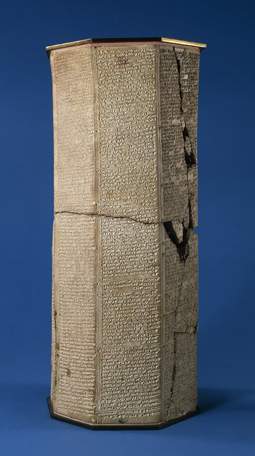
BM 91033. © The Trustees of the British Museum.
During the tenth and ninth centuries BCE, kings such as Aššur-dān II (r. 934–912 BCE), Adad-nārārī II (r. 911–891 BCE), Tukultī-Ninurta II (r. 890–884 BCE), and Ashurnasirpal II (r. 883–859 BCE) restored Assyrian rule over much of northern Mesopotamia, laying the foundations of the Neo-Assyrian Empire. Their inscriptions suggest that they were well aware of following in the footsteps of earlier conquerors. They repeatedly invoked rulers from the Middle Assyrian period, such as Adad-nārārī I (r. 1295–1264 BCE), Shalmaneser I (r. 1263–1234 BCE), Tukultī-Ninurta I (r. 1233–1197 BCE) and Tiglath-pileser I (r. 1114–1076 BCE), who had extended Assyrian power across northern Mesopotamia centuries earlier.
The early Neo-Assyrian kings recalled lands conquered by their predecessors, cities that had once belonged to Assyria and peoples that had subsequently stopped paying tribute, using these precedents to justify their claims. The Assyrian scribes could apparently connect particular kings with particular places and events.
Such references are often taken to show that the early Neo-Assyrian kings knew the full territorial extent of the Middle Assyrian Kingdom and consciously sought to restore it. There is some truth in this interpretation. Their knowledge of earlier Assyrian rule undoubtedly shaped how they presented their campaigns. But knowing that a predecessor conquered a certain land is not the same as understanding the historical circumstances of that conquest. The Assyrians remembered facts about their past. But did they also understand the world in which those events had occurred?
The world of the Late Bronze Age
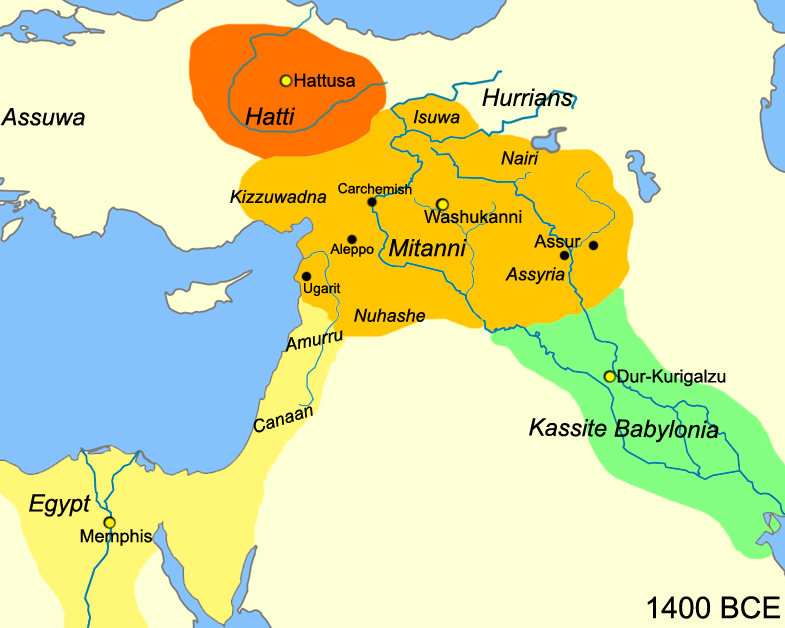
Source: Cambridge Ancient History Vol II Middle East & Aegean Region 1800-1300. I. E. S. EDWARDS (Ed) et al.
The Late Bronze Age political order differed profoundly from that of the early Neo-Assyrian kings. During much of the fifteenth and early fourteenth centuries BCE, Assyria had been overshadowed by Mitanni, a powerful kingdom that dominated northern Mesopotamia and much of northern Syria. Assyria appears to have spent a considerable period within its sphere of power.
This changed during the fourteenth century BCE. Assyria began to assert its independence while Mitanni was weakened by internal conflict and Hittite expansion. Under Šuppiluliuma I (r. ca. 1350–1322 BCE), the Hittites defeated Mitanni and brought much of its former territory west of the Euphrates under their control. Assyria profited from the same collapse. Its kings expanded westward and eventually conquered what remained of Mitanni east of the Euphrates. This region continued to be called Hanigalbat, but what had once been the centre of an independent great power was gradually incorporated into the Assyrian provincial system.
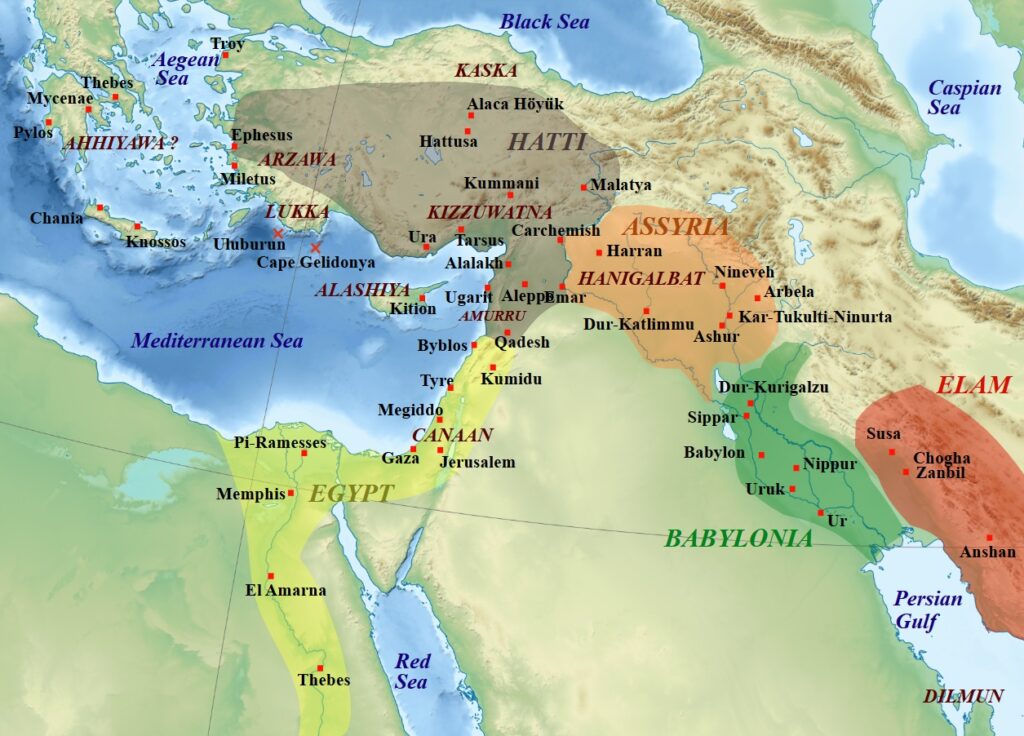
Source: Middle_East_topographic_map-blank.svg: Sémhur (talk)derivative work: Zunkir, CC BY-SA 3.0 https://creativecommons.org/licenses/by-sa/3.0, via Wikimedia Commons
The destruction of Mitanni brought Assyria and Hatti into direct competition along the Euphrates and in northern Syria. This rivalry formed part of a wider system of great powers that included Egypt and Babylonia. Their rulers exchanged letters and gifts, negotiated marriages and addressed one another as equals. Assyria was acutely aware that it was one among several powerful kingdoms.
That world largely disappeared around the end of the thirteenth century BCE. The Hittite Empire collapsed, its capital at Ḫattuša was abandoned and Egypt withdrew from most of its Asiatic possessions. Assyria survived, but gradually lost much of its western territory during the twelfth and eleventh centuries. Aramaean-speaking groups settled throughout northern Mesopotamia and Syria, while new Luwian and Aramaean kingdoms emerged in territories formerly divided between Hatti, Mitanni and Assyria. By the time Assyria began expanding again in the late tenth century, the region consisted not of a few great kingdoms but of numerous cities, tribal polities and small territorial states.
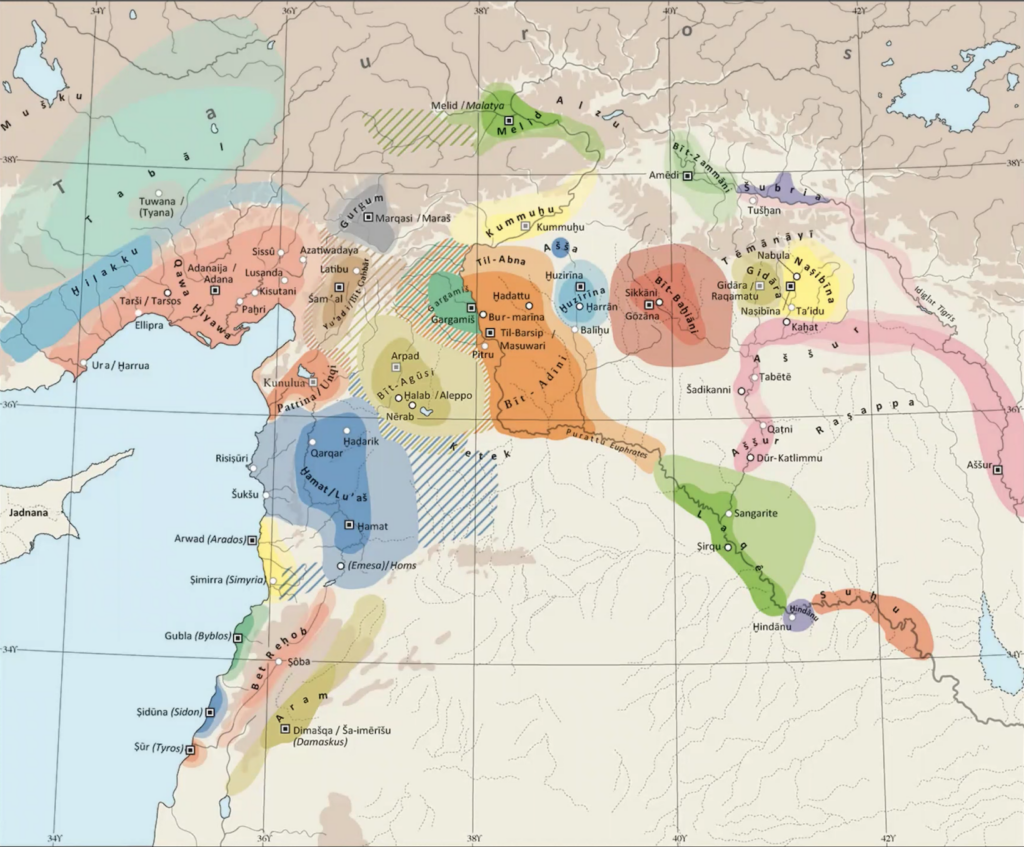
Source: M. Novák, in Brill’s New Pauly Supplements I Online – Volume 3
Some old geographical names nevertheless survived. “Hatti” continued to designate western lands long after the empire ruled from Ḫattuša had disappeared, while “Hanigalbat” remained associated with territories now inhabited and governed by very different peoples. Early Neo-Assyrians could therefore encounter familiar names in old inscriptions and contemporary geographical terminology without necessarily understanding how profoundly the political worlds behind them had changed.
Remembered facts, forgotten contexts
Early Neo-Assyrian scribes had several sources of knowledge about earlier kings. The Assyrian King List preserved their names, sequence and genealogies, and royal inscriptions and foundation deposits associated them with particular campaigns, conquests and building projects. The court could therefore retain remarkably precise information about former rulers and territories. In addition, they may have had access to information passed down in oral tradition.
Yet none of these sources were works of critical history. Royal inscriptions recorded what an Assyrian king had conquered, built or received in tribute, not the wider political circumstances. A ninth-century scribe might learn that Shalmaneser I conquered Hanigalbat without understanding that this region had previously formed the heartland of Mitanni, a great power that had once overshadowed Assyria, or how Hittite intervention had contributed to its collapse.
Neither does oral tradition necessarily preserve the missing context. Stories can retain genuine names, places and events for centuries by adapting them to later audiences. The Homeric epics offer a useful comparison. They preserve memories of Mycenaean places, objects and practices, and perhaps of conflicts involving Troy, but place them within a composite world containing institutions and customs familiar to later Greeks. The Bronze Age remained recognizable partly because it had been made intelligible in terms of the present.
Something similar could have happened in Assyria. A story about a Middle Assyrian king fighting Hatti might preserve a genuine event while transforming its political setting. Without additional context, a ninth-century audience might have imagined the Hittite army as something familiar from its own experience: a coalition of western petty kings led by one ringleader. The “Neo-Hittite” city-states would replace the vanished empire ruled from Ḫattuša. Similarly, the conquest of Hanigalbat might have been imagined as the subjugation of Aramaean rulers or tribal communities rather than the overthrow of a former overlord.
History is more than memorizing
The process is comparable to Renaissance depictions of Biblical and Graeco-Roman scenes. Artists dressed ancient figures in contemporary clothing and placed them amid Renaissance buildings and objects. They knew that they were depicting the past, but imagined it through the visual and social vocabulary of their own time.
Such anachronisms are obvious to us because historical and archaeological research allows us to distinguish first-century Jerusalem from fifteenth-century Florence. Equivalent distortions in ancient memory are harder to detect. A ninth-century Assyrian encountering the name “Hatti” had no means of consulting Hittite archives or reconstructing how fundamentally its political meaning had changed.
Modern historians can reconstruct some of these differences because they combine evidence from different states and disciplines. Assyrian inscriptions can be compared with Hittite treaties, Egyptian correspondence, Babylonian letters, administrative documents and archaeological remains. No single source provides a neutral overview. The larger system becomes visible only through comparison and source criticism.
Historical method therefore does more than recover information. It attempts to reconstruct the difference of the past rather than unconsciously filling ancient names with familiar meanings. In this respect, the Homeric epics and Renaissance paintings illustrate the same basic problem in different ways. The past can be remembered with surprising accuracy in some details while simultaneously being remodelled into a world that makes sense to the people remembering it.
In a way, the early Neo-Assyrian kings did remember the Middle Assyrian Kingdom. They knew its rulers, invoked its conquests and claimed its former territories. But they remembered it through Assyrian inscriptions and later traditions that separated those achievements from their original context. Hatti and Hanigalbat remained familiar names even as the political worlds behind them faded from view. While the Assyrians knew some of what their predecessors had done, that does not mean they still understood the world in which they had done it.