Public domain, via Wikimedia Commons
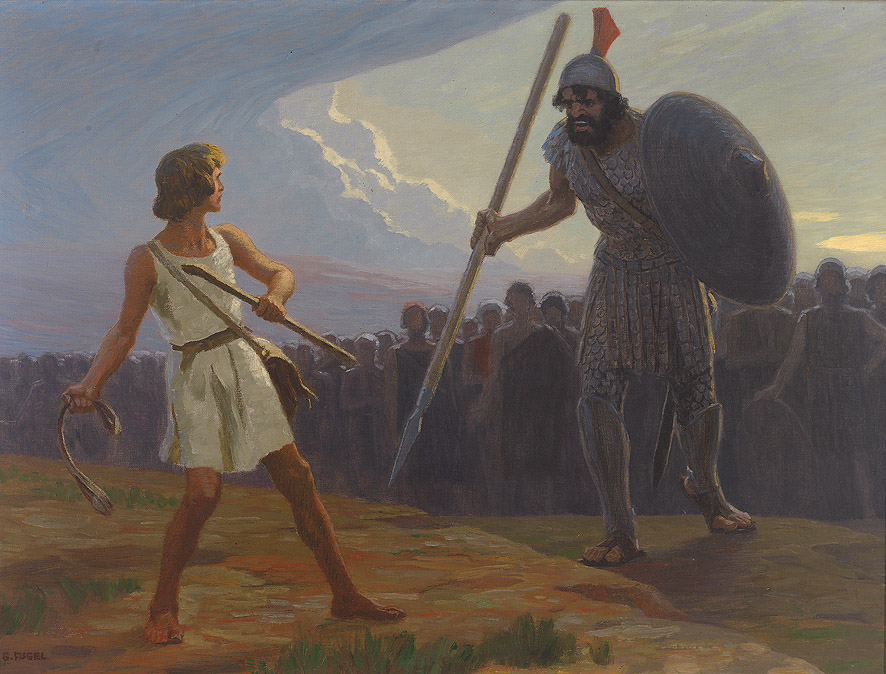
Ask someone about the ancient history of Palestine and they will probably mention the Israelites. Ask about the Philistines and most people know only one story: David and Goliath. And some would probably mention Samson as well.
Yet for centuries the Philistines were among the most powerful peoples of the southern Levant. Their cities controlled international trade, negotiated with Assyrian kings and dominated the Mediterranean coast. Long before Jerusalem became famous, Gaza, Ashkelon and Ashdod ranked among the region’s most important urban centres.
Their civilization eventually disappeared. But although the Philistines themselves vanished, they left behind something unexpected: the geographical name by which much of the region would later become known.
Before the Philistines
Long before the Philistines arrived, the coastal plain of Palestine was dominated by prosperous Canaanite city-states. During the Late Bronze Age (c. 1550–1200 BCE), these cities formed part of Egypt’s sphere of influence and controlled the routes linking Egypt and Syria.
Among them was Gaza, one of the oldest and most important cities in the region. Long before it became Philistine, it served as Egypt’s principal administrative and military centre in southern Canaan. Merchants, soldiers and officials passed through its gates, while caravans carried goods up and down the coast.
The importance of the coastal plain therefore did not begin with the Philistines. They inherited a region that had already been a crossroads of trade, empire and cultural exchange for centuries. When Egypt’s grip on Canaan weakened around 1200 BCE, the stage was set for new peoples and new identities to emerge.
The rise of the Philistines
The first people whom we can plausibly identify as Philistines appear not in Palestine, but in the Nile Delta. Around 1177 BCE, Pharaoh Ramesses III recorded invasions by groups known today as the Sea Peoples. Among them were the Peleset, a name strikingly similar to that of the later Philistines.
What happened next remains debated. Earlier scholars imagined mass migrations from the Aegean, but modern historians are more cautious. Archaeology reveals strong Aegean influences in pottery, architecture and other cultural practices, yet this need not imply large-scale population movements.
A more likely scenario is that relatively small groups of migrants, mercenaries or military elites settled in the coastal cities of southern Canaan, perhaps with Egyptian approval. Over the following generations, Aegean-inspired pottery became common in cities such as Gaza, Ashkelon, Ashdod, Ekron and Gath, while the population remained overwhelmingly Levantine in origin.
The Philistines therefore did not suddenly appear as a fully formed people. Rather, a new identity emerged through the interaction of Mediterranean newcomers and local inhabitants. Whatever their precise origins, by the eleventh century BCE they had become a recognizable political and cultural force in southern Palestine.
Philistines vs. Israelites
The arrival of the Philistines coincided with another major transformation. As the old Bronze Age order collapsed, many lowland cities declined while hundreds of new settlements appeared in the central hill country. It was within these highland communities that the Israelites would eventually emerge.
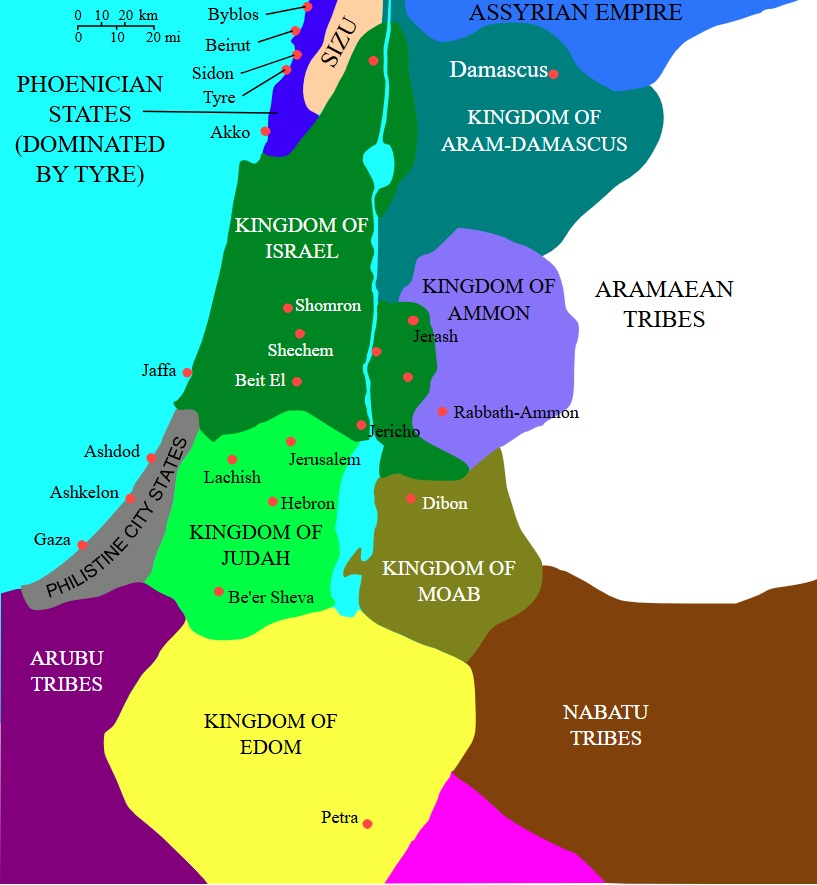
Over time, the Philistine city-states came to dominate the coastal plain while growing Israelite communities occupied the hills further inland. The frontier between these worlds became one of the defining features of early Iron Age Palestine.
Set in the borderlands between the Philistine plain and the Israelite hills, stories about heroes such as Samson preserve memories of raiding, intermarriage and local conflict. While legendary in form, they likely reflect genuine tensions along a contested frontier.
By the time of Saul and David, these tensions had escalated into a struggle for regional dominance. The Philistines controlled the richer and more densely populated lowlands, while the Israelites sought to unite the highland tribes into a single kingdom. The wars described in the books of Samuel formed part of a broader process of Israelite state formation and nation-building.
Briangotts on en.wikipedia and Slashme on en.wikipedia, CC BY-SA 3.0 http://creativecommons.org/licenses/by-sa/3.0/, via Wikimedia Commons
Yet the frontier eventually stabilized. From the ninth century BCE onwards, neither side succeeded in absorbing the other. Trade, migration and cultural exchange increasingly blurred the distinctions between them. The Philistines adopted local Semitic languages, while Israel and Judah became more urbanized and integrated into the wider Levantine world. They were no longer two alien societies, but neighbouring peoples participating in the same regional economy. This balance would last until a new power arrived from the east.
The Philistine cities under Assyria
The arrival of the Assyrian Empire transformed the political landscape of Palestine. From an Assyrian perspective, cities such as Gaza, Ashdod and Ekron often mattered more than Jerusalem. These coastal centres controlled trade routes and guarded the frontier with Egypt. Maintaining stability there was therefore a priority.
Assyrian rule combined direct and indirect control. Local rulers continued to govern the Philistine cities as Assyrian vassals, while imperial governors and their garrisons supervised trade and monitored developments along the Egyptian frontier. The result was a flexible system adapted to local circumstances.
The importance of the coastal plain is illustrated by the revolt of Judah’s king Hezekiah in 701 BCE. Seeking to expand westward, Hezekiah imprisoned Padi, the pro-Assyrian ruler of Ekron, and annexed parts of the coastal plain. When Sennacherib invaded, one of his priorities was restoring Padi to his throne. The territories Judah had seized were taken away again and returned to the Philistine cities. To the Assyrians, the issue was not the conquest of Judah but the recovery of the prosperous coastal plain.
The end of the Philistines
The Philistines survived centuries of conflict with Israelites, Judeans and Assyrians, but they ultimately fell victim to a different empire. In the late seventh and early sixth centuries BCE, the Babylonians conquered the southern Levant and destroyed many of its major cities. Excavations at sites such as Ashkelon have uncovered dramatic evidence of these campaigns.
The Babylonian conquest marked a turning point. Although the cities were rebuilt, Philistine identity gradually faded. By this time, the Philistines had largely adopted local Semitic languages and shared many cultural practices with their neighbours. As populations mixed and political structures changed, the distinctions that had once set them apart became increasingly difficult to maintain.
Yet this did not mean that the coastal population became Judean. The inhabitants of Gaza, Ashkelon and Ashdod remained culturally and politically distinct from the Jewish communities of the interior. What disappeared was not the population itself, but the specific Philistine identity that had emerged during the Iron Age. The descendants of the Philistines were gradually absorbed into the broader Semitic population of the coastal plain while retaining the region’s long-standing orientation towards trade, commerce and the Mediterranean world.
The legacy of the Philistines
By the time the Romans arrived, the Philistines had long ceased to exist as a distinct people. Yet the cities that had once formed the heart of Philistia remained important. Gaza, Ashkelon and Ashdod continued to thrive as centres of trade and administration.
Their name survived as well. Greek authors had long referred to parts of the southern Levant as Palaistinē, a term ultimately derived from the Philistines. Over time, this designation expanded beyond the coastal plain and came to encompass a much larger region. By the Roman period, Palestine was already a familiar geographical name.
This places the famous Roman renaming of Judaea in context. After suppressing the Bar Kokhba Revolt in 135 CE, the Romans reorganized the province as Syria Palaestina. Whether intended to diminish Jewish identity or not, they were not inventing a new name. They were adopting an older geographical designation that had been in use for centuries.
The result is one of history’s great ironies. The Israelites and Judeans survived as a people. The Philistines did not. Yet when the Greeks and Romans looked at the region, it was the name of the vanished Philistines — not that of the surviving Judeans — that became the dominant geographical label. More than two millennia later, it remains so.
I love this region and historie…