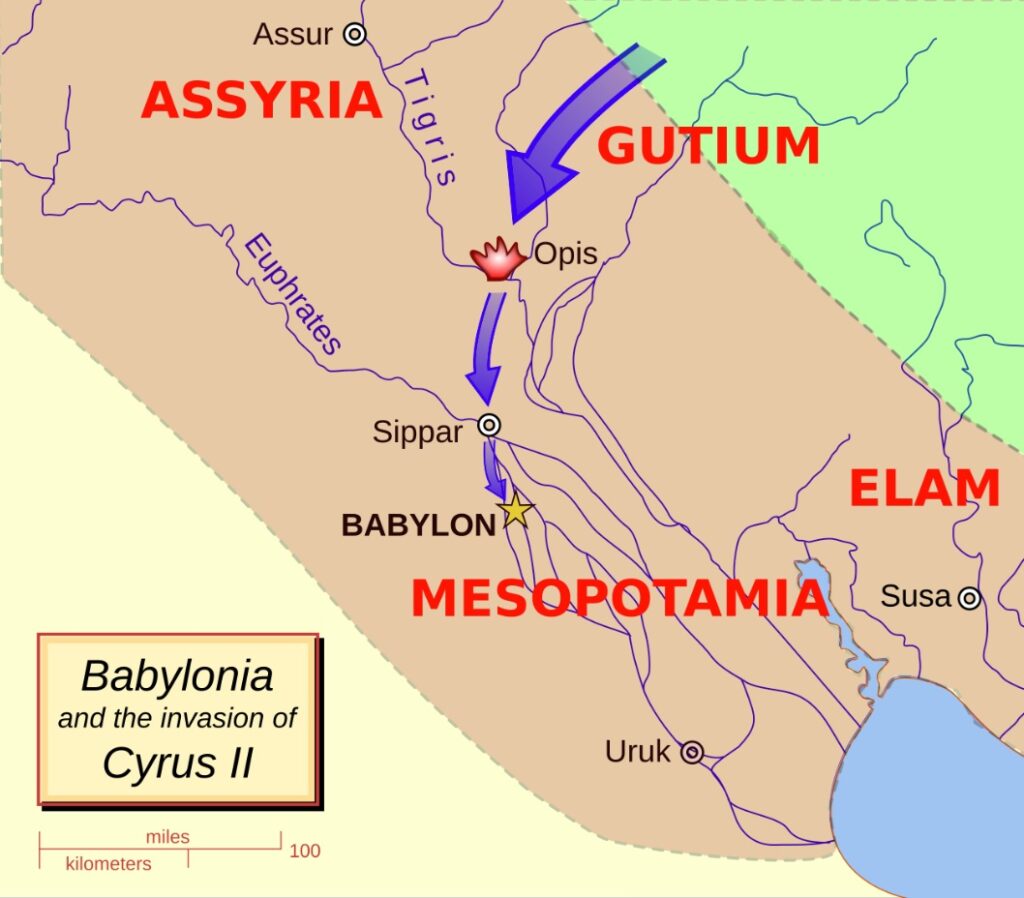
ChrisO, Public domain, via Wikimedia Commons
In October 539 BCE, Cyrus the Great conquered the Babylonian Empire in one swift campaign. He defeated the Babylonian army at the Battle of Opis, captured the last Babylonian king Nabonidus, and took the city of Babylon without a battle. The Babylonian Empire thus became part of the rapidly expanding Persian Empire. At least, that is how we usually tell the story. I have often wondered how an empire as powerful and prestigious as Babylonia could fall so easily to a foreign conqueror. But perhaps we have been asking the wrong question.
We know surprisingly little about what actually happened. Our most important contemporary narrative source, the Nabonidus Chronicle, reduces the decisive events to a handful of brief paragraphs. Later Babylonian texts like the Cyrus Cylinder tell us how Cyrus’s new regime wanted his accession to be understood. And Greek authors like Herodotus and Xenophon provide elaborate yet unreliable stories written long after the event. But none of them gives us access to the political calculations taking place behind the scenes.
Forget the end result
To understand how strange the events of 539 BCE were, we first have to forget the long-term consequences. We know Cyrus as “Cyrus the Great”, founder of the Persian Empire and conqueror of Media, Lydia and Babylonia. When we read about Cyrus marching against Babylon, we already know how the story ends. But Cyrus did not. Nor did the Babylonians.
From Babylon, Cyrus might have looked rather different. His origins lay in Anshan, a small kingdom in the Zagros Mountains. Within a remarkably short period, he had transformed from one of many rulers on the Iranian Plateau into the dominant warlord of West Asia. He defeated Astyages, the Median king of Ecbatana, and took over the political network he had dominated. He subsequently turned west, defeated Croesus of Lydia and added his kingdom to his growing collection of territories. Other campaigns brought regions further east under his authority.
But we should be careful not to project the Persian Empire of Darius and Xerxes backwards onto Cyrus. His enormous dominion had been assembled within his own lifetime through conquest, negotiation and the incorporation of existing political structures. Cyrus was already one of the most powerful rulers in the Near East, yet his power was fickle, personal and accumulated through an astonishing series of victories. Now he turned towards the great imperial power of the Mesopotamian lowlands.
The empire in the lowlands
Babylonia was a very different political world. Its cities stood at the centre of an ancient urban civilization that stretched back millennia. Nabonidus ruled over Mesopotamia, the Levant, and even parts of northern Arabia. At its heart stood Babylon, protected by formidable fortifications and possessing an enormous religious and political prestige.
Nabonidus was certainly an unusual king. Most famously, he spent roughly ten years at Tayma in northern Arabia, while he left his son Belshazzar in Babylon to govern the empire in his stead. His devotion to the moon god Sîn would later be used against him by his enemies. Older accounts sometimes turned these peculiarities into evidence that his kingdom was already falling apart. Nabonidus was supposedly an unpopular religious eccentric whose subjects were waiting for Cyrus to liberate them.
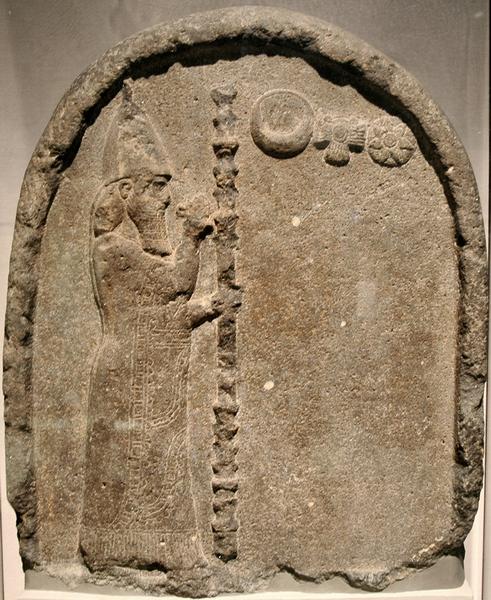
British Museum, CC BY 3.0 https://creativecommons.org/licenses/by/3.0, via Wikimedia Commons
Nevertheless, whatever tensions might have existed, Babylonia remained a major power. Nabonidus had returned from Arabia and was capable of mobilizing an army against Cyrus. Imagine, then, that we do not know what happens next. Cyrus has conquered an enormous arc of territory stretching from the Syr Darya River in Central Asia towards the Aegean coast. But before him lies the wealthy Mesopotamian lowland, its imperial possessions and the colossal city of Babylon. Why would he take the risk of invading it?
Only one battle
Of course, successful rulers take risks. Cyrus may simply have believed that he could defeat Nabonidus. Still, it’s surprising how quickly events unfolded once he tried. According to the Nabonidus Chronicle, Cyrus defeated the Babylonian army at Opis on the Tigris in the month of Tašrītu, roughly September–October 539 BCE. On 14 Tašrītu, Sippar was taken without battle. Nabonidus fled. Two days later, Ugbaru, governor of Gutium, entered Babylon with Cyrus’s army. Again, without a siege or a battle. Nabonidus was subsequently captured. Cyrus himself arrived more than two weeks later, on 3 Arahsamna. By then, the transition of power was already underway.
There was no long sequence of battles as Cyrus fought his way through Babylonia. There was no protracted siege of Babylon. According to our principal contemporary account, one battle was followed by the bloodless capture of Sippar and then the bloodless entry of Cyrus’s forces into Babylon. The Babylonian Empire appears to have lost the will or ability to resist almost immediately after the Battle of Opis. But why?
What did Cyrus know?
It is easy to answer retrospectively. The Babylonian army had been defeated and the remaining cities recognized that resistance was futile. Perhaps that is all there was to it. But that does not entirely answer the question Cyrus confronted before the Battle of Opis. A victory in the field did not automatically guarantee possession of every fortified city in an enemy kingdom. Even after defeating Nabonidus, Cyrus could have faced prolonged resistance. Babylon itself was hardly an obvious place to attack if its inhabitants were determined to keep him outside.
A long war also carried risks. Cyrus’s territories were enormous and comparatively new. Prolonged campaigning in Babylonia could create opportunities for trouble elsewhere. Yet Cyrus committed himself to the invasion. Perhaps his previous victories simply made him confident. But there is another possibility. Perhaps Cyrus knew more about what would happen after a victory over Nabonidus than our surviving sources tell us.
Military campaigns do not take place in political vacuums. Rulers communicate, governors defect, merchants cross borders, powerful families cultivate contacts. People anticipating conflict do not necessarily wait until two armies meet before deciding what they will do.
The invisible half of the conquest
This brings us to the central problem: our evidence is much better at recording public events than private calculations. A battle can appear in a chronicle, the capture of a city can be dated, a king’s ceremonial entrance can be recorded, but a conversation usually is not. If a Babylonian official quietly sent a messenger to Cyrus before the invasion, we would probably never know. If a governor decided beforehand that he would abandon Nabonidus after a major defeat, no chronicle needed to record that decision. If powerful Babylonian families discussed the possibility of accommodating a new king, their conversations have disappeared.
The rapid fall of Babylon is not evidence of a conspiracy. But neither should we automatically imagine two hermetically sealed camps — Persians and Babylonians — who only began interacting politically once Cyrus had secured his victory. Perhaps the campaign recorded in the Nabonidus Chronicle was only the visible half of what happened in 539 BCE.
After one major military victory, the political structure confronting Cyrus offered remarkably little further resistance. Within weeks, the ruler from the Iranian highlands had become king of Babylon. Perhaps, then, we have been asking the wrong question. Instead of asking only how Cyrus conquered the Babylonians, we should also ask what the Babylonians themselves were doing while Cyrus approached. And that leads to a considerably more provocative possibility: what if some of them had already decided that Cyrus should win?
More in Part II: Did the Babylonians invite Cyrus?