In 640 BCE, the Neo-Assyrian Empire still dominated much of the Near East, but signs of decline were already becoming apparent. King Ashurbanipal had strained Assyria’s military resources fighting a civil war against his brother Šamaš-šuma-ukīn in Babylonia and launching several devastating campaigns into Elam. Meanwhile, nomadic invaders threatened the empire’s frontiers, Egypt was re-emerging as a major rival, and Assyria’s grip on the Levant was weakening.
It was against this unstable backdrop that eight-year-old Josiah ascended the throne of Judah. Since the reign of Ahaz in the 730s BCE, Judah’s kings had acknowledged Assyrian overlordship, paying tribute and pledging loyalty to the Assyrian king. As Assyrian power declined, however, Judah gained greater freedom of action. This presented Josiah with an opportunity to redefine not only his kingdom’s political position, but perhaps also its relationship with its God.
Near Eastern loyalty treaties
In the ancient Near East, powerful kings often concluded treaties with weaker rulers, promising protection in exchange for tribute, loyalty, and military support. These were not merely political agreements, but sacred obligations guaranteed by the gods. This tradition dated back at least to the Late Bronze Age, when Hittite kings concluded elaborate treaties with their vassals. These specified the obligations of the subordinate ruler and invoked the gods as witnesses. The Neo-Assyrian kings adopted similar practices, placing particular emphasis on unconditional loyalty.
A famous example is the succession treaties imposed by Esarhaddon in 672 BCE to secure the succession of his son Ashurbanipal. Those who swore the oath were forbidden from supporting rival claimants or concealing conspiracies. To reinforce their loyalty, the treaties invoked terrifying divine punishments, ranging from disease and famine to the destruction of entire families. These treaties provide an intriguing background to one of the most familiar concepts in biblical religion: the covenant between YHWH and the people of Israel.
The discovery of the Law
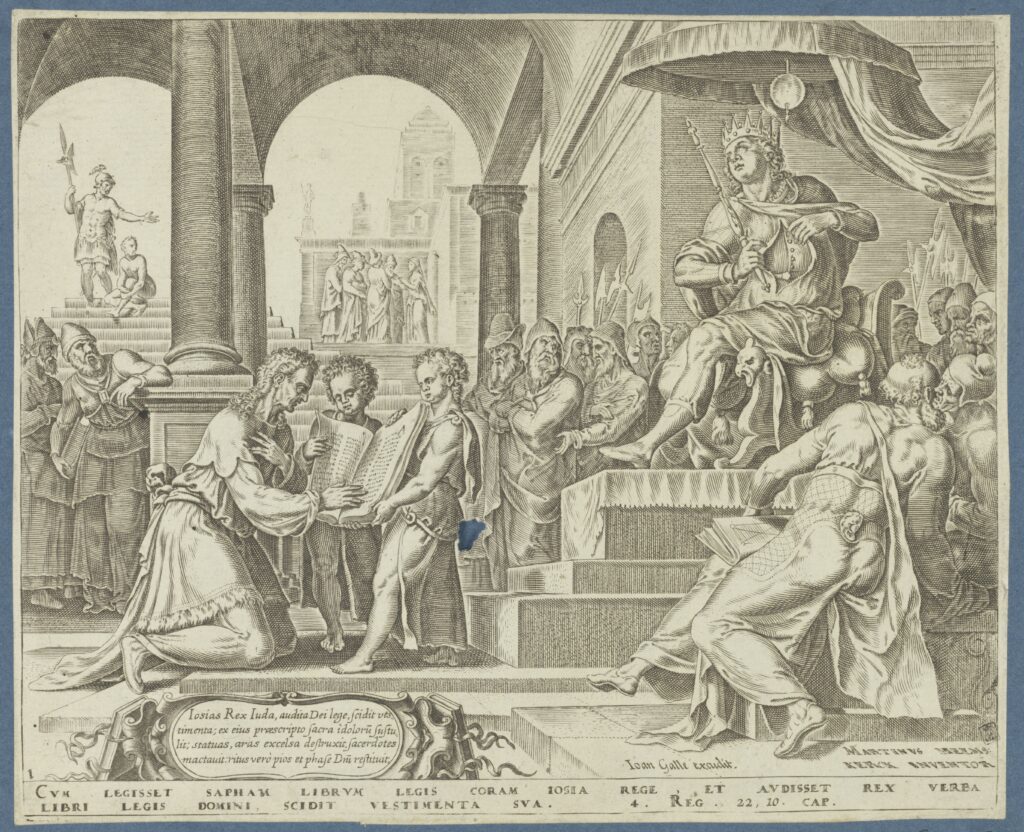
According to 2 Kings 22–23, a remarkable discovery took place in Jerusalem in 622 BCE. During repairs to the Temple, the high priest Hilkiah found a forgotten book of the Law. When it was read to Josiah, the king was horrified: his people had apparently violated YHWH’s commandments for generations, exposing themselves to divine punishment. Josiah assembled the people of Judah, had the book read publicly, and renewed their covenant with YHWH. He then launched an ambitious religious reform, removing objects associated with other gods, suppressing local sanctuaries, and establishing Jerusalem as the sole legitimate centre of worship.
Scholars have traditionally identified the mysterious book with an early version of Deuteronomy, although its precise contents and date remain disputed. Some have suggested that the discovery story served to legitimise reforms Josiah and his supporters already intended to introduce. By presenting their programme as the restoration of an ancient law, they could claim divine authority for changes that might otherwise have faced resistance. But what makes Deuteronomy particularly intriguing is its resemblance to the imperial treaties discussed earlier.
An Assyrian blueprint?
Like ancient Near Eastern treaties, Deuteronomy establishes obligations between a sovereign and his subjects, demands loyalty, and threatens punishment for disobedience. Some passages bear especially striking similarities to Esarhaddon’s succession treaties.
One example concerns the demand for absolute loyalty. Esarhaddon’s treaties required subjects to report anyone plotting against his designated successor, even a close relative. Similarly, Deuteronomy 13 warns against prophets, friends, and family members who encourage the worship of other gods. Even a brother, wife, or beloved friend must not be spared if they attempt to lead someone away from YHWH. In both texts, loyalty to the sovereign takes precedence over the closest personal relationships.
Another parallel appears in the curses. Esarhaddon’s treaties threatened disloyal subjects with disease, famine, military defeat, and the loss of their families and possessions. Deuteronomy 28 describes remarkably similar punishments for disobeying YHWH, sometimes in a comparable sequence. In both cases, the consequences could extend beyond the individual offender to the wider community.
Even the language of obedience is reminiscent of the treaty tradition. Esarhaddon’s treaties demanded unwavering loyalty to the designated heir, while Deuteronomy forbids adding to or taking away from God’s commandments (Deuteronomy 12:32). In both cases, the sovereign’s commands were to be treated as inviolable.
From earthly to divine sovereignty
There was, however, one fundamental difference between the Assyrian treaties and the biblical covenant. In the former, loyalty was owed to an earthly king whose authority was guaranteed by the gods. In Deuteronomy, the sovereign was YHWH himself. Just as Assyrian vassals were forbidden from transferring their allegiance to another king, the Israelites were forbidden from worshipping other gods. This demanded exclusive worship of YHWH, though not necessarily a belief that no other gods existed.
If the covenant traditions associated with Josiah’s reign reflect a response to Assyrian domination, the political implications were considerable. By recognising YHWH as their supreme sovereign, the people of Judah could claim an allegiance that took precedence over their obligations to any foreign overlord. This arrangement also strengthened Josiah’s position. By presenting himself as YHWH’s faithful servant, he could legitimise his reforms as divine commandments rather than personal ambitions. Centralising worship in Jerusalem could reinforce the authority of the king and the Jerusalem priesthood while weakening competing religious institutions.
A kingdom falls, a covenant survives
Whatever Josiah’s ambitions, they were cut short in 609 BCE, when he was killed at Megiddo during an encounter with Pharaoh Necho II of Egypt. Judah soon fell under Egyptian domination, followed by Babylonian overlordship. In 586 BCE, Jerusalem was destroyed and the kingdom came to an end. Yet the idea of a people united by a covenant with YHWH survived. As biblical traditions continued to develop during and after the Babylonian exile, the Israelites could imagine themselves as a community defined not by allegiance to an earthly ruler, but by their relationship with God. There is a remarkable irony here. The Assyrian kings had used sacred oaths to bind their subjects to an empire. Biblical authors may have adapted this very model to express a covenant with a divine sovereign, allowing Israel to preserve its identity long after both its own kingdom and the Assyrian Empire had disappeared.