Antiquistik, CC BY-SA 4.0 https://creativecommons.org/licenses/by-sa/4.0, via Wikimedia Commons
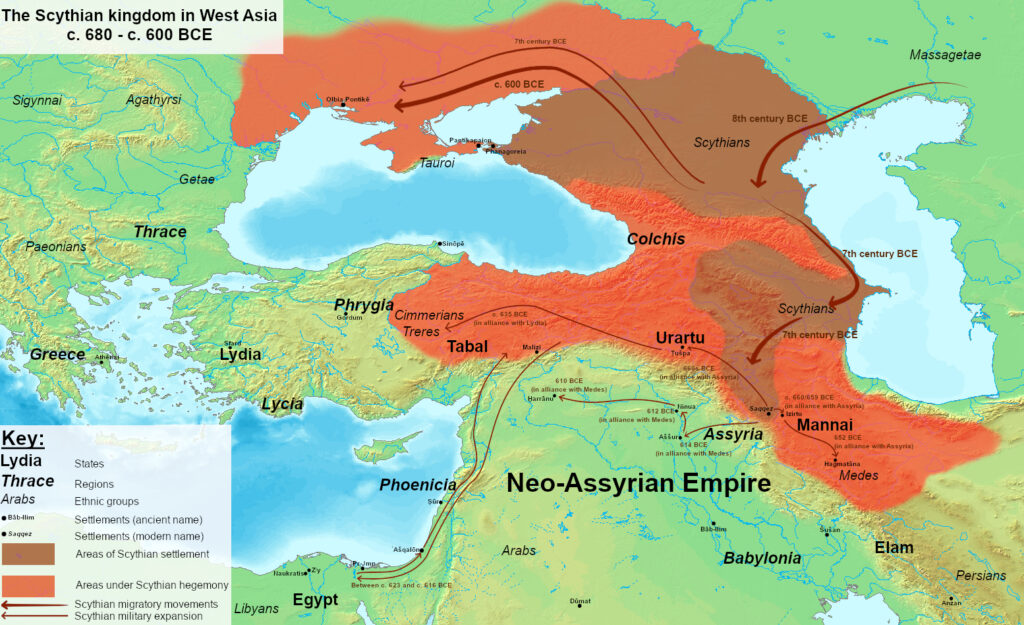
Those familiar with the history of the ancient Near East will have heard of the Assyrian, Babylonian, and Persian Empires. They may also have encountered the debate over the existence of a Median Empire. But was there ever a Scythian Empire? According to the Greek historian Herodotus, there was. In Histories 1.103–106, he describes a Scythian king named Madyes, son of Protothyes, who allegedly ruled over ‘Asia’ for 28 years and led his warriors as far south as Palestine, where the Egyptian pharaoh Psamtik I persuaded him to turn back.
Madyes is also said to have driven back the Median king Cyaxares during his first attempt to besiege Nineveh, the Assyrian capital. The Scythians subsequently subjugated the Medes, imposing tribute while at the same time plundering their territories. After having suffered 28 years of humiliations, Cyaxares invited the Scythian leaders to a banquet, got them drunk, and murdered them, thereby restoring Median supremacy, before fulfilling his original ambition of taking Nineveh.
It is a compelling story, but one that is difficult to reconcile with what we know about this period. Neither Assyrian royal inscriptions and correspondence, Babylonian chronicles, nor the Old Testament mention a Scythian Interregnum, or even widespread Scythian raids across the region, during the latter half of the seventh century BCE.
A Scythian warlord seeks an Assyrian bride
As is often the case when Herodotus’s account isn’t directly corroborated, various scholars have attempted to reconstruct a more modest version. Perhaps Scythian rule did not encompass all of Asia, their supposed ’empire’ amounted to little more than extensive raiding, and the 28 years of supremacy should not be taken literally. Herodotus may have preserved oral traditions in which historical events became distorted over time, while stories of Scythian raids as far south as Palestine may have some basis in reality.
Moreover, oracle queries from the reign of the Assyrian king Esarhaddon (r. 681–669 BCE) provide an intriguing clue. Esarhaddon regularly consulted diviners about potential threats to his empire. The king would pose a question, usually requiring a yes-or-no answer, and a diviner would examine the liver of a sacrificed animal to determine the gods’ response. One such query mentions a Scythian chieftain named Bartatua, whose name is almost certainly identical with Protothyes, the father of Madyes mentioned by Herodotus, who had requested the hand of Esarhaddon’s daughter in marriage. He may have sought a formal alliance with Assyria to strengthen his position in the region. Unfortunately, no surviving source confirms whether the marriage took place.
Madyes, the forgotten Assyrian prince?
Such clues invite speculation. Suppose Bartatua married Esarhaddon’s daughter, and their son was Madyes. This would make Madyes a grandson of Esarhaddon and a nephew of Ashurbanipal (r. 669–ca. 631 BCE). He would therefore have belonged not only to the Scythian ruling elite, but also to the Assyrian royal family. Such connections could have given him considerable political influence and might explain his involvement in the affairs of the Assyrian Empire.
Perhaps Madyes initially supported his uncle Ashurbanipal, commanding Scythian warriors against Assyria’s enemies. This could explain why he supposedly came to Assyria’s aid when the Median king Cyaxares besieged Nineveh. His campaign as far south as Palestine might likewise have served Assyrian interests, perhaps aiming to confront Psamtik I, who had broken free from Assyrian overlordship. And following Ashurbanipal’s death, Madyes may have become involved in the struggles over the Assyrian succession. As a grandson of Esarhaddon, he might even have considered himself a legitimate contender for the throne.
We can thus construct a coherent narrative in which Madyes emerges as a powerful Scythian leader with close ties to the Assyrian dynasty. His supposed intervention against Cyaxares, his campaign into Palestine, and his possible involvement in the struggles following Ashurbanipal’s death all become episodes in a larger story of dynastic loyalty and political ambition. We might even be tempted to attribute a significant role to Madyes in the final decades of the Assyrian Empire and overplay any power he really had.
A story too good to be true?
But how much of this story can we actually substantiate? We know that Bartatua requested an Assyrian princess in marriage, but not whether the marriage took place. We do not know whether Madyes was born from this hypothetical union, whether he maintained close ties with Ashurbanipal, or whether his military activities were motivated by dynastic considerations. Indeed, Madyes is not mentioned in any surviving contemporary Assyrian or Babylonian source. Nor do we have reliable information about the military strength of the Scythians or the extent of their political influence. This should make us cautious about assigning him such a prominent role in Assyrian history.
The problem is that we have constructed a seemingly compelling narrative by stacking several plausible but unproven assumptions on top of one another. Because the resulting story seems coherent, we may begin using it to fill in the blanks, especially regarding the poorly documented final decades of the Assyrian Empire. The apparent explanatory power of our reconstruction may therefore tell us more about the story we have constructed than about what actually happened.
The value of historical speculation
Should we therefore refrain from speculation? O the contrary, I believe it is often essential to historical research. The surviving sources leave enormous gaps in our knowledge, and limiting ourselves to what they explicitly tell us would produce a rather incomplete picture of the past. Speculation allows us to explore possible connections, motives, and explanations that might otherwise remain unnoticed.
I see nothing wrong with entertaining the possibility that Bartatua married Esarhaddon’s daughter and that Madyes was their son. Nor is it unreasonable to investigate how such a relationship might have influenced Madyes’s actions. The problem arises when we become so convinced by one plausible reconstruction that we start using it to explain almost everything, without considering whether the evidence actually supports these conclusions.
We should therefore remain open to alternative scenarios and take seriously whatever evidence might challenge our preferred interpretation. Perhaps Madyes was Esarhaddon’s grandson, but his Assyrian ancestry played little role in his decisions. Perhaps he was an important Scythian leader without any dynastic connections to Assyria. Or perhaps his historical significance was far more limited than Herodotus’s account suggests. Even if our initial hypothesis turns out to be correct, the explanations we build upon it need not be.
Ultimately, we may never know whether there really was a Scythian Interregnum or what role Madyes played in Assyria’s final decades. But that uncertainty should not prevent us from exploring the possibilities. We should be willing to develop plausible hypotheses and investigate their implications, without mistaking their explanatory potential for proof. The purpose of historical speculation is to open up possibilities, not to become so attached to one of them that we lose sight of all the others.