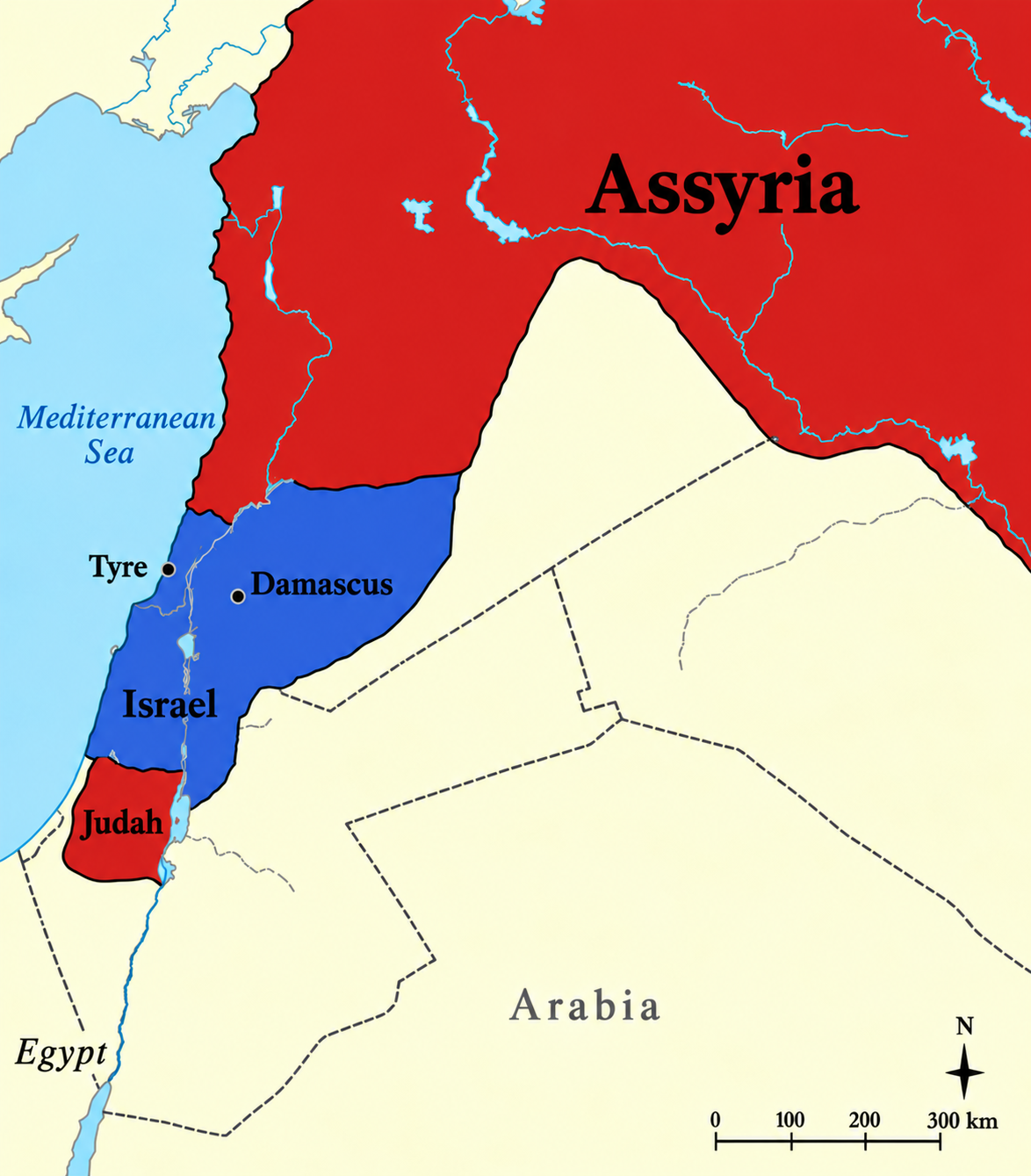
By Daan Nijssen (CC BY 3.0)
In 734 BCE, King Ahaz of Judah faced an immediate crisis. King Rezin of Damascus and King Pekah of Israel had joined forces and invaded his kingdom. According to Isaiah 7, they even intended to depose him and replace him with another ruler. Ahaz responded by appealing to King Tiglath-pileser III of Assyria, saying: “I am your servant and vassal. Come up and save me from the kings of Damascus and Israel.” He sent silver and gold from the temple and palace, and Assyria intervened.
From the perspective of international-relations theory, Ahaz’s decision raises a deceptively simple question: was he “bandwagoning” or “balancing”? In traditional balance-of-power theory, balancing means opposing a stronger power, either by strengthening oneself or by joining forces with others, whereas bandwagoning means aligning with the stronger side rather than resisting it. The distinction seems straightforward: weaker states can either combine against power or accommodate it.
At first sight, Ahaz appears to have bandwagoned. Assyria was by far the strongest power in the Near East. Damascus, Israel and Judah were comparatively small kingdoms operating under the shadow of a rapidly expanding empire. Rather than joining Rezin and Pekah in resisting Tiglath-pileser, Ahaz aligned himself with the strongest actor in the system. In the most straightforward sense, he chose the stronger side. But this interpretation depends on what exactly states are supposed to balance against.
The strongest power or the greatest threat?
The political scientist Stephen Walt famously argued that states do not necessarily balance against power alone. They also balance against threats. Aggregate strength matters, but so do geographical proximity, offensive capabilities and perceived intentions.
That distinction immediately complicates the case of Ahaz. Assyria was immensely more powerful than Damascus and Israel, but in 734 BCE it was not Tiglath-pileser but Rezin and Pekah that were besieging Jerusalem. Isaiah depicts considerable alarm in Judah when news arrived that Damascus and Israel had allied. Their objective was not merely to raid Judah but apparently to overthrow Ahaz and install “the son of Tabeel” in his place.
If threat is defined by a combination of capabilities and intentions, the so-called Syro-Ephraimite coalition (Syria = Damascus, Ephraim = Israel) therefore presented Ahaz with an exceptionally immediate danger. It was militarily weaker than Assyria but geographically much closer, openly hostile and already using force against him. Seen from this perspective, appealing to Assyria looks more like external balancing. Ahaz brought in a powerful outside actor to offset a coalition he could not defeat alone.
Balancing by bandwagoning
Yet calling Ahaz a balancer also feels unsatisfactory. The power with which he aligned was the dominant imperial power whose expansion had helped create the crisis in the first place. Rezin and Pekah were themselves attempting to resist Assyrian domination. By refusing to join them and instead submitting to Tiglath-pileser, Ahaz strengthened the very power against which the coalition was balancing. His own language is striking. According to 2 Kings, Ahaz described himself to Tiglath-pileser as his “servant” and “son” and sent substantial wealth to Assyria. Whatever terminology we choose, this was clearly an acceptance of an unequal relationship.
The same action can therefore be described in two different ways. If we look at it from a balance-of-power perspective, Ahaz bandwagoned with the overwhelmingly stronger power. If we look at it from a balance-of-threat perspective, Ahaz balanced against the actors posing the most immediate threat to his throne. Neither description is obviously wrong.
A third option
Isaiah complicates the picture further, because he appears to recommend neither balancing nor bandwagoning. In Isaiah 7, the prophet urges Ahaz not to panic in the face of Rezin and Pekah. Their plans will fail, he insists, and their kingdoms will not remain a serious threat indefinitely. The theological message is clear: Ahaz should trust in God rather than seeking salvation through foreign alliances.
Yet the advice also has an interesting strategic implication. Ahaz did not necessarily need to invite Tiglath-pileser into the conflict. Pekah and Rezin had already challenged the political order Assyria had established in the west. Tiglath-pileser therefore had reasons of his own to break their coalition, whether the king of Judah formally appealed for assistance or not.
Viewed purely in strategic terms, Isaiah’s advice consequently resembles what international-relations theorists call “buck-passing”: avoiding the costs and risks of confronting a threat oneself while leaving another power to deal with it. Judah could, in theory, remain outside both camps. It would neither join the anti-Assyrian coalition nor formally subordinate itself to Assyria. Instead, Ahaz could wait for Tiglath-pileser to eliminate Rezin and Pekah for reasons of his own. We can’t be sure whether Isaiah himself used this reasoning. After all, his argument was theological rather than realist. But the strategic implications of his advice were nevertheless similar: let somebody else solve the problem.
Ahaz therefore faced at least three possible strategies. He could theoretically join Rezin and Pekah and help balance against Assyria, although the fact that these two kings had already invaded his land and sought to depose him would make that practically off-limits. He could do what he ultimately did and appeal directly to Tiglath-pileser. Or, following Isaiah’s advice, he could refuse both alignments and hope that Assyria would dismantle the coalition anyway.
A problem of perception
The difficulty in categorising Ahaz’s behaviour illustrates a broader problem with concepts such as balancing and bandwagoning: their meaning depends on which actors and relationships we examine. Ahaz aligned with the strongest power in the Near East, but did so to counter a much weaker coalition that posed a more immediate threat to his throne. Meanwhile, Isaiah offered a third possibility: avoid both alignments and let Assyria deal with the coalition on its own.
But this raises an even more fundamental question: what makes one actor appear more threatening than another? Assyria was objectively more powerful than Damascus and Israel, but this did not necessarily make it the greatest threat in Ahaz’s eyes. His assessment depended not only on the military capabilities of these powers, but also on how he understood their intentions, their relationships with Judah and the consequences of aligning with them.
This is where a constructivist perspective may offer additional insight. In international-relations theory, constructivism emphasises that the interests, identities and perceptions of political actors are not simply determined by material circumstances. They are also shaped by ideas, experiences, social relationships and shared understandings. Power matters, but its meaning depends partly on how actors interpret it. The same powerful state may be perceived as an enemy, a protector or a potential partner, depending on the relationship.
Applied to Ahaz, this suggests that we cannot fully understand his decision merely by comparing the military strength of Assyria, Damascus and Israel. We must also ask why he regarded Assyria as a potential source of protection, while viewing his immediate neighbours as enemies. These perceptions were not independent of political circumstances, but neither were they automatic consequences of measurable distributions of power.
Realism therefore remains useful for understanding the constraints under which Ahaz operated and the strategic options available to him. Constructivism can complement it by helping us understand how he interpreted those constraints and why certain options appeared more attractive than others. Rather than asking only whether Ahaz was balancing or bandwagoning, we might learn more by asking how he came to perceive his political situation in a way that made submission to Assyria seem the best available choice.