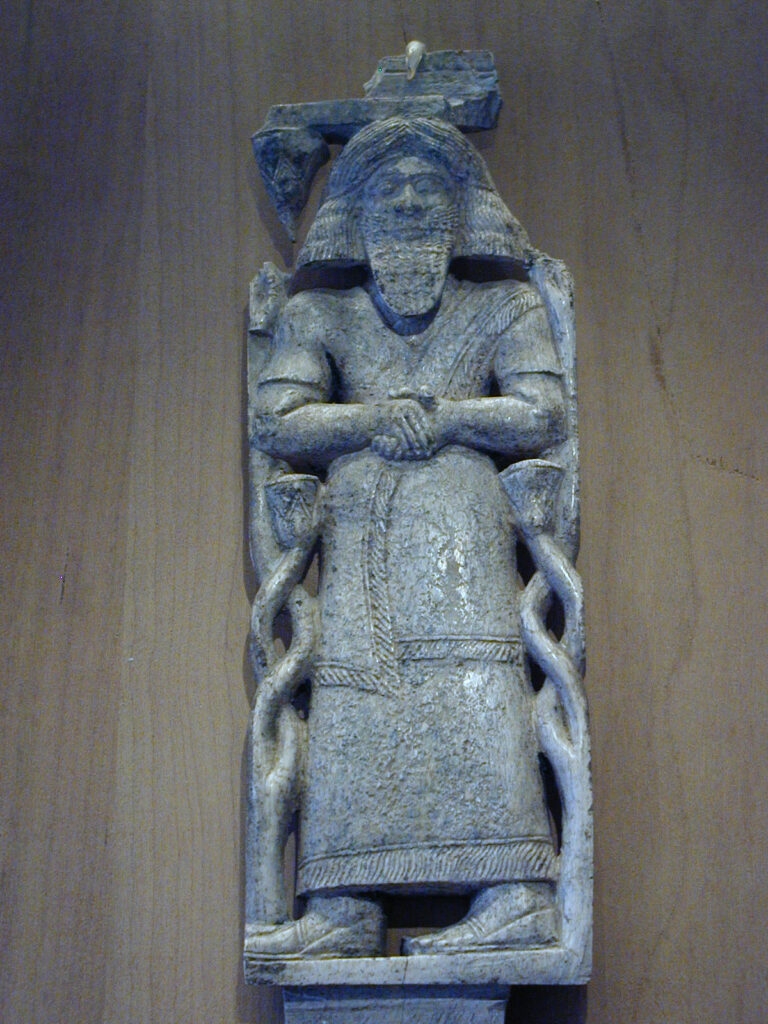
Earlier I argued that during the late ninth and early eighth century BCE a relatively stable regional order existed in the Levant. Before that system emerged, however, one ruler briefly came closer than anyone else to establishing his dominance over all of Syria: Hazael of Damascus.
Hazael is one of the most remarkable figures of the ninth-century Levant. Unlike many contemporary kings, he was probably not born into a royal dynasty. According to the Books of Kings, he served at the court of the former king Ben-Hadad II before seizing the throne around 843 or 842 BCE. The biblical account describes how he assassinated his master after being informed by the prophet Elisha that he would one day become king. Whether or not every detail of this story is historical, few scholars doubt that Hazael was a usurper.
Hazael and the Assyrians
His accession may also help explain an otherwise curious development in Assyrian policy. In 841 BCE, shortly after Hazael seized power, Shalmaneser III launched a major campaign against Damascus. Traditionally, this campaign has been viewed as another episode in the long struggle between Assyria and Damascus that began with the coalition at Qarqar in 853 BCE. Yet the timing raises interesting questions.
By the 840s BCE, Assyria’s relations with several western states appear to have become less confrontational. Irhuleni of Hamath remained independent, despite various military confrontations with Assyria, and there are indications that Shalmaneser increasingly preferred a balance of power in the region to outright conquest. It is therefore possible that an understanding had emerged between Assyria and Ben-Hadad II of Damascus similar to the arrangement that seems to have existed with Irhuleni of Hamath. If so, Hazael’s coup may have upset an emerging balance of power. From an Assyrian perspective, a usurper who suddenly controlled Damascus and sought to consolidate his position may have appeared far more threatening than his predecessor.
When Shalmaneser III marched against Damascus in 841 BCE, Hazael gathered a large army to resist him. The Assyrians claimed to have inflicted enormous casualties and devastated the countryside around Damascus. As always, such claims should be treated cautiously. The campaign itself demonstrates how seriously Assyria regarded the new ruler. More importantly, it’s ultimate failure is clear. Hazael remained on the throne and within a few years began a period of expansion that would make him the most powerful ruler in the Levant.
Building a Damascene empire
The evidence for this expansion comes from several independent sources. The Books of Kings portray Hazael as the principal enemy of Israel for much of the second half of the ninth century BCE. According to the biblical authors, he repeatedly defeated the Israelites, conquered large territories east of the Jordan, and reduced their military strength to a shadow of its former self.
Hazael’s ambitions extended beyond Israel. The biblical narrative states that he captured the Philistine city of Gath, one of the most important urban centres of southern Palestine, before advancing toward Jerusalem itself. Whether or not every detail is accurate, the overall picture is clear. Damascus was projecting military power deep into the southern Levant.
Archaeological evidence supports this picture. The famous Tel Dan Stele, discovered in northern Israel, is generally attributed to Hazael. The inscription celebrates victories over the kings of Israel and Judah and contains the earliest known extra-biblical reference to the House of David. Although the text is fragmentary, its tone is unmistakable. The author presents himself as a conqueror reshaping the political order of the southern Levant, revealing the extent of Damascene royal ideology and political ambition.
Taken together, the Assyrian inscriptions, the biblical narratives and the Tel Dan Stele suggest that Hazael achieved something unprecedented in the post-Qarqar Levant. Damascus was no longer merely one kingdom among many. For roughly a generation it occupied a position of regional supremacy.
An empire built on opportunity
Hazael’s greatest successes coincided with a period in which Assyria became increasingly distracted by internal problems. During the late reign of Shalmaneser III, in the 820s BCE, the Assyrian Empire was weakened by civil war. The western campaigns that had once constrained Syrian rulers became less frequent. This created an opportunity that Hazael exploited with remarkable skill.
For a brief moment, Damascus resembled a regional empire. Its authority extended far beyond its traditional heartland, neighbouring rulers were forced to accommodate its interests, and no rival state possessed the strength to challenge it directly. Yet this dominance rested on fragile foundations. Unlike the Assyrian Empire, Damascus lacked a large administrative apparatus capable of permanently integrating conquered territories. Hazael’s power was hegemonic rather than imperial in the later Assyrian sense. It depended on military prestige and personal authority rather than provincial administration.
The return of multipolarity
When Hazael died around 805 BCE, his son Ben-Hadad III inherited a kingdom that appeared powerful but was already beginning to unravel. Within a few years, the Assyrian king Adad-nirari III campaigned against Damascus and extracted tribute. Israel recovered territories lost during Hazael’s reign and the Damascene sphere of influence gradually contracted.
No ruler would again achieve the same level of dominance in Syria. Instead, the region evolved into a more fragmented and competitive system in which states such as Damascus, Hamath, Luḫuti and Arpad balanced one another’s power through alliances and rivalries. This is the political world reflected in the Zakkur inscription a few decades later.
In this sense, Hazael occupies a unique place in Levantine history. He was neither the founder of a lasting empire nor merely another local king. Rather, he represents the final successful attempt by an Aramaean ruler to establish regional hegemony before Syria settled into the balance-of-power system that characterized much of the eighth century BCE. His career demonstrates both the possibilities and the limits of political power in a world that remained too fragmented for any single kingdom to dominate for long.