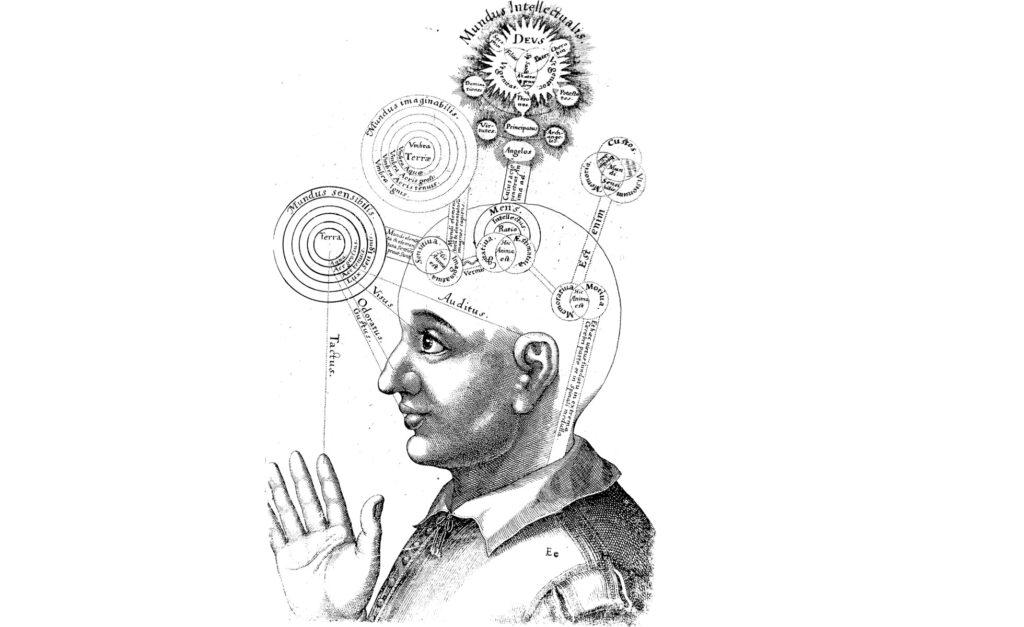
In my previous post, I explored Julian Jaynes’ bicameral mind hypothesis on its own terms. Taken seriously, it offers a strikingly coherent picture: ancient humans did not experience their thoughts as their own, but as the voices of gods. Seen through that lens, a wide range of otherwise puzzling features of ancient literature fall neatly into place. Divine commands, the absence of introspection, and the suspicion of acting “on one’s own” all begin to look less like metaphor and more like a fundamentally different way of experiencing thought.
That explanatory power is precisely what makes the hypothesis so attractive. But it is also a reason for caution. A theory that seems to explain everything risks explaining too much. Once adopted, it becomes easy to reinterpret any piece of evidence — any text, silence, or ambiguity — as confirmation. In that sense, it bears a resemblance to the ancient aliens “theory”, where the framework is so flexible that it becomes difficult to falsify.
And yet, Jaynes’ idea has not only attracted fringe enthusiasm. It has also intrigued prominent skeptical thinkers. Richard Dawkins once described it as “either complete rubbish or a work of consummate genius, nothing in between.” Daniel Dennett, too, has explored its implications. That combination — boldness, scope, and resistance to easy dismissal — helps explain its enduring appeal.
My own view lies somewhere in between. The strongest version of the theory — that ancient humans lacked introspective thought altogether and relied entirely on hallucinated voices — is not supported by the evidence. But the broader insight remains valuable: the way we experience our thoughts may not be fixed, but shaped by culture. In what follows, I outline three reasons why this “hard” version of the bicameral mind hypothesis is difficult to sustain: 1) it confuses cultural expression with cognitive capacity, 2) it underestimates human agency, and 3) it treats a gradual historical development as a fundamental divide in the human mind.
1) A matter of expression, not capacity
One of Jaynes’ most compelling insights is that references to gods in ancient texts are too common to dismiss as mere figures of speech. They likely reflect something real about how thought was experienced. Not every thought was automatically felt to belong to the individual. In certain contexts — especially religious or authoritative ones — thoughts could be experienced as coming from beyond the self and understood as divine.
But this does not require us to assume that ancient humans lacked a sense of self or the ability to reflect. That stronger claim — that there was no introspective awareness at all — goes beyond what the evidence can support. It asks us to deny not only the expression of inner life, but its very existence.
A more plausible reading is that the capacity for reflection was present, but not central. Ancient humans were likely just as capable of abstract, second-order thought as we are. What differs is the role this reflective self occupied. It was not the primary point of reference, but part of a broader framework in which society, tradition, and the gods took precedence.
This helps explain what we find in the sources. Personal doubts or inner deliberations may not be absent because they did not occur, but because they were not considered meaningful to record. What mattered was alignment with divine and social order, not the articulation of an individual inner life.
The difference, then, is not in cognitive ability, but in emphasis. Reflection was possible, but not foregrounded. The self existed, but was not central. And thoughts could be experienced in different ways — sometimes as one’s own, sometimes as something given — depending on the cultural context.
2) Agency does not disappear in a world of gods
Even in a strongly theocentric worldview, the sources presuppose a thinking subject. The idea that gods speak to humans implies a listener who can understand. A command only functions as a command if it is recognized, interpreted, and applied. Dreams, omens, and voices do not explain themselves. They require a human recipient capable of making sense of them.
This creates tension with the idea that deliberation played no role at all. If decisions were simply issued and obeyed, it becomes difficult to account for the interpretive work that these practices clearly involve. Understanding an omen or applying a divine command presupposes a subject who can reflect, distinguish, and respond.
The evidence instead points to a more complex situation. Thoughts could be experienced as external — as divine voices or signs — while still requiring active interpretation. People were not passive recipients of instructions, but participants in a process of meaning-making.
What differs, again, is not the presence of agency, but its framing. Decisions are not presented as “my choice”, but as aligned with divine will. The language of dependence does not eliminate agency, but relocates it. Humans act within a framework in which ultimate authority lies outside the self, and in which not every thought is automatically experienced or claimed as one’s own.
3) A gradual shift points to culture, not neurology
Jaynes himself, and many of his followers, accept that the transition from bicameral to conscious thought was gradual. But this concession has important implications. If there was no sharp break, it becomes difficult to pinpoint the transition from non-conscious tot conscious.
Instead, the evidence suggests a slow change in how mental processes are experienced and understood. Over time, introspective language becomes more common. The sense of a continuous, self-reflective “I” becomes more stable. Thoughts that may once have been experienced as external — as voices or commands — are increasingly internalized.
This points not to the sudden emergence of a new ability, but to the gradual reorganization of an existing one. The capacity for reflection was likely always there. What changed was its prominence, its expression, and its cultural support.
Rather than a shift from non-conscious to conscious humans, we are looking at a movement from a more externally framed experience of thought to a more internalized, self-centered one — a change in how thoughts are situated, not in whether they exist at all.
To whom do thoughts belong?
And yet, if the strongest version of Jaynes’ hypothesis does not hold, something important remains. Jaynes may be wrong in claiming that ancient humans lacked introspective thought altogether. But he is right to question something we usually take for granted: that our thoughts belong to us.
The idea that there is a coherent and continuous “I” at the center of our mental life — the author of our thoughts, the subject of our decisions — feels self-evident. But that feeling may itself be the product of a particular way of interpreting experience, one that has been culturally reinforced over time.
In that sense, the most valuable insight of the bicameral mind hypothesis is not that ancient people heard voices, but that the boundary between “my thought” and “something given” may not be as fixed as we assume. The experience of thought can take different forms. Not every thought must be claimed as one’s own, and not every mind must be organized around a strongly defined inner self. This resembles the Buddhist concept of no-Self: the claim that the coherent and continuous “I” we experience is not a fundamental reality, but an abstraction, or, in stronger terms, a construct, even an illusion.
Seen from that perspective, the difference between “hearing a voice” and “having a thought” begins to blur. Both can be understood as ways of interpreting mental events, rather than direct insight into their source. The modern sense that thoughts arise from within and belong to a stable self may itself be a kind of normalized experience, no less constructed than the voices attributed to gods in earlier cultures.
The cognitive shift in Mesopotamian history
Even if Jaynes was not right about everything, he may have been pointing in a direction worth taking seriously. The way we experience our own minds is not fixed. It can shift, and it has shifted.
In the next posts, I will explore how this transformation may have unfolded in practice. Rather than a sudden “breakdown” of the bicameral mind, we will look at a long-term development: how, over the course of centuries, a more group-oriented and god-oriented mode of consciousness in Mesopotamia gradually gave way to a more internalized, self-centered one, and what traces of that process can still be found in the sources.
A convincing assessment of Jaynes’ theory, Daan!