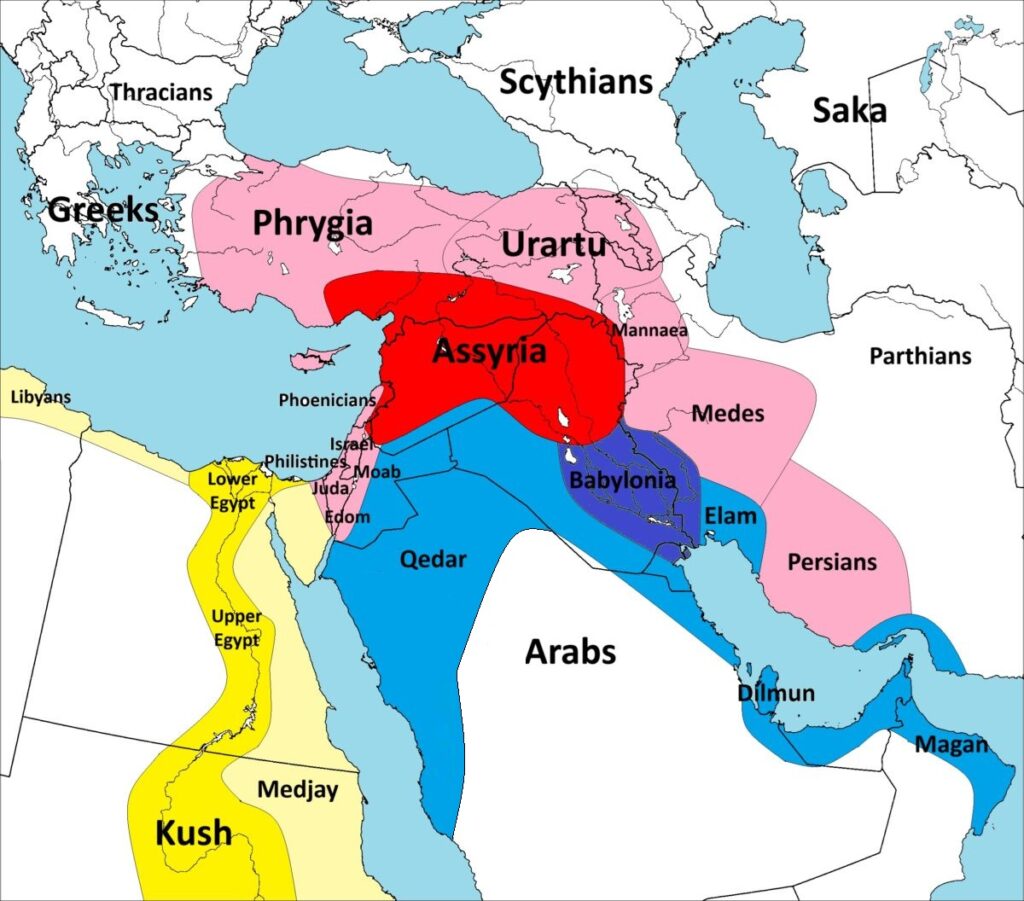
Map of an alternate Near East in 645 BCE, marking the 100th year anniversary of the Assyro-Babylonian alliance.
Assyria is shown in red, with allied and vassal states in light red.
Babylonia is shown in blue, with allied and vassal states in light blue.
Egypt is shown in yellow, with allied and vassal states in light yellow.
Author: Daan Nijssen ©
In my previous post, I argued that the collapse of the Neo-Assyrian Empire was not caused by a single weakness, but by a long chain of interconnected crises. After revisiting that argument, however, I increasingly came to suspect that many of those problems revolved around one central issue: Assyria’s attempts to dominate Babylonia.
Assyrian kings repeatedly intervened in Babylonian politics, either ruling Babylonia directly or installing unpopular puppet rulers. The result was a cycle of revolts, civil wars, and destructive campaigns that drained Assyrian resources for generations. Elam supported Babylonian rebels in order to create a buffer state against Assyria, dynastic struggles erupted within the Assyrian royal house, and entire reigns were consumed by conflicts in the south.
The most infamous example was Sennacherib’s destruction of Babylon in 689 BCE, which severely damaged Assyria’s legitimacy. Later, the revolt of Šamaš-šum-ukin, Ashurbanipal’s older brother who ruled as king of Babylon, devastated the empire further, until Nabopolassar finally restored Babylonian independence and contributed to Assyria’s destruction.
But what if Assyria had never become trapped in this cycle? What if Tiglath-pileser III had maintained a stable alliance with Babylonia instead of trying to dominate it directly?
745–734 BCE: The pact of kings
When Nabonassar (r. 747–734 BCE) became king of Babylon, Babylonia had endured decades of instability and tribal conflict. Only two years later, Tiglath-pileser III (r. 745–727 BCE) seized the Assyrian throne and began rebuilding Assyrian power.
The two rulers appear to have viewed one another not as rivals, but as useful partners against the Aramaean and Chaldaean tribes threatening both kingdoms. An informal Assyro-Babylonian alliance emerged: Assyria recognized Nabonassar’s dynasty, while Babylonia accepted Assyrian predominance in northern Mesopotamia and Syria. For the first time in generations, the Mesopotamian core stabilized.
734–729 BCE: The Babylonian civil war
The death of Nabonassar threatened this fragile balance. A rapid succession of coups culminated in the rise of the Chaldaean usurper Nabu-mukin-zeri.
Historically, Tiglath-pileser III invaded Babylonia and eventually crowned himself king of Babylon. In this alternate timeline, however, he chooses a different course. Presenting himself as defender of legitimate kingship, he invades Babylonia, defeats the Chaldaean tribes, and restores a nephew of Nabonassar — Nabu-ēreš I (r. 729–703 BCE) — to the throne.
This decision fundamentally reshapes Near Eastern history. Babylonia retains its own dynasty, while Assyria gains a loyal southern ally. Elam loses much of its influence in Mesopotamian affairs, and Chaldaean resistance becomes increasingly isolated in the southern marshes.
729–710 BCE: The great consolidation
Freed from endless intervention in Babylonia, Assyria turns outward. Under Shalmaneser V (r. 727–710 BCE), Assyria consolidates its control over Syria and Cilicia. Unlike in real history, Shalmaneser is never overthrown by Sargon II. With a stable Assyria not distracted by Babylonian affairs, Israel, Judah, and Mannaea remain loyal vassals, allowing Assyria to focus on long-term frontier strategy rather than constant rebellions.
Rather than launching endless campaigns deep into the Armenian Highlands, Assyria constructs a vast network of military roads, fortresses, and buffer states along the Taurus and Zagros Mountains, creating a cordon sanitaire against its main rival Urartu.
Meanwhile, Babylonia under Nabu-eres (r. 729–703 BCE) faces one final challenge to the new Assyro-Babylonian order. Around the middle of his reign, the Chaldaean leader Marduk-apla-iddina II rises in revolt in the Sea Land. Unlike in real history, however, he receives little outside support. Most Babylonian cities remain loyal to Nabu-ēreš, while only Bīt-Yakīn and a handful of neighboring tribes join the rebellion.
With the aid of Shalmaneser V, Nabu-ēreš launches a coordinated campaign into southern Babylonia. The marshes of the Sea Land are gradually subdued, Bīt-Yakīn is broken, and Marduk-apla-iddina is executed after having been denied entry into Elam. The revolt ultimately strengthens the alliance rather than weakening it.
Once the Sea Land has been secured, Babylonia increasingly turns outward toward maritime trade. Royal expeditions begin sailing regularly to Dilmun and Magan, laying the foundations for Babylonian commercial expansion across the Persian Gulf.
Egypt also adapts to the new geopolitical reality. Recognizing that the Levant lies firmly within the Assyrian sphere, Egyptian rulers largely abandon attempts to dominate Syria-Palestine. Instead, they focus westward and southward, expanding commercial influence along the Mediterranean coast across Libya and throughout the Red Sea basin toward East Africa.
710–679 BCE: The Mountainous Crescent
During the reign of Aššur-bēl-kala II (r. 710–679 BCE), Assyria’s frontier system begins reshaping the political geography of the Near East. Under mounting Cimmerian pressure, Urartu weakens severely and eventually submits as an autonomous Assyrian client kingdom guarding the Armenian Highlands. Phrygia also enters the Assyrian alliance system. Protected on its eastern frontier, it expands westward across much of Anatolia.
Assyria now dominates the entire “Mountainous Crescent” surrounding Mesopotamia: the Armenian Highlands, the Taurus Mountains, and the Zagros frontier.
At the same time, Babylonia experiences a demographic and economic boom under Marduk-zakir-šumi III (r. 703–676 BCE). Irrigation systems expand, population increases, and Babylonian merchants establish permanent colonies along the Persian Gulf. Dilmun and Magan gradually become Babylonian client states, while Elam declines into dependency.
Egyptian maritime power also expands rapidly. Trade routes linking the Nile Valley, Arabia, and East Africa become increasingly important, laying the foundations for closer contact with regions later associated with Aksum.
679–665 BCE: The age of raids
The stability of the Assyro-Babylonian world is increasingly tested by Cimmerian and Scythian migrations. Raids sweep through the Armenian Highlands and frontier regions, threatening Urartu and Phrygia.
Unlike in real history, however, Assyria now possesses a broad network of loyal buffer states capable of absorbing the initial shock. More importantly, Assyria itself is no longer weakened by constant crises in Babylonia.
Under Aššur-erība (r. 679–624 BCE), Assyrian armies repeatedly intervene to stabilize allied kingdoms, while the imperial military elite becomes increasingly multiethnic. Medes, Persians, Armenians, and Mannaeans begin playing a major role within the army and administration.
Meanwhile, Babylonia expands its maritime networks dramatically under Nabu-apla-iddina II (r. 676–656 BCE). Trade routes linking Mesopotamia to the Indian Ocean become increasingly regular, while Babylonian temple schools evolve into major scholarly centers devoted to astronomy, mathematics, medicine, and textual preservation.
665 BCE – ???: Pax Mesopotamica
By the mid-seventh century BCE, the Near East enters a long period of relative stability known as the Pax Mesopotamica.
Assyria gradually transforms from a conquering empire into a multiethnic military commonwealth guarding the Mesopotamian heartland and its surrounding frontiers. Peripheral elites become deeply integrated into the imperial system, while the Assyrian heartland remains its political and logistical center.
At the same time, Babylonia enters a Golden Age under Marduk-apla-uṣur (r. 656–633 BCE) and Nabû-mukīn-zēri II (r. 633–587 BCE). Chaldaean tribes become increasingly integrated into settled Akkadian civilization, while Arabs linked to the Qedarites emerge as merchants and military auxiliaries.
Babylonian astronomy, mathematics, and maritime trade flourish on an unprecedented scale. Commercial routes now connect Mesopotamia to the Persian Gulf, the Mediterranean, Arabia, India, and East Africa. Egypt, meanwhile, evolves into the dominant naval and commercial power of the Red Sea.
Together, Assyria and Babylonia dominate the Near East in complementary ways: Assyria controls the military and political systems of the north and east, while Babylonia dominates the commercial and maritime networks of the south.
Map of an alternate Near East in 645 BCE, marking the 100th year anniversary of the Assyro-Babylonian alliance.
Assyria is shown in red, with allied and vassal states in light red.
Babylonia is shown in blue, with allied and vassal states in light blue.
Egypt is shown in yellow, with allied and vassal states in light yellow.
Author: Daan Nijssen ©
La longue durée
Beyond this point, the timeline becomes too speculative to predict with confidence. By the mid-seventh century BCE, the divergence from real history would already be enormous.
Still, some broader developments seem likely. Both Assyria and Babylonia would probably survive far longer than they did historically. Without endless Babylonian revolts and destructive southern campaigns, Assyria remains more stable and cohesive, while Babylonia avoids centuries of devastation.
The Medes and Persians would likely still rise in importance, but within the framework of a durable Assyro-Babylonian system rather than in the power vacuum created by Assyria’s collapse.
A surviving Mesopotamian superpower extending into the sixth or fifth century BCE would also interact more extensively with the emerging Greek and Punic worlds. Greek mercenaries, traders, and scholars might increasingly enter Mesopotamian service, while Babylonian astronomy and imperial administration could exert even greater influence on the Mediterranean.
At the same time, Babylonian maritime expansion might bring Mesopotamia into growing competition with Phoenician and Carthaginian trade networks.
Yet even this alternate Assyro-Babylonian order would not last forever. Over the longer term, its greatest threats might come from the Eurasian steppe – from Scythian confederations, Yuezhi migrations, or even Turkic invasions – or from gradual internal transformation. Peripheral peoples such as Medes, Persians, or Arabs could eventually dominate the imperial military and administration, perhaps even producing Iranian dynasties in Assyria or Arab dynasties in Babylonia.
Conclusion
That is ultimately what makes this thought experiment interesting. It suggests that Assyria’s attempts to dominate Babylonia may have destabilized the empire from within, while a stable partnership between the two kingdoms could have reshaped the history of the ancient Near East.
Instead of exhausting themselves through centuries of revolt and repression, Assyria and Babylonia might together have formed a remarkably durable political, military, and economic system. Assyria’s military power and control over the highland frontiers would have complemented Babylonia’s commercial and maritime influence in the south.
Under such conditions, Mesopotamian civilization might have remained one of the central engines of Afro-Eurasian history for centuries longer than it did in reality.