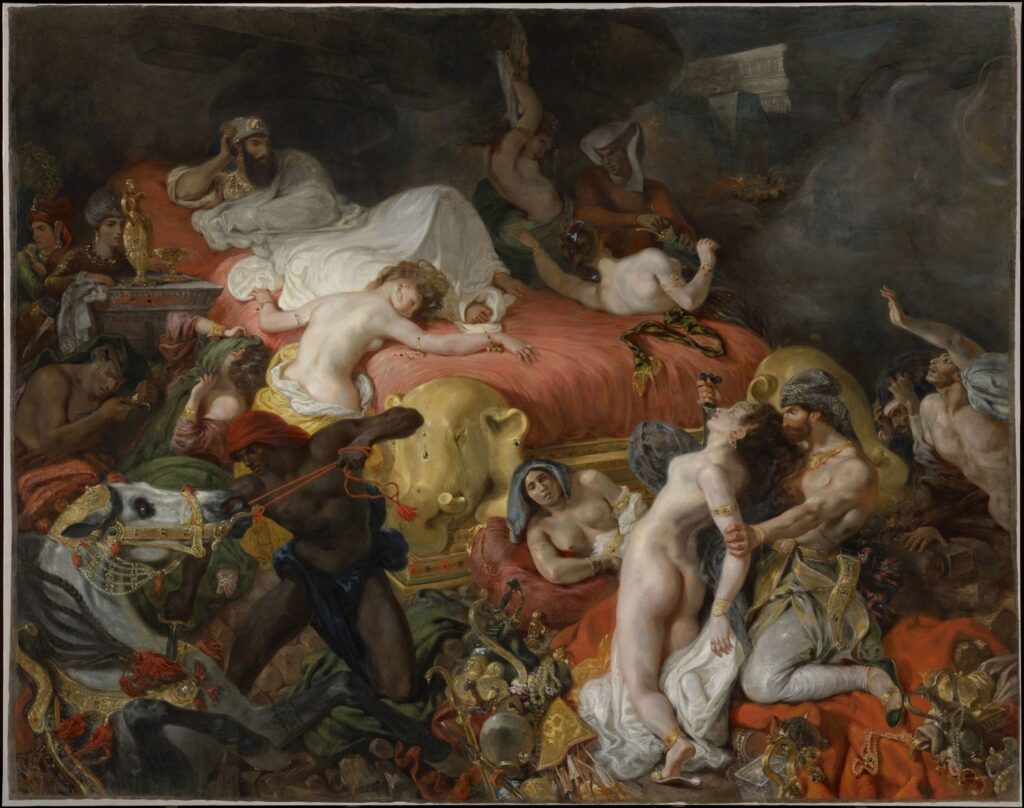
The flames must have been visible for miles. In 612 BCE, after a long siege, a coalition of Babylonians and Medes stormed the Assyrian capital of Nineveh. Temples burned. Palaces were looted. Statues were smashed or buried beneath rubble. The great imperial city that Assyrian kings had called “the city without equal” was transformed into ruins.
For more than two centuries, the Neo-Assyrian Empire had dominated the Near East. Its armies had marched from the Zagros Mountains to the Mediterranean Sea, from Anatolia to Egypt. Kings such as Ashurbanipal and Sargon II had presented themselves as rulers of the world itself, chosen by the gods to impose order upon all lands. And yet, within a few years, this seemingly invincible empire disappeared almost entirely.
The standard explanation for Assyria’s collapse is straightforward enough. Following the death of Ashurbanipal, the empire was weakened by civil war and instability in the Assyrian heartland. Nabopolassar revolted in Babylonia in 626 BCE, while the Medes under Cyaxares attacked from the east. Together, they exploited a moment of weakness and destroyed the empire.
This explanation is not wrong. But it does not explain everything. The Neo-Assyrian Empire had survived civil wars before. It had survived revolts, invasions, dynastic crises, and military defeats. Why, then, did this crisis destroy the empire, when earlier crises had not? Why had Assyria become unable to absorb instability? To answer that question, we must move backward through time.
Ashurbanipal’s Pyrrhic victories
To later generations, Ashurbanipal appeared as the embodiment of Assyrian greatness. He presented himself not merely as a conqueror, but also as a scholar and a sage. In his inscriptions, he boasted that he could read ancient texts and master scribal knowledge alongside the arts of war. Modern images of Assyria’s “golden age” are often closely tied to his reign.
Yet beneath this image of imperial confidence lay deep structural strain. Ashurbanipal spent much of his reign fighting exhausting wars across the empire. In Egypt, Assyrian armies repeatedly intervened to suppress rebellions and restore Assyrian authority, but the region ultimately slipped from imperial control anyway. In Elam, to the east, Assyria launched devastating campaigns that culminated in the destruction of Susa, yet Elam remained a persistent source of instability for decades.
Most dangerous of all was the revolt of Ashurbanipal’s brother, Šamaš-šumu-ukin, who ruled Babylon as king under Assyrian supremacy. In 652 BCE, the conflict exploded into a massive civil war. The rebellion attracted support not only from Babylonians, but also from Chaldaeans, Aramaeans, Arabs, Elamites, and possibly even Egypt. Large parts of the empire rose against Assyrian domination simultaneously.
Ashurbanipal eventually prevailed. Babylon was starved into submission. The rebellion collapsed. Assyria remained intact. But the victory came at enormous cost. The civil war revealed how fragile imperial cohesion had become. Entire regions were willing to unite against Assyria the moment central authority weakened. Moreover, the war devastated Babylonia, one of the wealthiest and most strategically important regions of the empire. The Assyrian state survived, but it emerged exhausted.
Indeed, the final decade of Ashurbanipal’s reign is strikingly obscure. The king who once campaigned relentlessly seems to have withdrawn increasingly from active warfare. Assyria still looked powerful from the outside, but the empire was beginning to show signs of overstretch.
Was it therefore Ashurbanipal’s failure that caused Assyria’s collapse? Not entirely. That would place too much responsibility on a single ruler. Ashurbanipal inherited many of these problems from his father.
The burden of Esarhaddon
Esarhaddon inherited the throne under dramatic circumstances. His father, Sennacherib, had been murdered by his own sons in 681 BCE. Esarhaddon himself had to fight a civil war to secure the throne. Even before he became king, Assyria was already struggling with dynastic instability.
Esarhaddon attempted to heal some of the wounds left by his father’s reign. Most famously, he restored Babylon, which Sennacherib had destroyed in 689 BCE. This was not merely a rebuilding project, but also an ideological act. Babylon possessed immense religious prestige throughout Mesopotamia, and its destruction had shocked much of the region. By restoring the city, Esarhaddon attempted to repair Assyria’s legitimacy.
At the same time, however, Esarhaddon pursued enormously ambitious military projects. Most notably, he invaded Egypt and briefly brought it under Assyrian control. This was perhaps the greatest territorial expansion in Assyrian history.
But conquering Egypt was one thing. Holding it was another. The Egyptian campaigns required huge logistical efforts and repeated military interventions far from the Assyrian heartland. They stretched imperial resources across unprecedented distances. Meanwhile, Esarhaddon also fought campaigns against the Medes, the Cimmerians, and the Scythians. Not all of these wars were successful.
The king himself appears to have ruled under constant anxiety. Court conspiracies repeatedly emerged. Divination texts reveal a ruler obsessed with omens and threats. Esarhaddon suffered from chronic illness and paranoia, and the court became increasingly consumed by succession politics.
Ironically, his attempt to secure stability may have contributed directly to future instability. Esarhaddon divided authority between his two sons: Ashurbanipal would rule Assyria, while Šamaš-šumu-ukin would rule Babylon. The arrangement may have seemed practical, but it recreated precisely the political dualism that had long destabilized Assyrian-Babylonian relations. The catastrophic civil war under Ashurbanipal was therefore rooted partly in Esarhaddon’s own succession policy.
But Esarhaddon, too, inherited a difficult situation.
Sennacherib and the destruction of Babylon
Sennacherib came to the throne in 705 BCE under ominous circumstances. His father, Sargon II, had died in battle in Anatolia, and his body was never recovered. In Mesopotamian thought, such a death was deeply disturbing. A king who died violently and remained unburied appeared abandoned by the gods.
The effect was immediate. Revolts erupted across the empire, especially in Babylonia. Much of Sennacherib’s reign was spent suppressing rebellions. Babylon repeatedly resisted Assyrian control, often with Elamite support. The conflict dragged on for years and consumed enormous resources. Eventually, after yet another rebellion, Sennacherib made a drastic decision. In 689 BCE, he destroyed Babylon itself. Temples were demolished, canals diverted, and large parts of the city systematically ruined.
From a military perspective, the decision may have seemed understandable. Babylon had become a permanent source of rebellion. But politically and ideologically, the destruction was disastrous. Babylon was not just another rebellious city. It was one of the oldest and most prestigious religious centers in Mesopotamia. Destroying it horrified many contemporaries, including Assyrians themselves. The act seems to have damaged Assyria’s legitimacy throughout the region. Esarhaddon’s later restoration of Babylon only makes sense against this background. He was trying to undo the damage caused by his father’s policies.
But Sennacherib’s difficulties themselves were not created in isolation.
Sargon II and the costs of expansion
Sargon II is often remembered as one of Assyria’s greatest rulers. He defeated rivals, expanded imperial control, and founded a magnificent new capital at Dur-Šarrukin. Yet much of his reign was spent fighting revolts and external enemies simultaneously. Babylonia rebelled repeatedly. Urartu remained a dangerous rival in the north. Egypt supported anti-Assyrian coalitions in the Levant. Elam interfered constantly in Babylonian affairs. Even distant powers such as Phrygia entered Assyria’s geopolitical horizon.
Sargon ultimately prevailed in most of these struggles. But victory came at a price. The empire required constant military mobilization simply to maintain itself. The sheer scale of resistance is revealing. Assyria was feared, but it was also deeply hated. The empire increasingly depended on coercion, deportation, and direct annexation. These methods generated immense power, but also widespread resentment. And this points us further backward still.
Tiglath-pileser III and the beginning of the problem
Many historians regard Tiglath-pileser III as the true founder of the Neo-Assyrian Empire. Beginning in the mid-eighth century BCE, he transformed Assyria into a far more aggressive and centralized imperial state. Earlier Assyrian kings had often relied on tributary kingdoms and indirect control. Tiglath-pileser increasingly replaced these arrangements with direct annexation. Local rulers were removed and replaced with Assyrian governors. Populations were deported on a massive scale. The empire expanded rapidly in multiple directions.
This expansion was not irrational. Assyria faced genuine geopolitical threats, especially from Urartu, whose expansion threatened Assyrian access to the Mediterranean and northern trade routes. Tiglath-pileser’s reforms and conquests were highly effective in the short term. But they also transformed the nature of the empire. Assyria was now ruling larger territories, more directly, over increasingly hostile populations. Expansion intensified rivalry with neighboring powers. The empire became more militarized, more centralized, and more dependent on continuous campaigning.
In many ways, the same processes that made Assyria extraordinarily successful also made it increasingly fragile. The empire expanded faster than it could politically integrate its conquests. Every victory generated new frontiers, new enemies, and new logistical burdens. The system worked brilliantly under strong kings. But it also created conditions in which imperial crises could become existential. By the time Nineveh fell in 612 BCE, many of the forces that destroyed Assyria had therefore been developing for generations.
Rethinking imperial collapse
So when did the Assyrian Empire begin to collapse? Was it after Ashurbanipal exhausted the empire through endless warfare? Was it when Esarhaddon overstretched Assyrian power into Egypt? Was it when Sennacherib destroyed Babylon and deepened Mesopotamian resentment? Was it when Sargon II spent his reign fighting rebellions on multiple fronts? Or was it already during the great expansion under Tiglath-pileser III?
The answer is perhaps all of them. History rarely divides itself neatly into phases of “rise,” “zenith”, and “collapse”. The seeds of decline are often planted during periods of greatest success. Expansion creates new obligations. Victory creates new enemies. Solutions generate new problems. From this perspective, the fall of Assyria was not simply the sudden destruction of a stable empire. It was the culmination of generations of accumulated strain, escalating commitments, and unresolved tensions.
That does not mean Assyria’s collapse was inevitable. History is never fully predetermined. Different kings might have made different choices. Revolts might have failed. Coalitions might have collapsed. The empire survived many crises that could easily have destroyed it earlier. And yet, the further we trace events backward, the more difficult it becomes to isolate a single cause. Every crisis emerged partly from attempts to solve earlier crises. Every king inherited problems created by his predecessors while creating new problems for his successors.
Perhaps that is the real lesson of Assyria’s fall: empires do not collapse because history suddenly turns against them. They collapse because the very processes that create imperial power can, over time, also undermine it.