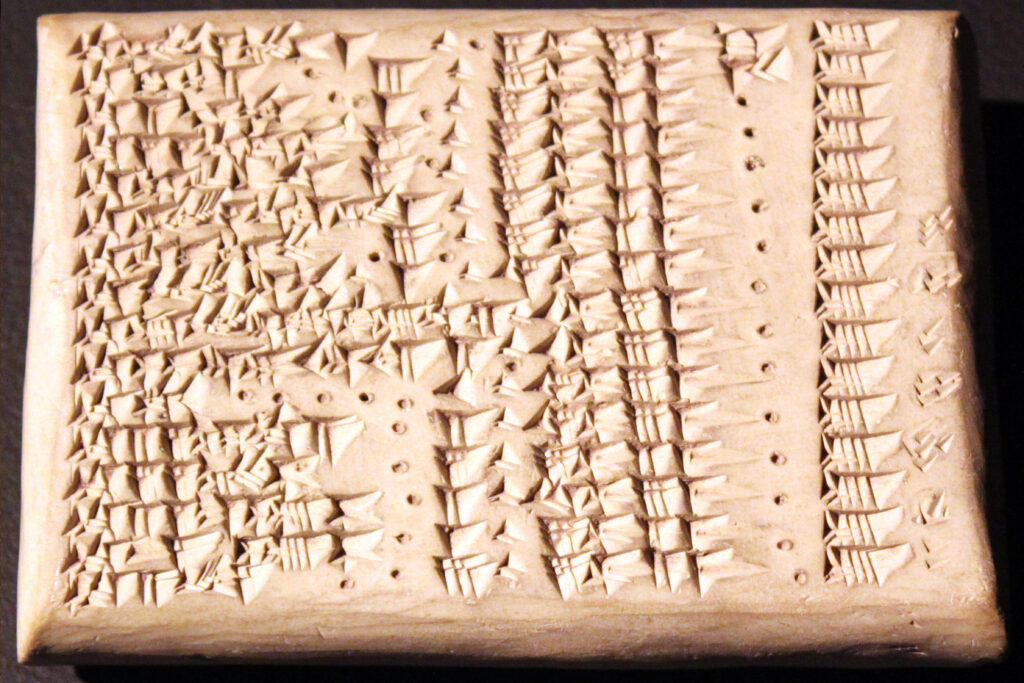
Anagoria, CC BY 3.0 https://creativecommons.org/licenses/by/3.0, via Wikimedia Commons
In the previous post, I argued that the difference between ancient and modern thought is not a matter of capacity, but of orientation: a shift from an externally framed experience of thought to a more internalized one. But what does such a shift look like in practice? One place where we can see this process unfold is Mesopotamia, where the relationship between humans, gods, and thought itself was worked out in strikingly concrete ways.
Ancient Mesopotamians believed they could “read” the world around them like a book. Nothing happened in isolation. The movement of the stars, the shape of a sheep’s liver, a sudden storm, an unusual birth, a dream in the night: each of these could reveal something about what lay ahead. The universe was seen as a dense web of connections in which the will of the gods was always present.
To modern readers, this may look like a system of “messages” sent by the gods. But that is slightly misleading. These signs were not so much messages as they were symptoms: visible expressions of deeper processes in a world where everything was connected. The task of the diviner was not to receive a message, but to interpret a pattern.
Divination and the silence of the gods
Why did people think the world could be read in this way? One of the most striking answers was proposed by Julian Jaynes. His theory of the bicameral mind is bold and controversial. According to Jaynes, ancient humans did not experience their thoughts as their own. Instead, they heard them as the voices of gods. Decisions were not made internally, but given from outside.
According to this view, Mesopotamian divination appeared when the voices of the gods fell silent. Without direct guidance, people began to develop indirect methods — astrology, extispicy, omen interpretation — to recover access to the divine will. It is an intriguing idea. But it raises some serious problems. More importantly, it obscures what Mesopotamian divination actually shows: not the absence of thought, but a different way of organizing it.
The problem with hearing voices
Jaynes’ model depends on a specific mechanism: one part of the brain produces commands, which are then experienced by another part as external voices. But this raises a basic question: why does the brain need to hear a voice at all? If a command comes from within the brain, why must it first be heard before it can be followed? Why not a direct link between impulse and action?
The idea of a “voice” is not a small detail. It does most of the heavy lifting in the theory. It turns something internal into something that feels external. But that step itself needs explaining. Why would the brain represent its own activity in such a way?
There is another issue. Understanding a command and applying it appropriately is a complex process that requires a flexible integration of context, memory, and judgment. It is not a purely automatic response. Just look at all the misunderstandings that arise between people when giving even the most clear and literal commands. The line Jaynes draws — between a mind that can only hear and obey, and a mind that can reflect and choose — becomes difficult to maintain. The very capacities required to “hear the voice of a god” already suggest a system capable of more than passive execution.
The problem of transition
This tension becomes even clearer when we consider how such a system could break down. Jaynes describes early humans as “noble automatons,” unable to misunderstand or disobey the voices they heard. But if the system was truly this rigid, it is difficult to see how it could ever begin to fail at all. A mind that can only obey cannot suddenly begin to doubt.
Jaynes’ explanation is that increasing social complexity made the voices less reliable. Faced with novel situations, people no longer received clear guidance, which led to confusion and eventually to conscious thought. But this explanation presupposes precisely what it seeks to explain. To notice that voices are unreliable, to compare alternatives, and to act without clear instruction requires interpretation, evaluation, and choice. In other words, it requires the very flexibility that the bicameral mind is supposed to lack.
The result is a dilemma. Either early humans were capable of such flexibility, in which case the distinction between “hearing and obeying” and “reflecting and choosing” collapses. Or they were not, in which case the transition to conscious thought becomes difficult to explain. The “breakdown of the bicameral mind” does not so much account for the emergence of these capacities as it reveals that they must already have been present.
A missing break in the record
Even if we ignore these conceptual problems, there is a historical issue. Jaynes’ theory suggests a shift from relying on voices to using divination. But in the Mesopotamian record, this shift is hard to find. Divination is not a late invention. It is already highly developed in the early second millennium BCE. The great omen series Enūma Anu Enlil, which lists celestial signs and their meanings, has roots going back at least this far. By the time it reaches its full form, it reflects centuries of careful observation and organization.
This is not what we would expect from a system that suddenly appears to replace something else. It looks more like a long-term intellectual project. One built precisely because signs were not clear or self-interpreting, but required systematic analysis.
Over generations, scholars collected and refined knowledge. If a lunar eclipse happens at a certain time, it has a specific meaning. If a sheep’s liver shows a certain feature, it points to a particular outcome. If planets appear in a certain pattern, it signals political change. These interpretations were recorded in structured series, taught in scribal schools, and used in royal decision-making.
Divination and the search for order
What Mesopotamian divination reveals is not the absence of thought, but a different way of organizing it. They looked to the outside world for guidance more than we do, and based themselves on signs we would never consider to be meaningful. But because the signs were often ambiguous, they required interpretation, comparison, and judgment in order to arrive at decisions, which is very much an “internal” process.
This effort becomes even clearer in the first millennium BCE. Under the Babylonian king Nabonassar (r. 747-734 BCE), several important developments take place: the calendar was standardized, the Astronomical Diaries began — recording observations of the sky and events on earth — and historical chronicles started being compiled. Together, these show a growing effort to track patterns over time. This marks a subtle but important shift: authority no longer lay primarily in the external signs, but in the system used to interpret it.
This trend continues in the Seleucid period (312-141 BCE), when Babylonian scholars developed advanced mathematical models to predict planetary movement. The introduction of personal horoscopes pushes this development further. What had once been a matter of interpreting signs for the state or king becomes a matter of calculating patterns for the individual. The locus of meaning begins to move. Instead of interpreting one sign at a time, scholars begin to calculate patterns across time. Divination becomes more abstract, more precise, and more personal.
From external signs to inner logic
These developments can be placed in a broader historical context often referred to as the “Axial Age”: a period from roughly 800 to 200 BCE, in which cultures across the Old World — from Greece to Judah and from India to China — began to place greater emphasis on inner reflection, ethical reasoning, and the examination of the self. The Axial Age marked a shift in where reflection was located: from the world to the individual.
The systematization of Mesopotamian divination fits within this broader pattern. As signs were collected, compared, and organized into increasingly formalized systems, authority shifted from the individual omen to the methods used to interpret it. Meaning was no longer simply encountered in the world, but constructed through structured procedures of analysis. This introduced a new level of abstraction and distance: decisions depended less on immediate signs and more on the frameworks through which they were understood. In that sense, divination did not remain purely external. It became mediated by systems that required reflection on rules, patterns, and interpretation itself.
In Mesopotamia, however, this shift does not begin abruptly in the first millennium. The tendency towards systemization starts already in the late second millennium BCE. Around the same time, we find texts that focus increasingly on personal doubt, suffering, and the search for meaning, also suggesting a movement inward had begun well before the period traditionally associated with it. It is to these texts, and to the question of what they reveal about the changing experience of the self, that the next post will turn.