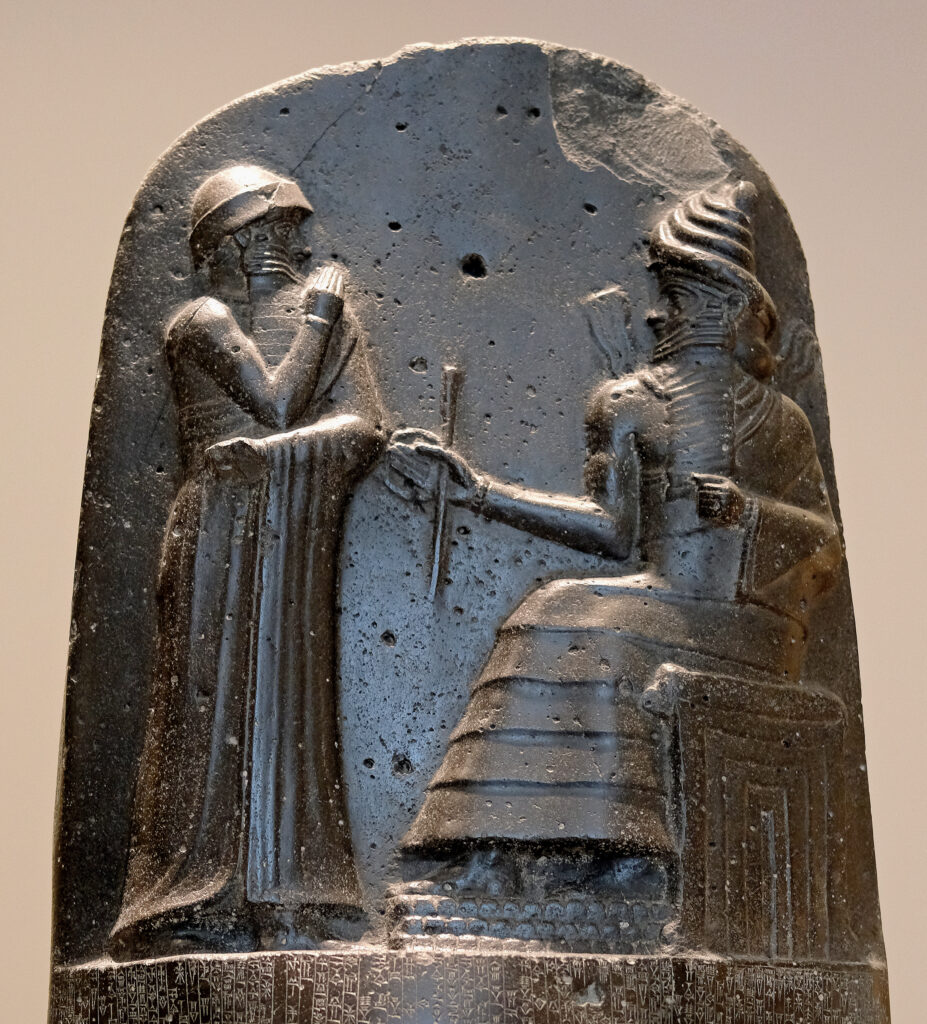
Louvre, Paris. Credits: Hammurabi, CC BY 3.0 https://creativecommons.org/licenses/by/3.0, via Wikimedia Commons
When reading ancient Mesopotamian literature, one is struck by a remarkable feature: the gods are not merely distant or hypothetical beings, they constantly appear to humans and speak to them directly. Mesopotamian texts abound with accounts of gods commanding kings to go on campaign, warning of impending disasters, prescribing in detail how temples should be built, dictating laws, or appearing in dreams. Likewise, when kings reflect on their achievements, they do not attribute them to their own judgment or skill, but to the will of a deity who guided them. To act “of one’s own design,” without consulting the gods, is not portrayed as admirable independence, but as a dangerous deviation.
Modern readers tend to treat such passages as rhetorical. Of course the king did not literally hear a god, he merely expressed his decision in religious language. Yet the consistency and seriousness of these accounts raise a more unsettling possibility: what if this was not just a way of speaking, but a way of experiencing? More specifically, what if the thoughts behind these decisions were not experienced as belonging to the individual in the way we assume our own thoughts belong to us?
A different kind of mind
This is precisely the possibility raised by Julian Jaynes’ bicameral mind hypothesis. Drawing not only on Mesopotamian sources, but also on Egyptian, Greek, and Hebrew literature — all of which contain accounts of gods speaking directly to humans — Jaynes proposes that such experiences were not merely literary conventions, but reflected a different mode of cognition. Crucially, his claim is not simply that some people occasionally heard voices. Rather, it is that what we call “thinking” was organized differently.
In Jaynes’ view, ancient people did not usually think in the reflective, self-directed way we are used to. They did not experience themselves as stepping back from their own thoughts, weighing options, and making a conscious choice. What was different was not their intelligence, but how they experienced thinking. They lacked the sense of an inner space in which a single “I” reflects, narrates, and decides. When action was required, responses still arose, but they were not felt to come from within. Instead, they appeared as given, often in the form of voices attributed to gods.
Jaynes connects this to basic features of the brain. The human brain can generate its own speech, something we experience today as our inner voice. Under certain conditions, however, this inner speech can be experienced as coming from outside. This also happens in modern cases of voice-hearing. Jaynes suggests that in earlier societies, this was not rare or pathological, but a normal and culturally supported way of experiencing thought. What we would now experience as “my thought” could then be experienced as “a voice.”
From this, he develops the idea of the “bicameral mind”: a way of organizing the mind in which its functions are effectively split. One part of the brain produces responses to complex situations, drawing on memory and learned patterns, the other experiences these responses as external instructions and acts on them. The key difference with modern thought is not what the brain can do, but how its activity is experienced. Thinking takes place, but it is not experienced as one’s own.
The birth of the self
Jaynes further argues that this system began to break down toward the end of the second millennium BCE. As societies grew larger, more interconnected, and more unstable — through trade, migration, and political upheaval — older systems of authority came under pressure. Different traditions came into contact, commands could conflict, and divine guidance became less reliable. In such a situation, relying on external voices became increasingly difficult.
According to Jaynes, this led to the emergence of something new: introspective consciousness. Instead of experiencing decisions as commands, people began to experience them as their own thoughts. They developed the ability to imagine possibilities, reflect on their thinking, and describe their actions in terms of a continuous self. Language played a key role in this shift. Everyday metaphors — such as “seeing” a point or “weighing” options — helped people think of their minds as something they could observe and use. Gradually, what had once been experienced as external guidance came to be recognized as internal thought.
From this point of view, consciousness is not simply a basic feature of the human mind, but something that developed over time: a learned way of organizing and interpreting mental activity. The familiar sense of an inner “I” — the feeling that I am the one thinking, deciding, and acting — is not simply given, but shaped.
Seen in this light, a number of otherwise puzzling features of the ancient world begin to make sense. The constant presence of divine guidance, the absence of introspective language, and the suspicion of acting “on one’s own” no longer appear as mere conventions, but as signs of a fundamentally different way of experiencing thought.
An unsettling conclusion
This is a radical reconstruction of mental history, but an intriguing one. It offers a seemingly coherent and naturalistic explanation for the prominence of divine guidance in ancient texts and challenges the assumption that our modern experience of thought is universal. If Jaynes is right, then the sense that our thoughts belong to a coherent “I” — perhaps the most intimate feature of our mental life — is not a given, but a historical development.
That possibility is as unsettling as it is illuminating. It invites a further question: does this hypothesis actually hold up? And if it does not, what, if anything, should we retain from it? In the next post, I will take a closer look at the evidence, and at what is at stake in accepting or rejecting the idea that our thoughts were not always experienced as our own.