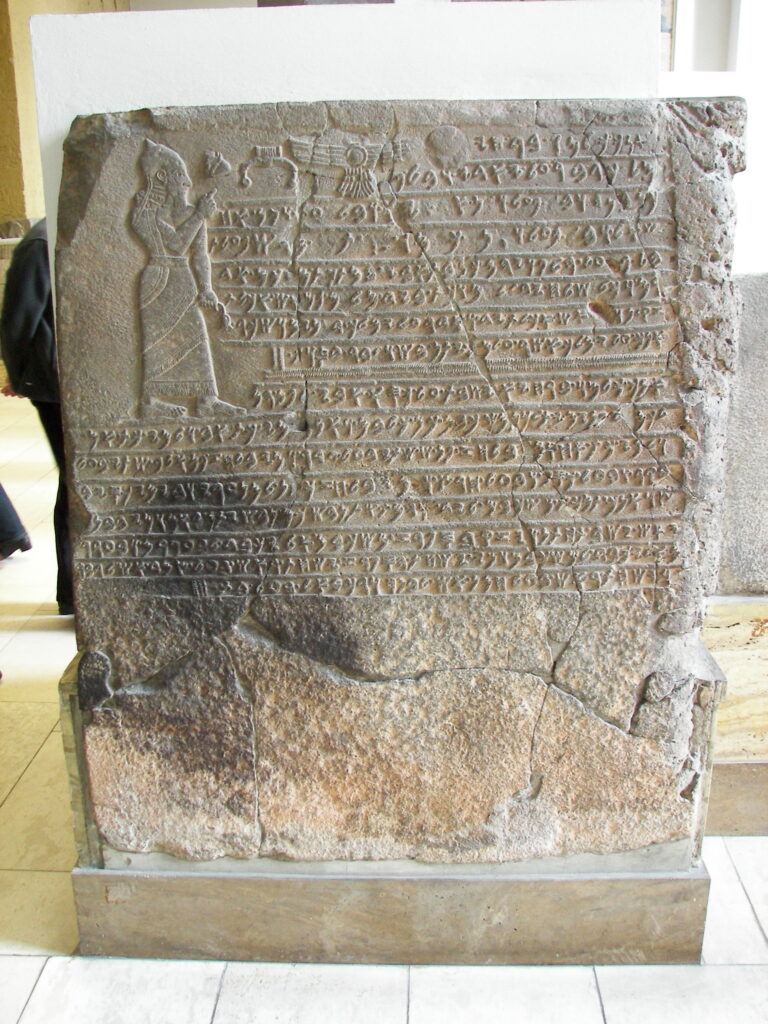
Pergamon Museum, CC SA 1.0 http://creativecommons.org/licenses/sa/1.0/, via Wikimedia Commons
In the second half of the ninth century BCE, the political landscape of the Near East was dominated by a single rising power: Assyria. Under kings such as Ashurnasirpal II (r. 883–859 BCE) and Shalmaneser III (r. 858–824 BCE), Assyria had re-established firm control over northern Mesopotamia. The lands east of the Euphrates were effectively under Assyrian authority, either as provinces or as closely supervised client states. From this secure base, Assyrian armies regularly crossed the Euphrates, campaigning across the Levant.
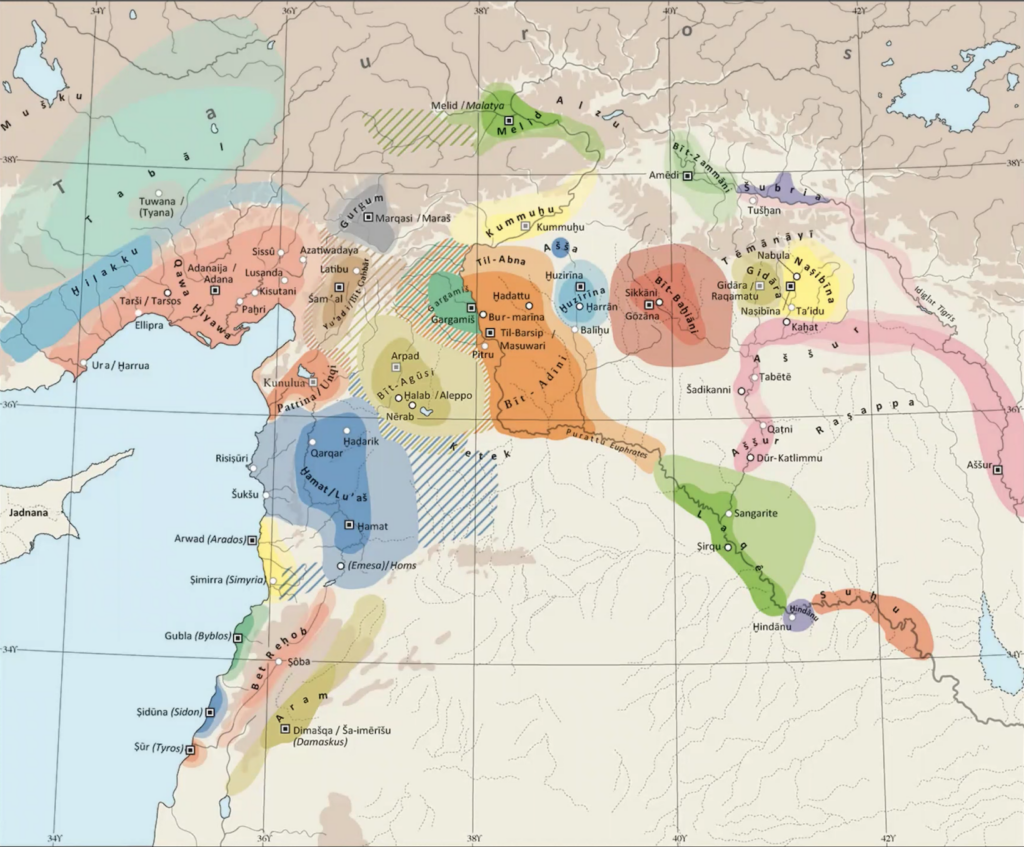
These western regions were politically fragmented. Instead of large territorial kingdoms, the landscape was dotted with small states: Neo-Hittite principalities such as Carchemish, Hamath, and Patina, alongside Aramaean kingdoms like Damascus and Bit-Agusi. Some resisted Assyrian expansion, others chose accommodation, many shifted between the two. Tributary relationships with Assyria became an increasingly common feature of the political order. It was within this environment that the small state of Bit-Gabbari, also known as Ya’diya, centred on the city of Samʾal (modern Zincirli in southern Turkey), emerged as a minor but interesting player.
A small kingdom in a crowded landscape
Bit-Gabbari was a modest kingdom, surrounded by other small polities competing for security and influence. Its ruling dynasty appears to have been of Aramaean origin, part of the broader wave of Aramaean political formations that had spread across northern Syria after the Late Bronze Age collapse. One of the earliest rulers known from Samʾal is Kilamuwa, who probably reigned in the mid-ninth century BCE. His inscription, carved on a stele in the Phoenician language, offers a rare glimpse into how a local ruler presented his own rise to power.
Kilamuwa begins his text by describing the situation before his reign in strikingly dismissive terms. His predecessors, he claims, had been weak:
“I am Kilamuwa, the son of King Chaya. King Gabar reigned over Ya’diya but achieved nothing. Then came Bamah, and he achieved nothing. Then there was my father Chaya, but he accomplished nothing. Then there was my brother Sha’il, but he also accomplished nothing. But I Kilamuwa, the son of TML, what I accomplished not (even) their predecessors accomplished.”
Whether this judgment is fair or merely rhetorical is difficult to say. But the statement suggests that Kilamuwa wished to present himself as the founder of a new and more effective political order.
The small kingdom he inherited was evidently vulnerable. Larger neighbours and shifting alliances made survival uncertain, and rulers had to navigate a complex web of regional rivalries.
My father’s house was in the midst of powerful kings, and each put forth his hand to eat it; but I was in the hand(s) of the kings like a fire that consumes the beard or like a fire that consumes the hand.
Calling on the king of Assyria
Kilamuwa’s solution, according to his inscription, was to seek the support of Assyria.
The king of the Danunians overpowered me, but I hired against him the king of Assyria. He gave me a maid for the price of a sheep, and a man for the price of a garment.
He describes how he “hired” the king of Assyria to help him defeat his enemies. The wording is striking. Rather than presenting himself as a subordinate ruler submitting to imperial authority, Kilamuwa frames the relationship almost as a business arrangement. He portrays himself as a client purchasing military assistance from a powerful ally.
The tone is very different from what we find in Assyrian royal inscriptions. In Assyrian texts, the same kind of relationship would almost certainly have been described as submission. Local rulers are typically said to have “grasped the feet” of the king, brought tribute, and acknowledged the supremacy of the Assyria. These inscriptions were carefully crafted instruments of imperial ideology, designed to emphasise Assyria’s dominance. Kilamuwa’s account offers a rare alternative perspective. From his point of view, invoking Assyrian support was not an act of humiliation but a strategic decision.
Two perspectives on the same relationship
The truth probably lay somewhere between these two portrayals. Assyria was undoubtedly the stronger partner. Its armies were capable of devastating campaigns and its rulers expected recognition of their authority. Yet local kings were not always passive recipients of Assyrian domination. They could actively seek Assyrian support when it served their interests.
For a ruler like Kilamuwa, the benefits were clear. Assyrian backing could help neutralise local rivals, stabilise borders, and strengthen a fragile dynasty. In return, tribute payments and political alignment were a relatively small price to pay. From the Assyrian perspective, such arrangements expanded their sphere of influence without the need for direct annexation. A network of cooperative local rulers could secure frontier regions and facilitate trade and communication across long distances.
Initiative from the periphery
Kilamuwa’s inscription therefore highlights something that is often overlooked in traditional accounts of Assyrian expansion. The growth of Assyrian influence was not always the result of unilateral conquest. In many cases, local rulers took the initiative themselves. Aligning with Assyria could be a rational strategy for survival in a fragmented and competitive political landscape.
Seen from this angle, Assyrian imperial power was not simply imposed from above. It also emerged through a series of pragmatic decisions made by rulers on the empire’s periphery. Men like Kilamuwa of Bit-Gabbari, who recognised that the safest path to power sometimes ran through the court of the king of Assyria.