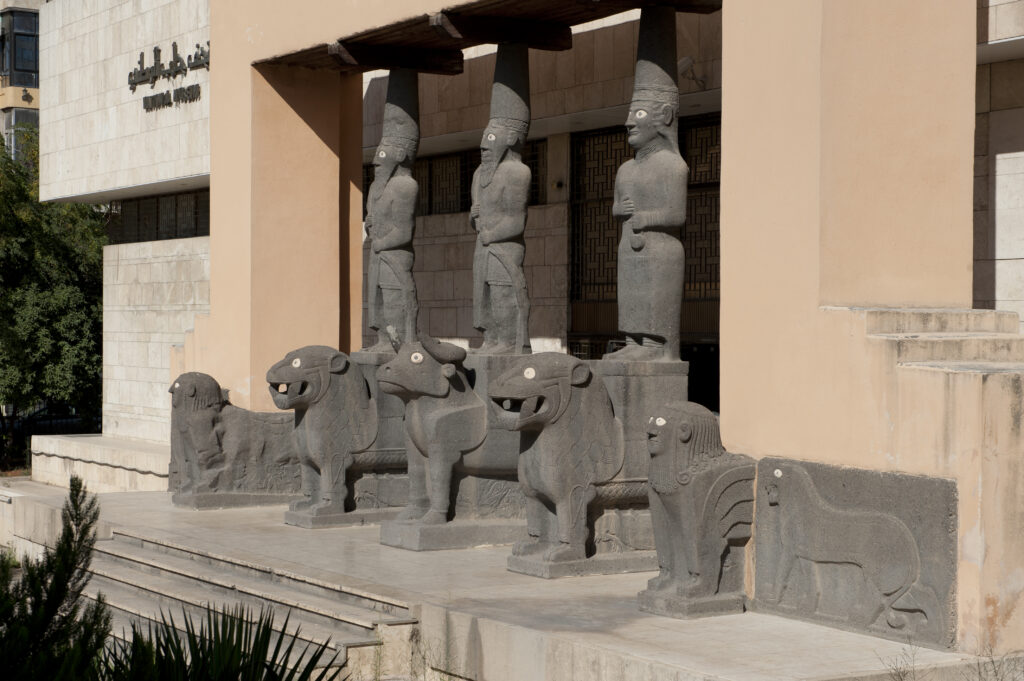
Dosseman, CC BY-SA 4.0 https://creativecommons.org/licenses/by-sa/4.0, via Wikimedia Commons
If you had travelled through northern Mesopotamia in the tenth century BCE, one thing would have stood out immediately: there was no central authority. The region was a political mosaic of small kingdoms, tribal confederations, and local strongmen controlling scattered territories along rivers and steppe margins. None was strong enough to dominate the others for long.
This fragmented landscape emerged in the aftermath of the Late Bronze Age collapse. Until the reign of Tiglath-Pileser I (r. 1114–1076 BCE), these lands had belonged to the Middle Assyrian kingdom. After his death, however, the structures that had once held northern Mesopotamia together gradually unraveled. Fortresses and farming settlements were abandoned, long-distance trade routes became less secure, and Aramaean tribal groups spread across much of the countryside.
In this environment, power rested largely on kinship and local loyalties. Instead of large territorial states, the region was dominated by smaller dynastic polities centred on ruling families and their followers. One of these was Bīt-Baḫiāni, an Aramaean kingdom along the Ḫābūr River whose capital was Guzana (modern Tell Halaf).
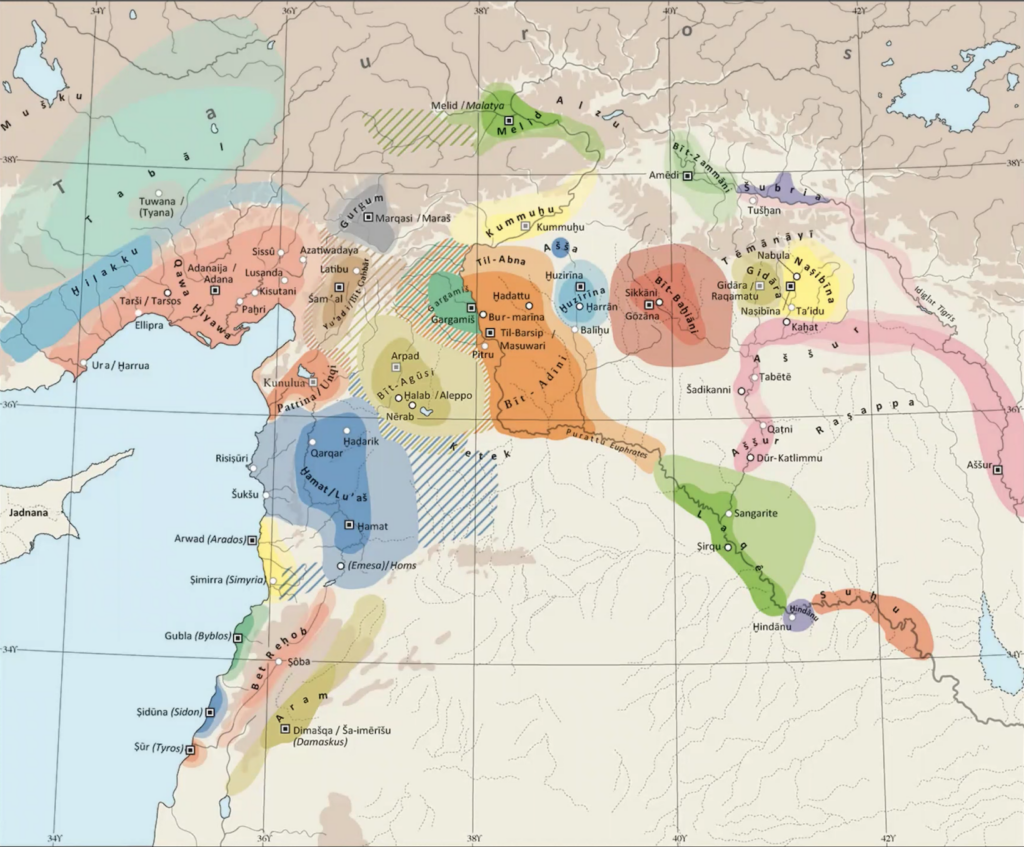
For much of the tenth century BCE, this fragmented system functioned without a single dominant power. Local kings competed, forged alliances, and occasionally fought wars, but none succeeded in establishing lasting hegemony. Around 900 BCE, one of the strongest rulers appears to have been Nūr-Adad the Temanite of Nasibina, who likely exercised influence over much of the northern Jazira.
From the perspective of Bīt-Baḫiāni, however, the geopolitical situation began to change in the late tenth and early ninth centuries BCE. To the east, beyond the steppe and the upper Tigris, a powerful neighbour was re-emerging: Assyria.
The arrival of a powerful neighbour
Under Adad-nerari II (r. 911–891 BCE), Assyria re-established firm control over the Middle Tigris valley after a long period of contraction. From this secure core, Assyrian armies pushed outward once again. Campaigns secured the agricultural plains around cities such as Aššur and Nineveh and extended Assyrian influence into the Zagros foothills.
For the states of the Upper Ḫābūr region, however, the most important development was Assyria’s renewed push westward. Assyrian inscriptions describe campaigns against several local rulers, among them Nūr-Adad the Temanite of Nasibina. If Nūr-Adad had indeed been the most powerful ruler in the region, his defeat would have sent a clear message to neighbouring kings: the balance of power was shifting.
For the rulers of smaller kingdoms such as Bīt-Baḫiāni, the rise of this revitalised Assyrian state posed a pressing strategic question. A powerful and increasingly successful neighbour had appeared on their eastern frontier. Local kings now had to decide whether to resist, or to accommodate the new power.
Bend rather than break
The kings of Bīt-Baḫiāni chose accommodation. Assyrian royal inscriptions record that its king Abi-salāmu paid tribute to Assyria in 894 BCE. Tribute payments in this context were not simply acts of humiliation imposed on defeated enemies. Rather, they often marked the formalisation of a relationship between two political actors.
For the Assyrian king, tribute demonstrated recognition of his supremacy and provided material benefits: precious metals, livestock, textiles, and other valuable goods. For the ruler of Bīt-Baḫiāni, paying tribute could secure a powerful ally and help deter aggression from neighbouring states.
In a fragmented geopolitical system, aligning with the strongest nearby power could be a rational strategy. By acknowledging Assyrian overlordship, the king of Bīt-Baḫiāni may have sought to stabilise his position within the regional balance of power rather than surrendering his autonomy outright.
The palace of Kapara
Archaeology offers an important perspective on what this relationship actually looked like on the ground. At Guzana (modern Tell Halaf), excavations uncovered the famous palace of king Kapara of Bīt-Baḫiāni. The complex is renowned for its monumental sculptures and orthostat reliefs, which once lined the walls of the building. The dating of Kapara’s palace remains debated, but the most common proposals range from the late tenth century BCE to the early ninth century BCE, and the chronology of the sculptures themselves is also contested.
Whatever its exact date, the palace presents a striking image of royal authority. The architecture and decoration do not resemble the residence of a powerless vassal living under tight imperial supervision. Instead, the palace looks like the seat of a confident local dynasty projecting its own power and identity. Kapara’s monumental sculptures depict deities, mythical creatures, and royal figures in a style that draws on both Levantine and Mesopotamian traditions.
One of the most characteristic architectural features of the palace is the bīt-hilani, a columned entrance hall that became a hallmark of northern Syrian palatial architecture. This type of structure, with its broad portico supported by columns, reflects local building traditions rather than Assyrian imperial design. Its presence at Guzana highlights the persistence of regional cultural forms even within a political landscape increasingly shaped by Assyrian power.
Dynast as well as governor
The relationship between Bīt-Baḫiāni and Assyria became even more complex in the following decades. One figure associated with the site, Hadad-Yiʾti, appears in inscriptions both as an Aramaean ruler and as an Assyrian official. He is described in some contexts as a local dynast and in others as a governor acting within the Assyrian administrative system.
This dual identity illustrates how fluid the political structures of the Neo-Assyrian world could be. The distinction between “independent king,” “vassal ruler,” and “Assyrian governor” was not always clear-cut. Local elites could remain in power while simultaneously integrating into imperial administrative networks. Rather than a sharp break between autonomy and direct rule, there was often a gradual process of political integration.
From kingdom to province
At some point, Bīt-Baḫiāni ceased to be ruled by a local king and became an Assyrian province. Once this transformation occurred, the city was fully incorporated into the imperial heartland and served as an important administrative centre in the empire’s core.
Pinpointing the exact moment when this transition took place, however, is surprisingly difficult. The reason lies precisely in the fluidity of the political arrangements described above. When a local dynast served simultaneously as an Assyrian official, the boundary between vassal kingdom and provincial administration could become almost invisible. What began as a relationship between two neighbouring powers — Assyria and Bīt-Baḫiāni — gradually evolved into full imperial integration.
A flexible imperial system
The history of Bīt-Baḫiāni in the ninth century BCE highlights an important aspect of early Neo-Assyrian expansion. Rather than imposing direct control everywhere from the outset, Assyria often worked through existing local rulers. Tribute relationships, alliances, and hybrid administrative arrangements allowed the empire to extend its influence without immediately replacing local political structures.
For the kings of Bīt-Baḫiāni, aligning with Assyria may initially have been a strategy for survival within a competitive regional system. Over time, however, this relationship drew their kingdom ever more tightly into the orbit of the expanding Assyrian state. By the time Bīt-Baḫiāni became a province, the political landscape of northern Mesopotamia had been fundamentally transformed.