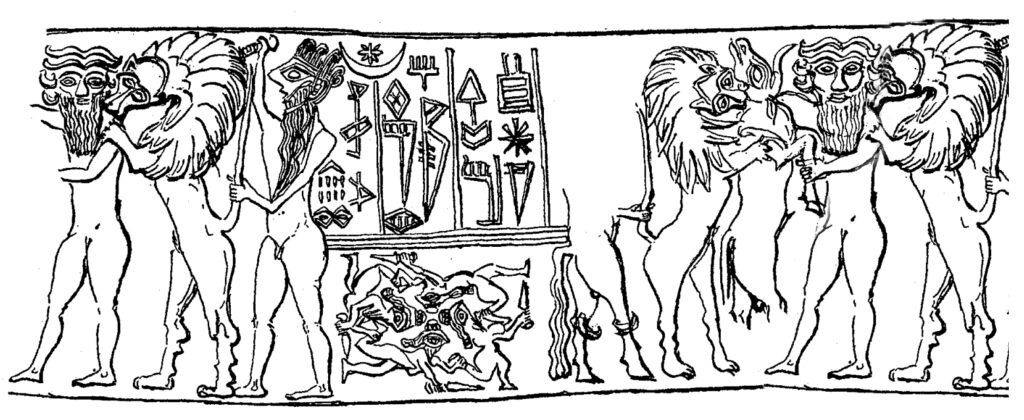
Source: Legrain, L. (1936): Ur Excavations Archaic Seal-Impressions.
It is by now almost a cliché to say that climate change is one of the defining challenges of our time. Rising sea levels threaten coastal communities, increasingly frequent heatwaves place pressure on public health systems, prolonged droughts devastate agricultural output, melting glaciers destabilize mountain ecosystems, coral bleaching undermines marine biodiversity, shifting weather patterns disrupt global supply chains, wildfires consume forests at unprecedented rates, permafrost thaw releases methane into the atmosphere, vector-borne diseases expand into new regions, and even the humble European beech tree now finds itself under existential stress in soils that are just slightly too dry, just slightly too warm, and just slightly too unpredictable to sustain its centuries-old rhythms.
And yet — if one may be permitted a moment of deeply irresponsible optimism — climate change has at least one unexpected advantage: as rivers dry up, they occasionally give back what they have hidden for millennia. Such is the case with the Euphrates. Over the past months, an unusually severe drop in water levels has exposed large stretches of the riverbed in southern Iraq. While this in itself is alarming for both ecological and humanitarian reasons, it has also allowed archaeologists to access areas that have long been considered unreachable. And it is here — beneath layers of silt, clay, and the slow accumulation of time — that a discovery has been made which, if confirmed, may fundamentally reshape our understanding of Mesopotamian history. A tomb. Not just any tomb, but one that archaeologists are now cautiously — but increasingly confidently — attributing to the semi-legendary king of Uruk: Gilgamesh.
Yes, that Gilgamesh. The one we all know and love: the mighty king who befriended Enkidu, slew Humbaba in the Cedar Forest, rejected the advances of Ishtar, killed the Bull of Heaven, and embarked on a doomed quest for immortality after the death of his companion. For generations, he has existed at the intersection of myth and memory, a literary figure whose story has been told and retold across centuries. But as is so often the case in Mesopotamian history, myth and reality are not easily disentangled. Because Gilgamesh, it turns out, was, in fact, a real historical person.
According to a growing body of philological and historical reconstruction, Gilgamesh was a ruler of Uruk in the early Early Dynastic period. He is best known for defeating Agga of Kish during the latter’s siege of Uruk in 2635 BCE, when he appeared atop the city walls, causing Agga’s troops to falter. In the ensuing confusion, Urukean forces launched a sortie, captured Agga alive. This victory brought an end to the so-called “Hundred Years War” (116, to be precise) between the Kishite and Urukean confederations of city-states. Its origins are traditionally traced back to the reign of Enmebaragesi of Kish, who is said to have captured Dumuzi the Fisherman of Uruk — yes, that Dumuzi — thus triggering a prolonged period of political fragmentation and intermittent warfare in southern Mesopotamia.
In this context, Gilgamesh emerges not as a mythic adventurer, but as a political and military actor of considerable importance: a king who consolidated power, defeated his rivals, and became the subject of legendary embellishment precisely because his deeds were so impactful.
Which brings us back to the tomb. The structure, uncovered beneath a collapsed section of the Euphrates riverbed, consists of a rectangular mudbrick chamber reinforced with bitumen and lined with what appear to be imported cedar beams. The burial itself was found on a raised platform, accompanied by a range of grave goods: weaponry, ceremonial vessels. Moreover, dating of the site corresponds broadly to the proposed lifetime of Gilgamesh, and the location — near ancient Uruk, but outside its main urban core — matches later traditions that describe his burial in or near the river.
But perhaps the most eye-catching detail concerns the skeleton itself. For centuries, there has been a persistent tradition that Gilgamesh was a giant: two-thirds divine and one-third human, towering above ordinary men. While the remains found in the tomb seem to dispel the idea that he was a real giant, osteological analysis suggests that the individual was approximately 200 centimeters tall. However, in a time when people were a lot shorter than today, this would have been impressive. One might even say: legendary.
Does this prove that the tomb belongs to Gilgamesh? Of course not. Extraordinary claims require extraordinary evidence, and much work remains to be done. Further excavations are planned, and a full publication of the findings is expected (eventually, possibly, depending on funding, permits, and the general state of the world). Still, one cannot help but feel a certain thrill. Because if the rivers continue to recede — again, not that we are in any way endorsing this as a strategy — who knows what else might emerge from the depths? For now, however, archaeologists urge caution. And patience. And, above all, more digging.