Ons verhaal begint in Mesopotamië, het land tussen de Eufraat en de Tigris. De Soemeriërs hadden het gebied tussen 4000 en 2300 v. Chr. gedomineerd, maar onder Sargon van Akkad (r. 2340-2278 v. Chr.) hadden de Semitisch sprekende Akkadiërs de macht overgenomen. In de loop van het tweede millennium v. Chr. ontstonden in Mesopotamië twee Akkadische koninkrijken: Assyrië in het noorden en Babylonië in het zuiden. Babylonië was, mede dankzij de erfenis van de Soemeriërs, al vroeg uitgegroeid tot een centrum van wetenschap en religie, terwijl Assyrië vooral bekend stond als militaristisch. Omdat de Assyriërs zich regelmatig tegen naburige volken moesten verdedigen werd oorlog al vroeg een belangrijk onderdeel van de Assyrische ideologie. De Assyriërs zagen het universum als een chaotisch strijdtoneel waarin zij, onder de bescherming van de god Ashur en onder leiding van hun koning, de goddelijke orde moesten handhaven.
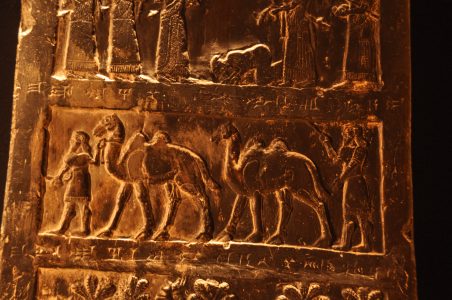
Plaatselijke vorsten uit het Zagrosgebergte brengen tribuut in de vorm van kamelen.
Zwarte Obelisk van Salmanasser III (r. 858-824 v. Chr.)
Een veredelde roversbende?
Uiteraard deelde niet iedereen hun ideologie. In de ogen van hun vijanden waren de Assyriërs waarschijnlijk weinig meer dan een veredelde roversbende. Sinds de veertiende eeuw v. Chr. organiseerden de Assyriërs jaarlijks veldtochten naar omliggende gebieden: de Armeense hooglanden, het Zagrosgebergte, de kusten van de Middellandse Zee en Babylonië. Met hun enorme leger paradeerden de Assyrische koningen door deze gebieden, daarbij tribuut eisende van de plaatselijke vorsten. Deze tribuut moet niet gezien worden als een belasting, maar als een eerbetoon waarmee de vorsten aangaven de koning van Assyrië als hun meerdere te erkennen. Vrijblijvend was deze tribuut echter niet. Vanwege de militaire dreiging stuurden de meeste vorsten direct hun tribuut zodra de koning in aantocht was. De koninkrijken die weigerden te betalen werden meestal onder de voet gelopen door het superieure Assyrische leger, dat hun akkers plunderde, hun steden plat brandde en hun leiders op de meest gruwelijke manieren ter dood bracht. Wanneer de Assyriërs echter weer vertrokken waren, gingen de plaatselijke vorsten weer hun eigen weg.
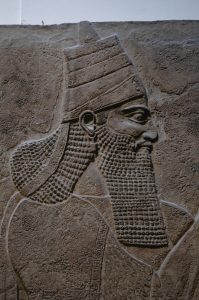
Tiglath-Pileser III
British Museum
Het eerste wereldrijk
Onder Tiglath-Pileser III (r. 744-727 v. Chr.) werden enkele belangrijke hervormingen doorgevoerd, waardoor het Assyrische Rijk een vastere vorm kreeg. Zo stelde hij gouverneurs aan over de veroverde gebieden en eiste hij een jaarlijks terugkerende tribuut van de plaatselijke vorsten. Zo konden de Assyriërs de veroverde gebieden langer onder hun gezag houden. Toch had het Assyrische Rijk ook na Tiglath-Pileser regelmatig te maken met opstanden onder de plaatselijke vorsten, vooral wanneer zij de nieuwe koning niet legitiem achtten. Bovendien hadden de Assyriërs weinig invloed op de onderworpen bevolking. Ze drongen hun cultuur en religie niet aan hen op en lieten – enkele steles en handelsnederzettingen daargelaten – nauwelijks bouwwerken na in de veroverde gebieden. Voor de gewone man veranderde er weinig; noch in positieve, noch in negatieve zin. Vooral de plaatselijke vorsten waren niet blij dat ze hun soevereiniteit moesten opgeven.
De Babyloniërs
De meest opstandige onderdanen van het Assyriërs waren de Babyloniërs. Als erfgenamen van Soemer en Akkad beschouwden zij zich als superieur aan de boerse Assyriërs uit het noorden. Toen Tiglath-Pileser in 734 v. Chr. Babylonië veroverde waren ze gedwongen geweest om hem als hun koning te erkennen, maar toen in 721 v. Chr. de usurpator Sargon II aan de macht kwam verklaarden ze zich onder leiding van de Chaldeeër Merodach-Baladan II weer onafhankelijk. Het kostte Sargon ruim tien jaar om de opstand de kop in te drukken. Toen hij echter in 705 v. Chr. sneuvelde in de strijd, kwamen de Babyloniërs opnieuw in opstand. Sargon’s zoon Sanherib had er 16 jaar voor nodig om Babylonië te pacificeren en zag zich in 689 v. Chr. genoodzaakt om de heilige stad Babylon geheel te verwoesten. Hij had het Assyrische gezag hersteld, maar de goodwill onder de Babylonische bevolking hadden hij definitief verspeeld.
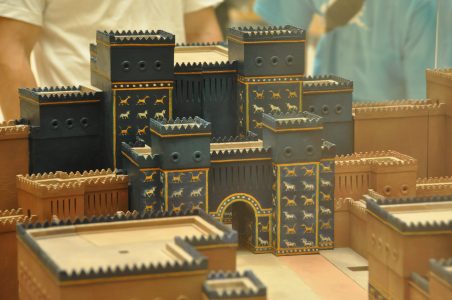
Maquette van de Ishtarpoort in Babylon.
Pergamon Museum.
De Assyrische burgeroorlog
Toen in 627 v. Chr. de laatste sterke Assyrische koning Ashurbanipal stierf, brak in Assyrië een troonstrijd uit. De Babyloniërs maakten van deze gelegenheid gebruik om zich in 626 v. Chr. onder leiding van een generaal genaamd Nabopolassar onafhankelijk te verklaren. Na enkele Assyrische aanvallen te hebben afgeslagen wist Nabopolassar zijn gezag veilig te stellen. Hij nam zich voor om Assyrië aan zijn gezag te onderwerpen en zijn plannen vorderden gestaag. Hij zocht echter nog naar een bondgenoot.
De Meden
Deze bondgenoot vond hij in de Meden, een Iraans volk dat in het Zagrosgebergte leefde. Van oorsprong waren de Meden een seminomadisch herdersvolk, bestaande uit tientallen onafhankelijke stammen. Als gevolg van de Assyrische kolonisatie waren zij zich echter op één plek gaan vestigen en stelden zij vaste leiders aan. Nadat de Assyriërs hun grip op het Zagrosgebergte waren kwijtgeraakt – zo rond 670 v. Chr. – vervielen de Meden echter tot anarchie. Wat er in die tijd precies is gebeurd is niet te zeggen, maar in 614 v. Chr. lijken de Medische stammen zich te hebben verenigd in een machtige stammencoalitie onder leiding van een krijgsheer genaamd Cyaxares.
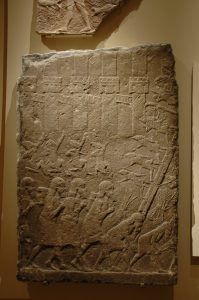
Assyrische belegering van een ommuurde stad.
De val van Assyrië
Nabopolassar en Cyaxares ontmoetten elkaar in 614 v. Chr. Het nieuws dat het Assyrische Rijk op instorten stond had ook de Meden bereikt en ze wilden graag een graantje meepikken. Met een enorm leger daalden de Meden de bergen af en liepen ze de heilige Assyrische stad Ashur onder te voet. Ze plunderden de stad en vertrokken met de buit. Nabopolassar was er graag bij geweest, maar hij was te laat. Nabij de ruïnes van Ashur spraken Nabopolassar en Cyaxares af om bij het beleg van Nineveh – de Assyrische hoofdstad – hun acties te coördineren. Dit gebeurde in 612 v. Chr. Van juni tot en met augustus omsingelden ze de stad. Uiteindelijk wisten ze de ringmuren te slechten. De Meden plunderden erop los en vertrokken met de buit. Bij deze plundering zijn veel kunstschatten verwoest en paleizen afgebrand. Ook de befaamde Bibliotheek van Ashurbanipal ging in vlammen op. Over wat toen verloren ging schrijf ik meer in mijn volgende column.