A case study in early Neo-Assyrian frontier governance
On Tuesday 24 March 2026, I presented a paper at the Oxford Postgraduate Conference in Assyriology as part of my PhD research. The paper examines the case of king Ammi-Baʾal of Bīt-Zamāni, who emerged as an important ally of the Assyrian king Tukulti-Ninurta II (r. 890–884 BCE). His violent demise early in the reign of Ashurnasirpal II (r. 883–859 BCE) would have far-reaching consequences for the region.
The Neo-Assyrian Empire is usually remembered for the violent conquests of the eighth and seventh centuries BCE. But the foundations of Assyrian power were laid much earlier.
Between roughly 930 and 880 BCE, Assyria gradually reasserted itself within a fragmented political landscape of small kingdoms and tribal polities. During these decades, Assyria began to rebuild its influence and reshape the political order of northern Mesopotamia.
This formative phase of imperial expansion is often overlooked, even though many of the patterns that later defined the Neo-Assyrian Empire first emerged during this period.
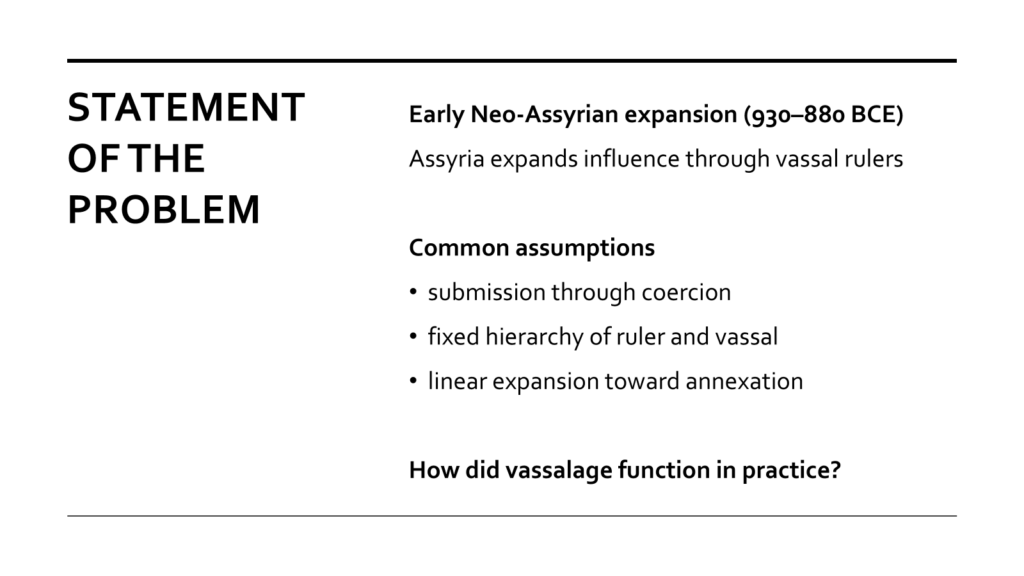
An important feature of this period — and one of Assyria’s main ways of expanding its influence in a fragmented political landscape — was the practice of vassalage. The Assyrian king entered into agreements with local rulers, who were required to pay tribute and sometimes provide military support. In return, they could remain in power and retain a significant degree of local autonomy.
Traditionally, however, vassalage has been interpreted largely through the lens of Assyrian royal inscriptions. This has led to the assumption that it was a burden imposed unilaterally by Assyria, that it reduced local rulers to subordinate status, and that it was simply a temporary stage in a larger plan to bring all of northern Mesopotamia under direct Assyrian control.
More recent research — especially by scholars such as Karen Radner and Alexander Edmonds — has challenged this picture. They have highlighted the agency and leverage that local rulers could exercise in their relations with Assyria, suggesting that these arrangements were more complex and negotiated than previously assumed.
Yet we still lack a systematic way to analyse these interactions. In this paper, I therefore draw on a concept from International Relations theory: asymmetric interdependence. The easiest way to explain this concept is to show how it worked in practice: through the case of a local ruler named Ammi-Baʾal of Bīt-Zamāni.
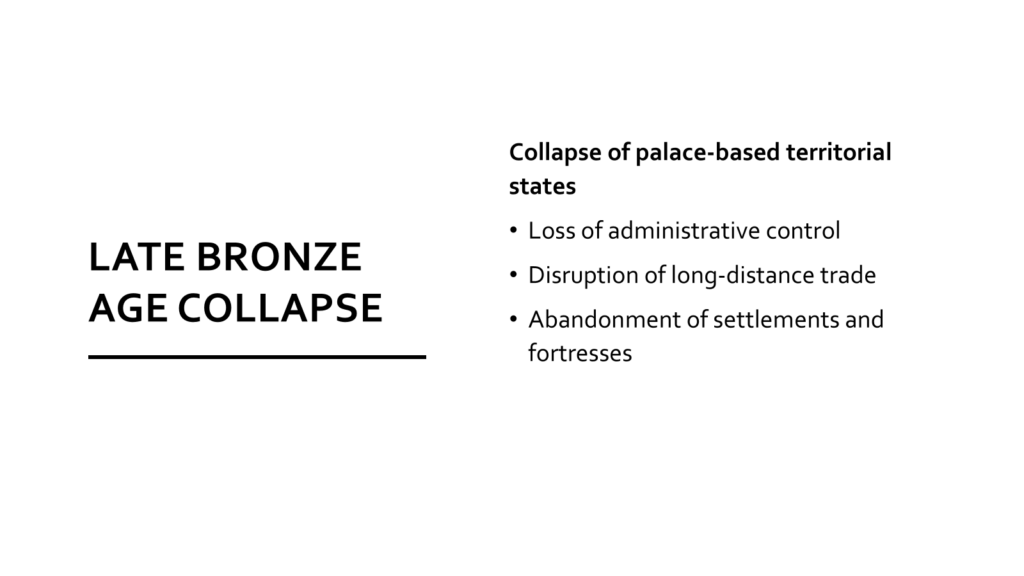
Before turning to the details, let me briefly step back and sketch the broader background. The story begins with the Late Bronze Age Collapse. I will not go into the many factors behind this crisis, but its consequences are clear.
The palace-based territorial states that had dominated the Late Bronze Age Near East collapsed or retreated to their core regions. Assyria was no exception. It lost administrative control over much of northern Mesopotamia. Long-distance trade networks were disrupted, and many settlements and fortresses were abandoned.
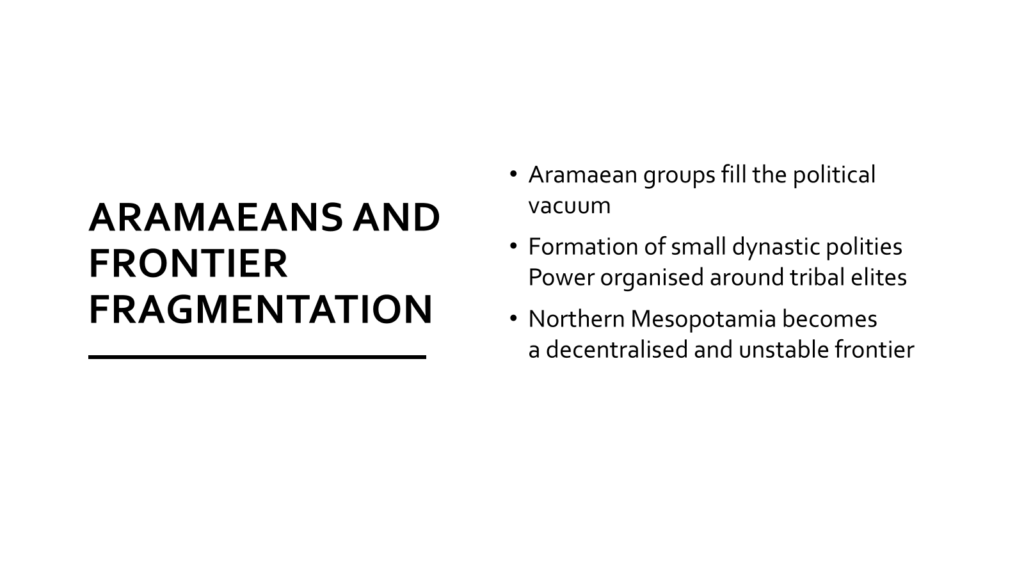
Life continued in the territories that had once been ruled by Assyria. Aramaean tribal groups gradually filled the political vacuum left by the empire’s retreat. Over time, lineages of local strongmen developed into dynasties, and tribal federations evolved into small kingdoms.
By the early first millennium BCE, northern Mesopotamia had become a patchwork of competing polities, none of which recognized Assyria’s old claims to rule these lands.
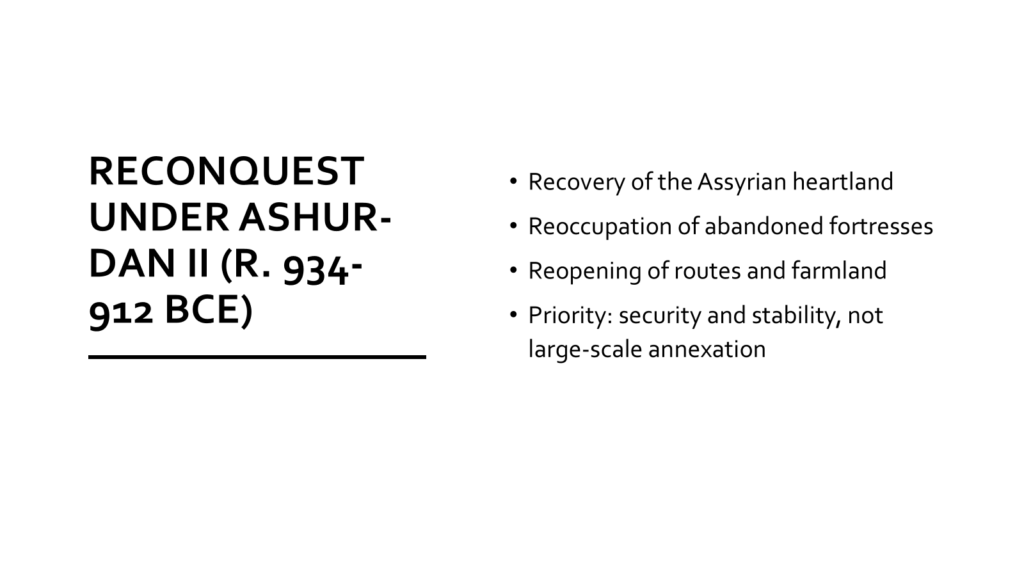
Assyria’s fortunes began to change under king Ashur-Dan II. His inscriptions portray a kingdom that had been under pressure from foreign groups but was beginning to fight back. Ashur-Dan increasingly took the initiative against these enemies, reclaiming abandoned fortresses, resettling deserted settlements, and reopening disrupted trade routes. In this way, he gradually restored Assyrian control over its heartland along the Middle Tigris.
At this stage, his goal was probably not world conquest, but the restoration of a secure and stable Assyria.

Ashur-Dan II laid the foundations for this revival, and his successor Adad-Nerari II continued his father’s aggressive policy, defeating rival powers one by one. From around 894 BCE onward, however, the focus of his campaigns seems to shift. Instead of retaliation and reconquest, we increasingly see peaceful tours through the region to collect tribute from local rulers.
These rulers could remain in power and retain considerable autonomy, as long as they paid tribute, provided military support, and aligned themselves diplomatically with Assyria. For the Assyrian state, this arrangement worked well. It secured a stable frontier and access to resources, while keeping both military and administrative costs relatively low.
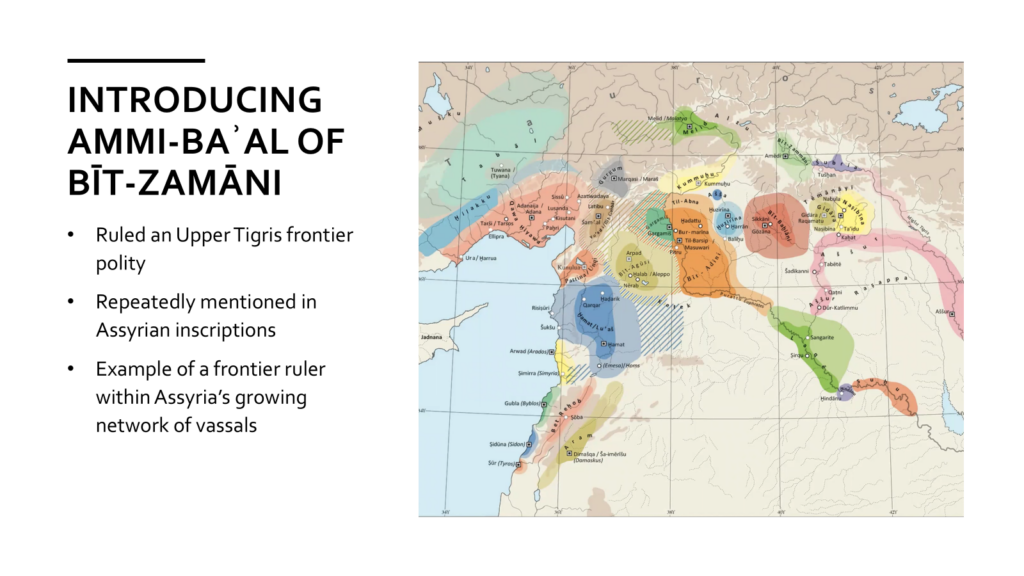
By the time Tukulti-Ninurta II came to the throne, vassalage had already become an established Assyrian practice. It is during his reign that we first hear of Ammi-Baʾal of Bīt-Zamāni, a local Aramaean ruler in the Upper Tigris valley. His kingdom lay on Assyria’s northern frontier, close to the hostile Nairi tribes of the Armenian Highlands.
Because Ammi-Baʾal appears relatively often in the sources, his case offers a valuable window into Assyria’s frontier policy and the formation of its growing network of vassal rulers.
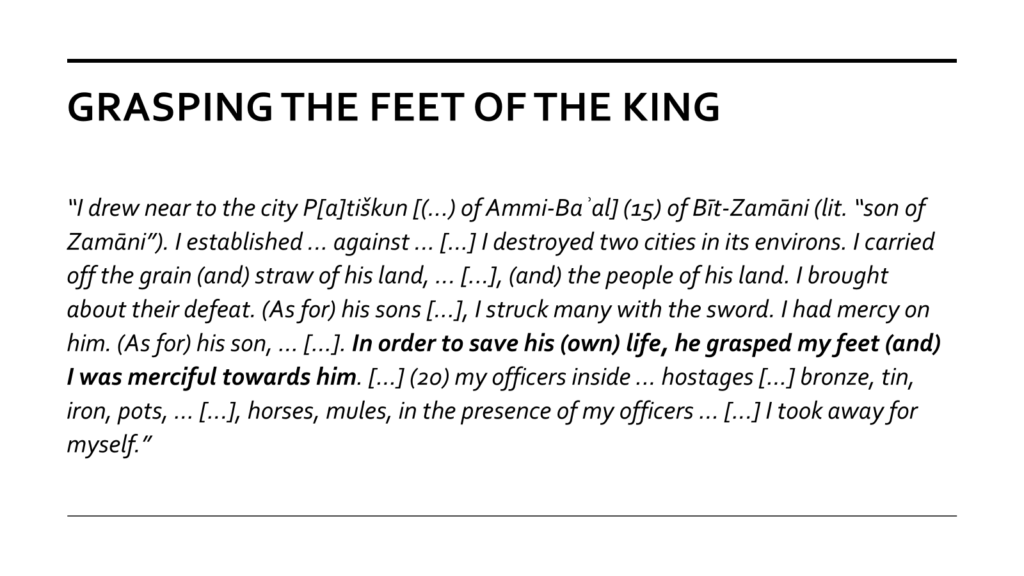
Ammi-Baʾal became a vassal after Tukulti-Ninurta II invaded his territory. According to the Assyrian inscriptions, he “grasped the king’s feet” in order to “save his life,” after which the Assyrian king granted him forgiveness.
This gesture is often interpreted as an act of desperation. Yet by this time it was already a well-established diplomatic practice. Rather than a last resort, it was likely a calculated decision: a choice to align with Assyria and accept vassal status instead of continuing to resist or remaining in hiding.
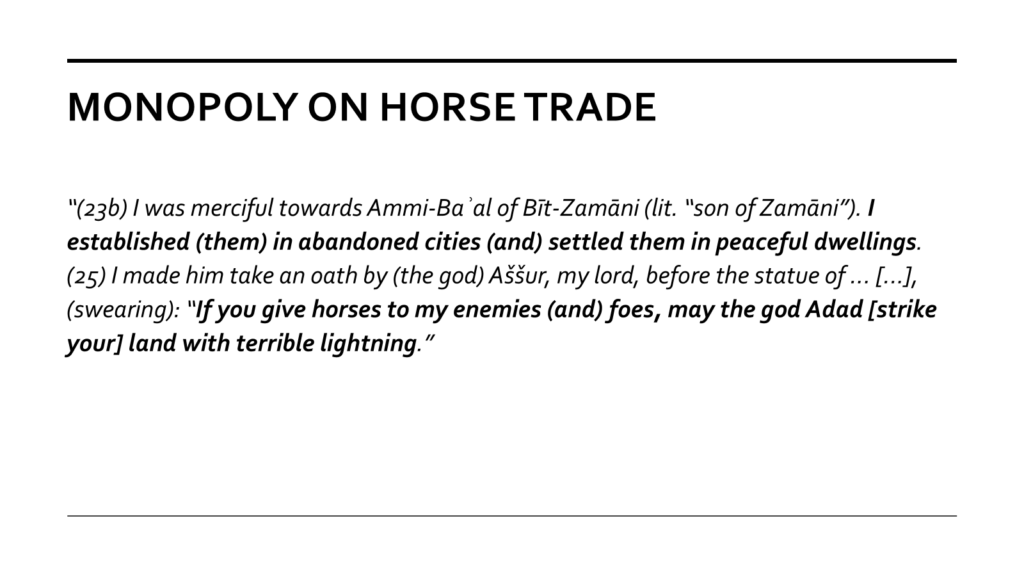
Tukulti-Ninurta II then concluded a contract with Ammi-Baʾal. The contract itself has not survived and is only paraphrased in the inscription. What is striking is that only one clause is mentioned: Ammi-Baʾal was forbidden to sell his horses to enemies of Assyria.
This detail suggests that Ammi-Baʾal played an important role in breeding and trading horses, possibly even supplying the Nairi tribes of the Armenian Highlands. In other words, he controlled a resource of clear strategic value.
This position gave him considerable influence and may have remained a source of leverage even after he submitted to Assyria. In fact, it may explain why Tukulti-Ninurta II invaded his territory in the first place. By agreeing to sell horses only to Assyria and its allies, Ammi-Baʾal secured access to an important market while also guaranteeing Assyrian military backing.
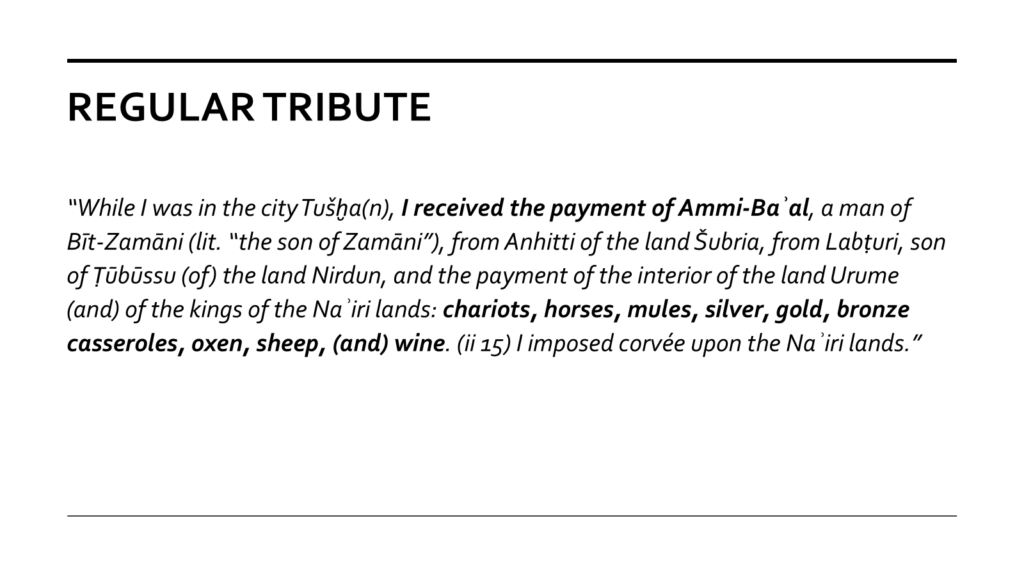
The agreement likely also included provisions concerning tribute, which formed another important source of leverage. Among the items delivered were chariots, horses, and mules: resources of particular strategic value to the Assyrian state.
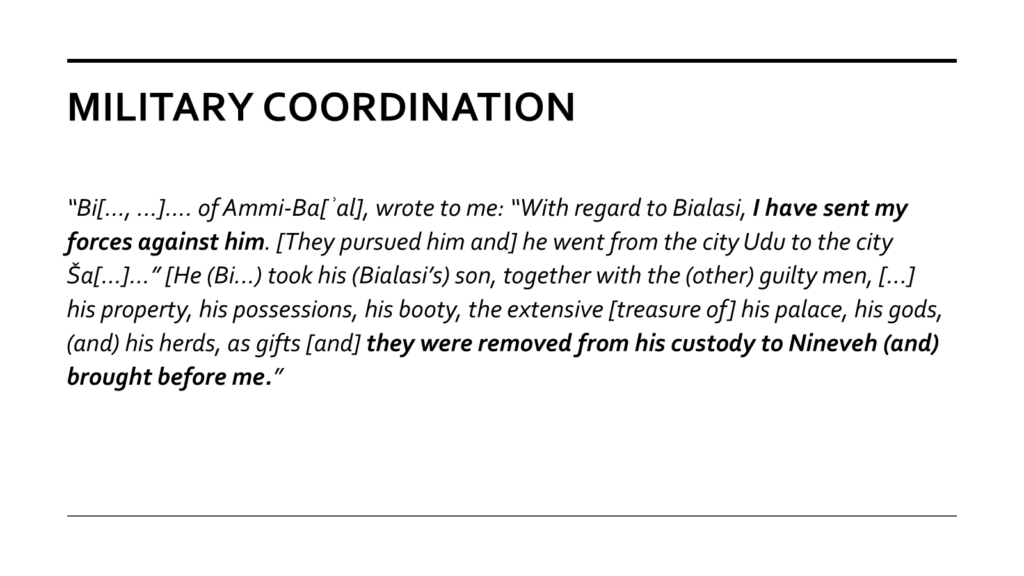
In one case, Ammi-Baʾal appears to have campaigned proactively against a local enemy of Assyria. He provided intelligence to the Assyrian king and forwarded the spoils of his campaign. In other words, he was not merely obeying orders. He was actively demonstrating his usefulness within the network of Assyrian vassals.
So far, Ammi-Baʾal appears to have prospered under Assyrian suzerainty. But his fortunes changed after the death of Tukulti-Ninurta II and the accession of Ashurnasirpal II.
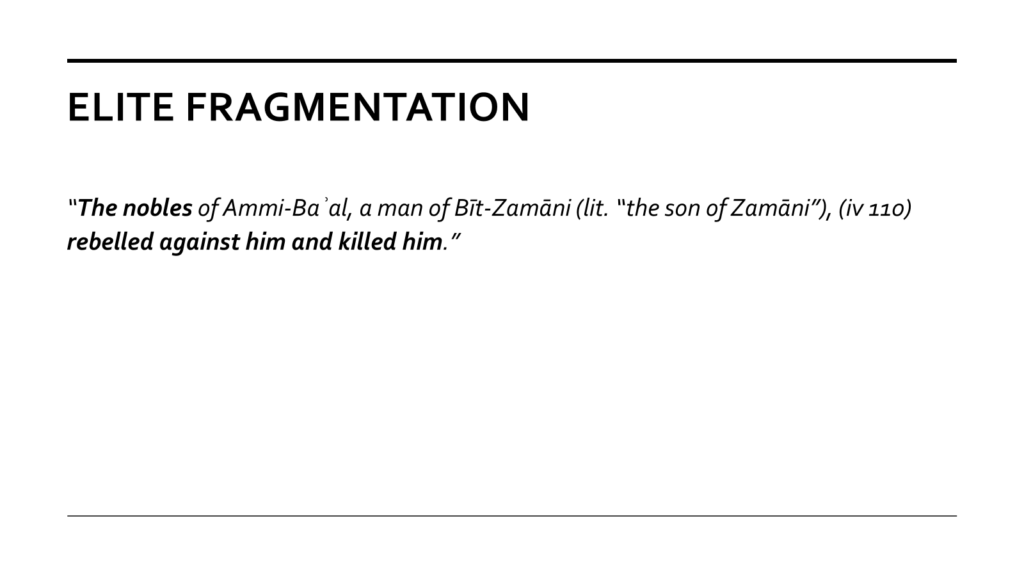
At that moment, his own nobles — more precisely, subordinate chiefs — conspired to kill him. They likely expected that the death of his Assyrian overlord would weaken his position and give them an opportunity to challenge his authority.
One of the advantages of having the Assyrian king as an overlord was precisely this: it provided military and ideological backing against internal rivals. Yet this same dependence could also provoke resentment. In this case, the support that had helped sustain Ammi-Baʾal’s rule ultimately proved fragile, and the Assyrian king was unable to protect his protégé.
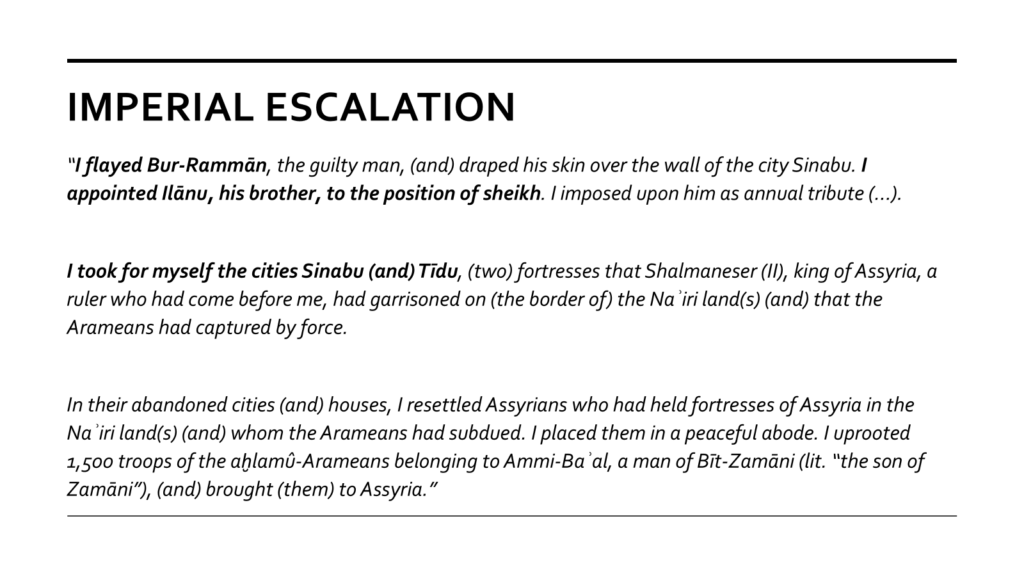
In the end, Ashurnasirpal II did respond, but by then it was too late. The murder of a loyal vassal must have damaged his reputation, and restoring his authority required a decisive reaction.
Ashurnasirpal plundered the region, deported part of its population, and executed the new ruler, Bur-Ramman. He then appointed Bur-Ramman’s brother, Ilanu, as local sheikh. At the same time, he annexed two old Assyrian forts located in the territory of Bīt-Zamāni.
The result was a kind of dual solution: Assyria took direct control of key frontier strongholds, while everyday governance remained in the hands of a local ruler who had just witnessed what Assyrian power could do.
The case of Ammi-Baʾal — one of the best documented examples we have — offers valuable insights into the power dynamics between Assyria and its vassals.
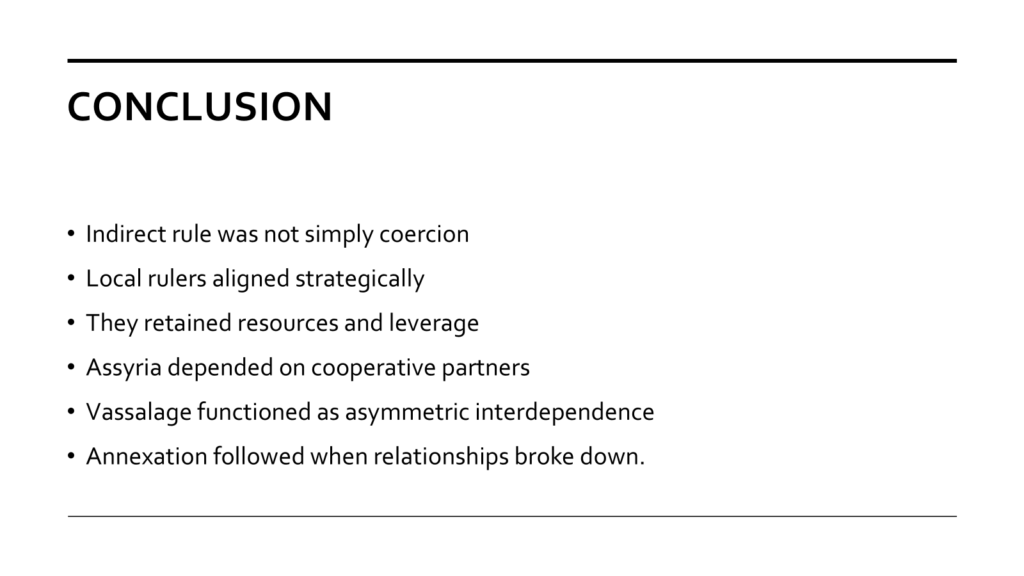
First, it shows that vassalage was not simply the result of coercion. Local rulers had their own reasons to align with Assyria and often took the initiative themselves, even though intimidation and the threat of violence certainly played a role.
Second, these rulers retained a degree of leverage. They controlled valuable resources, occupied strategic locations, and could serve as useful frontier allies. In this sense, their relationship with Assyria resembled what International Relations scholars call asymmetric interdependence. The states of northern Mesopotamia were interconnected and depended on one another for resources, security, and political support. However, Assyria was clearly the stronger partner — partly because it maintained a network of vassals — while a ruler like Ammi-Baʾal increasingly depended on Assyria for protection.
Third, the case suggests that annexation was not always part of a predetermined imperial strategy. In this instance, partial annexation occurred only after local arrangements broke down. It appears less as the execution of a long-term plan and more as a form of crisis management.
The case of Ammi-Baʾal therefore illustrates how Assyria expanded its influence during this formative phase. Rather than relying solely on direct conquest, Assyrian kings often worked through networks of local rulers whose interests were, at least temporarily, aligned with their own.
Understanding these relationships as forms of asymmetric interdependence helps us move beyond the image of a purely coercive empire and instead see a more complex political system, in which power was negotiated and contingent.
By looking closely at cases like that of Ammi-Baʾal, we can better understand how Assyria transformed from one kingdom among many into the dominant power of the ancient Near East.