In the previous installment of this series, we saw how the Late Bronze Age balance of power collapsed and why the Iron Age Near East proved unable to regenerate a comparable system of restraint. The central question was straightforward but unsettling: why did no new balance of power emerge in the eighth century BCE, even though Assyria faced multiple strong rivals?
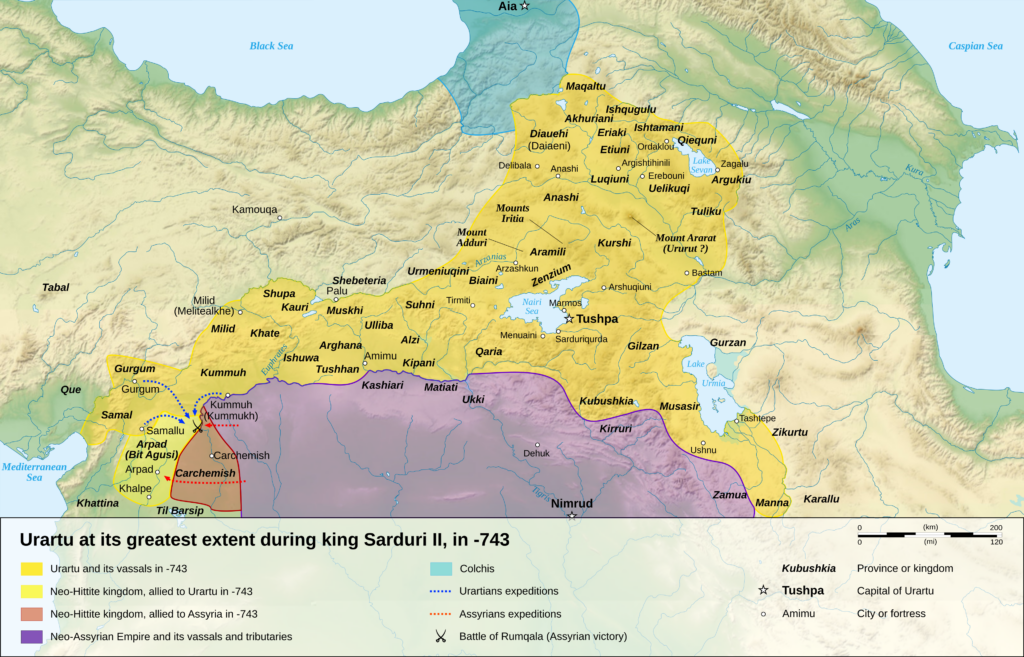
Urartu is the obvious place to begin. Of all Assyria’s challengers, it was the most immediate, the most persistent, and — at moments — the most dangerous. Its armies operated close to the Assyrian heartland. Its kings openly challenged Assyrian claims to universal rule. And its rise coincided almost perfectly with Assyria’s renewed expansion in the ninth and early eighth centuries BCE.
And yet Urartu never became the nucleus of a counterbalancing system. It could hurt Assyria. It could destabilize Assyria’s periphery. But it could never replace Assyria, nor organize the wider Near Eastern world against it. The reasons lie not in a lack of ambition or competence, but in Urartu’s structural limits.
A coalition turned kingdom
Urartu did not emerge as a ready-made rival empire. Its origins lie in the Armenian highlands, a region long inhabited by small, often loosely organized polities. These communities shared little beyond geography and a growing exposure to Assyrian pressure.
From the ninth century BCE onward, Assyrian campaigns pushed deeper into the highlands, seeking tribute, control of trade routes, and symbolic submission. In response, local rulers began to coordinate. Out of these anti-Assyrian coalitions grew a centralized kingdom with its own royal ideology, fortification system, and administrative apparatus.
This origin story mattered. Urartu was, from the beginning, defined by opposition to Assyria. Its kings styled themselves as equals to the Assyrian ruler. Their inscriptions mirror Assyrian royal language, proclaiming victories, building projects, and divine favor. Urartu was not a peripheral irritant. It was a conscious alternative.
Why Urartu looked like a true rival
Several factors made Urartu appear uniquely well positioned to check Assyrian power.
First, geography. Urartu lay dangerously close to Assyria’s core territories. Unlike Egypt or Elam, it did not operate at the margins of Assyrian reach. Its armies could threaten Assyrian provinces, disrupt communication lines, and raid regions vital to Assyria’s prestige and security.
Second, diplomacy. Urartu proved adept at drawing Assyria’s vassals and allies away. By offering protection, status, or simply an alternative overlord, Urartian kings undermined Assyria’s indirect control over frontier regions. This did not require decisive battlefield victories, it required patience and credibility.
Third, defensive strength. The rugged terrain of the Armenian highlands favored defense. Fortified cities, mountain passes, and difficult supply routes limited Assyria’s ability to impose a decisive military solution. Urartu could absorb blows and survive.
From an Assyrian perspective, this combination made Urartu an existential nuisance. Not because it could conquer Assyria, but because it could never be safely ignored.
The limits of the Urartian challenge
Yet these strengths concealed deeper weaknesses. Urartu’s core territory, while defensible, was poorly suited to serve as the heartland of a self-sustaining empire. Agricultural capacity was limited. Population density was low compared to Mesopotamia. Long-distance power projection was difficult and the logistical demands of sustained campaigns beyond the highlands were immense.
In practical terms, this meant that Urartu could raid, threaten, and destabilize, but not absorb or administer large conquered territories. The worst-case scenario for Assyria was not replacement by a Urartian Empire, but devastation: the sack of major cities, humiliation of kings, disruption of prestige.
That distinction is crucial. A balance of power requires not just the ability to resist, but the capacity to endure and coordinate at scale. Urartu lacked the economic and demographic depth to anchor such a system.
How Urartu was neutralized
Assyria recognized these limits and acted accordingly. Rather than seeking to annex Urartu outright, Assyrian kings focused on neutralizing its leverage. They reduced the pool of potential defectors by annexing key frontier regions that had previously been governed through vassal treaties. Where vassals were retained, treaties became stricter, more explicit, and more punitive.
This strategy aimed not at territorial expansion for its own sake, but at denying Urartu the diplomatic oxygen it needed to matter. A rival that cannot attract allies is a rival that can be contained.
Sargon II’s campaign of 714 BCE illustrates this logic clearly. He plundered Urartian territory, destroyed fortresses, and humiliated its king, but he did not attempt permanent occupation. The cost would have outweighed the benefit. What mattered was demonstrating that Urartu could not protect itself, let alone others.
Peace as subordination
The result was not the destruction of Urartu, but its marginalization. In the later eighth century BCE, Urartu enjoyed periods of relative peace and prosperity precisely because it no longer seriously challenged Assyria’s regional dominance. Whether formally a vassal or not, it had been strategically defanged.
This outcome underscores a broader pattern. Assyria did not need to eliminate rivals to prevent balance. It needed only to ensure that no rival could organize resistance at a systemic level. Urartu failed not because it was weak, but because its strengths were mismatched to the demands of balancing power in the Iron Age Near East.
The failure of balance
Urartu demonstrates that proximity, military competence, and ideological ambition were not enough. A rival needed depth: demographic, economic, administrative, and diplomatic. Without these, resistance remained local and episodic.
In the Late Bronze Age, roughly equal powers constrained one another through shared norms and mutual vulnerability. In the eighth century BCE, those norms were gone and vulnerability was asymmetrical. Urartu could wound Assyria, but Assyria could absorb the damage and respond again, and again, and again.
In the next installment, we will turn to a very different kind of rival: Babylonia. Unlike Urartu, Babylonia did possess the depth and prestige of an equal. And yet it, too, failed to produce balance. Not by threatening Assyria from outside, but by entangling it from within.