Was Assyria a colonial empire?

A family on ox-cart leaving a captured Babylonian city. Detail from the wall decoration of Tiglat-pileser III’s Central Palace in Kalhu (modern Nimrud), later reused in Esarhaddon’s Southwest Palace. British Museum, ANE 118882; photo by Karen Radner.

Across the shores of the ancient Mediterranean, a quiet revolution once took place. From the ninth century BCE onward, the Phoenicians of Tyre, Sidon, and Byblos began to establish new towns and trading enclaves far from home. They built their first stations on Cyprus, then along the coasts of North Africa, Sicily, and Spain. Each outpost — from Kition on Cyprus to Gadir (modern Cádiz) on the Atlantic — was both a port and a cultural bridgehead. Here, Phoenician merchants exchanged goods and ideas with local peoples. Over time, these settlements evolved into enduring centers of mixed identity, culminating in the rise of Carthage, itself the offspring of Tyre.

The Greeks soon followed. From the Aegean and Ionian coasts, settlers from cities such as Miletus, Corinth, and Megara founded colonies across the central and western Mediterranean, from Syracuse and Tarentum in Italy to Cyrene in Libya and Sinope on the Black Sea. These were purposefully founded communities: civic offshoots of their mother cities, tied to them by language and religion, yet politically independent. Each became an island of Hellenic life in a foreign landscape: a place where Greek temples rose beside indigenous shrines and where local artisans copied Greek styles as much as Greeks borrowed from them. Together, these settlements spread not only trade but also a shared visual language and worldview.

While these maritime peoples expanded westward, another power was transforming the lands between the Mediterranean and the Zagros Mountains. The Assyrian kings, ruling from cities like Kalhu (Nimrud), Dur-Šarrukin (Khorsabad), and Nineveh, were not seafarers but empire-builders on land. Through conquest and administration they linked the highlands of Iran with the plains of Syria and the shores of the Mediterranean. Yet their control depended not only on armies, but on settlements: enclaves established to channel goods, monitor borders, and assert imperial presence. The Assyrians called them karû, a word meaning “harbor” or “quay,” which came to designate trading quarters and frontier outposts under royal supervision.

Continue reading “Was Assyria a colonial empire?”

Ullusunu of Mannaea: king-broker between Assyria and Urartu

The Dena sub-range of the Zagros Mountains. Alireza Javaheri, CC BY 3.0 https://creativecommons.org/licenses/by/3.0, via Wikimedia Commons

In western Iran, the Zagros Mountains stretch for about 1,500 km, forming a rugged barrier between the Mesopotamian Plain and the Iranian Highland. The landscape is harsh: steep ridges, narrow passes, deep valleys, and many peaks over 4,000 m. Seasonal snow and floodwaters further influence how people move and settle.

From early times, small and scattered communities lived here. Some farmed the valleys, others moved livestock between seasonal pastures. The terrain favored fortified settlements, and local chiefs who could gather armed followers or escape into the hills often held more practical power than distant kings. In this setting a ruler’s grip on power was never secure. Success depended on keeping subordinate chiefs loyal, controlling trade and movement routes, and managing the influence of stronger neighbours.

When empires such as Assyria and Urartu pressed into the region in the late 8th century BCE, smaller kingdoms faced a stark choice: resist (and risk destruction), or submit (and accept outside oversight). But submission did not always mean the end of authority. With the right strategy, it could help preserve it under imperial protection.

One of the most adept rulers in this context was Ullusunu of Mannaea. He shifted between Urartian and Assyrian support at key moments to secure and stabilize his rule. In doing so, he transformed the Zagros’ instability from a liability into an asset.

Continue reading “Ullusunu of Mannaea: king-broker between Assyria and Urartu”

Qarqar (853 BCE): a battle for the Levantine trade system

The Levantine trade network, by: Daan Nijssen

In 853 BCE, on the plains near Qarqar, the armies of Assyria met a coalition of kings unlike anything seen before in the Near East. Shalmaneser III, king of Assyria, boasted that he faced twelve rulers united against him: Ben-Hadad of Damascus, Irhuleni of Hamath, Ahab of Israel, and a string of Phoenician, Transjordanian, and even Arabian allies. The Assyrian king, true to form, claimed a sweeping victory: rivers dammed with corpses, tens of thousands cut down. Yet Damascus and Hamath survived, Israel endured, and Shalmaneser was forced to return again and again in later years to campaign in the west.

The contradiction is striking: if Assyria truly triumphed at Qarqar, why did the Levant remain independent for decades afterward? The answer lies not only in the battle itself, but in the long-drawn conflict over the Levantine trade system. The battle of Qarqar was no accident, nor a desperate last stand. It was a clash between two ambitious projects: Assyria’s bid to extend its authority over the western trade routes and the Levantine states’ determination to keep that system in their own hands.

Continue reading “Qarqar (853 BCE): a battle for the Levantine trade system”

An Assyrian governor’s inbox

File:Neohititas-es.svg: Rowanwindwhistlerderivative work: Morningstar1814, CC BY-SA 3.0 https://creativecommons.org/licenses/by-sa/3.0, via Wikimedia Commons

Imagine opening your inbox to find a message from the Assyrian king Sargon II (r. 722–705 BCE) himself. It begins reassuringly — “I am well, Assyria is well: you can be glad” — but quickly turns into a barrage of instructions: how to reply to Phrygia’s king, how to handle a rival vassal’s land-grab, how to manage a succession dispute, even how to stage the symbolic humiliation of local rulers. It was just another day at the office. For Aššur-šarru-uṣur, the Assyrian governor of Que — a former kingdom on the Cilician plain, now reduced to provincial status — diplomacy, intelligence, and administration were part of the same job description.

A letter like this is not only a fascinating glimpse into daily imperial business; it is also a crash course in how the Assyrian Empire managed its fragile seams. To appreciate it fully, we need to look at the wider historical and geopolitical context.

Continue reading “An Assyrian governor’s inbox”

Kaštaritu of Karkaššî: a rebel in the king’s imagination

The Assyrian siege of the Median fortress Kišessim, renamed Kar-Nergal by the Assyrians and turned into the centre of the province of the same name, as shown on a now lost relief from the wall decoration of Room 2 in Sargon II’s palace at Dur-Šarrukin (modern Khorsabad). This type of settlement was common in the Zagros mountains. Drawing from P.-É. Botta and E. Flandin, Monument de Ninive, vol. 1, Paris: Imprimerie Nationale, 1949, pl. 68bis.

When we think of the Assyrian Empire at its height, we often imagine an unstoppable war machine. The royal inscriptions of kings like Esarhaddon certainly encourage this picture: Assyria is always victorious, its enemies always crushed or submissive, its rulers described as the unquestioned masters of the Near East. Yet if we shift our gaze away from the official record and look instead at other genres of texts, a different story emerges. One in which Assyria’s supremacy was far from guaranteed and local rulers in the empire’s periphery could pose serious challenges.

Nowhere was this more apparent than in the Zagros mountains to Assyria’s east. This rugged region in western Iran was home to dozens of small city-states and tribal groups, each ruled by a local “city-lord” (bēl āli). These rulers were technically Assyrian vassals, bound by treaty to provide troops, tribute, and loyalty. In reality, however, their allegiances were fluid. Some cooperated when it served their interests, others plotted behind the empire’s back, and rivalries among them often flared into violence. To complicate matters further, the Zagros served as a corridor for nomadic powers such as the Cimmerians and Scythians, whose raids could destabilize the region overnight. For Esarhaddon, holding the loyalty of these eastern vassals meant navigating a web of ambitions, rivalries, and external threats.

Continue reading “Kaštaritu of Karkaššî: a rebel in the king’s imagination”

Hezekiah of Judah: “caged bird” or thorn in the side?

The Lachish Relief, now in the British Museum, depicting Assyrian soldiers scaling the city walls using siege ramps, battering rams and projectiles. Photo taken by Daan Nijssen.

When we last left King Hezekiah of Judah, he was emerging as one of the most powerful rulers of the Southern Levant. Unlike many of his neighbors, he dared to test the patience of the Assyrian empire. Hezekiah strengthened his kingdom militarily, reformed its religious practices, and looked for openings in the power struggles of the wider Near East. In a world where most local rulers were cautious to the point of submission, Hezekiah stood out for his boldness.

That boldness would soon bring him into direct conflict with Sennacherib, king of Assyria.

Continue reading “Hezekiah of Judah: “caged bird” or thorn in the side?”

Hezekiah of Judah: a small king in a big world

Kingdoms_of_Israel_and_Judah_map_830.svg: *Oldtidens_Israel_&_Judea.svg: FinnWikiNoderivative work: Richardprins (talk)derivative work: Richardprins, CC BY-SA 3.0 https://creativecommons.org/licenses/by-sa/3.0, via Wikimedia Commons

Hezekiah of Judah was the king of a country the size of Luxembourg. His realm consisted mainly of rugged hill country, with just enough farmland to feed its people. The fertile plains of the Shephelah and the wealthy Philistine ports lay tantalizingly close, but just out of reach.

By today’s standards Judah seems tiny. But in its own time it was not unusually small. Most of its neighbors – Ammon, Moab, Edom, the Philistine cities, even Israel – were similar in scale. Their armies were modest, their ambitions restrained by geography, and their prospects for expansion slim. None could grow much larger without outside help.

And yet, within these narrow limits, Hezekiah became one of the most memorable figures of his age. For a brief, dramatic moment he strengthened his state, reshaped his people, and tested the patience of the greatest empire the world had ever seen.

Continue reading “Hezekiah of Judah: a small king in a big world”

Paradise Regained: from original sin to the heavenly city

“The Heavenly Jerusalem,” taken from the Apocalypse Tapestry of the Château d’Angers, France. Octave 444, CC BY-SA 4.0 https://creativecommons.org/licenses/by-sa/4.0, via Wikimedia Commons

In a previous blog, I traced the myth of the Garden of Eden back to its Mesopotamian roots. But this was just the beginning. Before long, Eden became more than just an ancient cautionary tale. It became a theological battleground, a mystical riddle, and a prophetic symbol of humanity’s ultimate destiny. As believers reinterpreted the garden, the myth of paradise stretched far beyond its Mesopotamian roots, reaching into doctrines of sin and salvation, mystical visions of union with God, and apocalyptic hopes for a new heaven and a new earth.

Continue reading “Paradise Regained: from original sin to the heavenly city”

Paradise Lost: from Mesopotamian gardens to the myth of Eden

Jan Brueghel the Elder and Peter Paul Rubens – The Earthly Paradise with the Fall of Adam and Eve

What comes to mind when you hear the word Paradise? Perhaps you picture a lush garden filled with trees, flowers, and animals. This image is far older than our modern imaginations and has deep roots in the ancient world. In Mesopotamia, the ‘land between the rivers’, the ability to make the desert bloom through irrigation and hydraulics was seen as the very height of civilization. Kings even styled themselves as gardeners. Not hobbyists tending a backyard patch, but rulers who created vast, cultivated gardens within their cities as living symbols of their duty to uphold and restore the divine order.

Continue reading “Paradise Lost: from Mesopotamian gardens to the myth of Eden”

A manual for deconstructing Assyrian propaganda

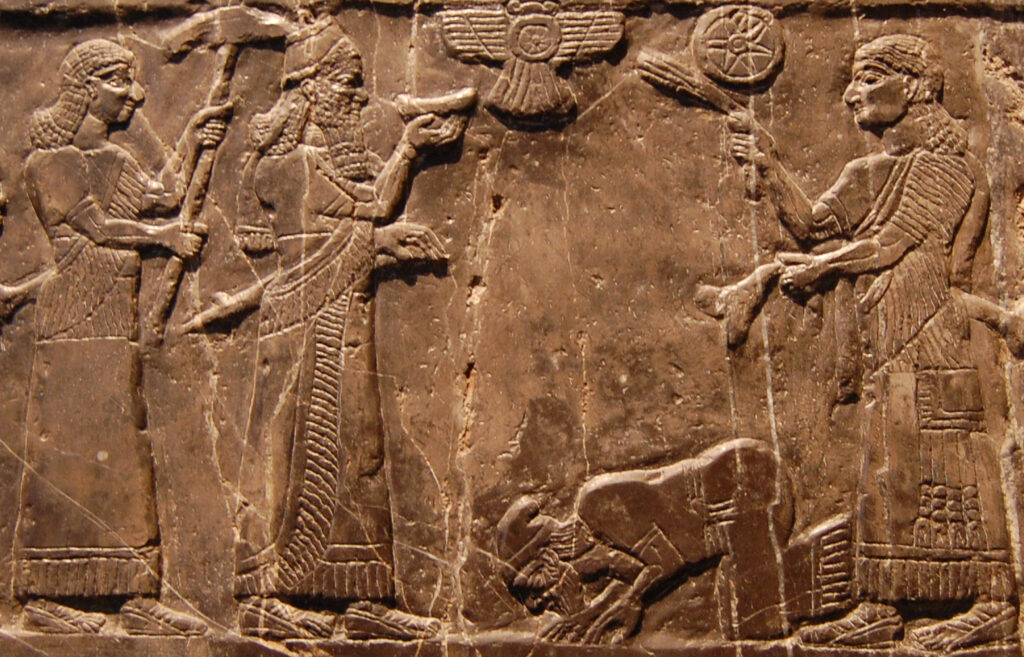
Depiction of Jehu King of Israel giving tribute to King Shalmaneser III of Assyria, on the Black Obelisk of Shalmaneser III from Nimrud (circa 827 BC) in the British Museum (London).

When the kings of ancient Assyria wanted to tell the world about their achievements, they didn’t publish press releases or give interviews. Instead, they had their deeds carved into stone and clay: lengthy texts that celebrated victories and praised the gods for granting them power. These are the Assyrian Royal Inscriptions: a huge body of texts that give us a direct line into how Assyrian rulers wanted to be remembered.

On the surface, these inscriptions can seem like straightforward historical accounts: the king marched to war, defeated his enemies, and brought back tribute. But it doesn’t take long to realize that they are far from neutral reports. They are propaganda, written to glorify the king and intimidate anyone who might think of resisting. Enemies are always crushed, cities are always captured, and rebellions are always put down. If you take the inscriptions at face value, Assyria looks unstoppable, its rulers larger than life.

And yet, that’s exactly what makes them so fascinating. Hidden behind the bombast are glimpses of the real political world the Assyrians lived in. Why did the king need to emphasize this particular victory? Why describe his enemy in such exaggerated terms? Why repeat certain stock phrases again and again? Reading these texts is a bit like doing a puzzle: you know the pieces are distorted, but with a little practice you can start to see what lies behind the spin.

In this blogpost, I want to share a few rules of thumb: simple strategies historians use to read between the lines of Assyrian propaganda. They won’t solve every mystery, but they can help you approach the inscriptions with a critical eye and appreciate both their artistry and their hidden messages.

Continue reading “A manual for deconstructing Assyrian propaganda”