
In the spring of 894 BCE, the Assyrian king Adad-Nerari II (r. 911-891 BCE) marched west into the land of Hanigalbat (present-day Northeast Syria). City after city opened its gates. Rulers handed over tribute. Camps were pitched along the banks of the Ḫābūr River. The king crossed frontiers, entered capitals, and received chariots, horses, silver, and gold.
What is striking is not what happened, but what did not happen. There were no major sieges. No pitched battles. No dramatic massacres. Instead, the royal inscription (r. 97-119) presents a long procession of acknowledgments, negotiations, and submissions. For a tradition famous for celebrating violent conquest, this campaign reads almost like a diplomatic tour.
Why did so many rulers accept Assyrian authority without fighting? And what does this reveal about the nature of power in the early Neo-Assyrian period? To understand this unusual moment, we need to step back from the language of imperial inevitability and look at the political landscape through a slightly different lens: one inspired by International Relations (IR) theory.
A world after collapse
Three centuries earlier, the land of Hanigalbat had been part of the Middle Assyrian Kingdom, a state that once dominated much of northern Mesopotamia. Assyrian authorities had built fortresses, founded agricultural settlements, and taken control of long-distance trade routes across the region. This landscape changed dramatically after the Late Bronze Age Collapse. Assyria lost control of Hanigalbat, and the region fragmented into a mosaic of smaller polities, many rooted in Aramaean tribal federations that gradually developed into dynastic states. This was not a geopolitical vacuum waiting to be filled. It was a crowded and competitive environment.
Assyria itself was far from dominant in the tenth century BCE. Earlier generations had fought simply to secure their own agricultural heartland and trade routes. Under Aššur-dan II (r. 934-911 BCE), the state began to recover: fortresses were reclaimed, borderlands resettled, and economic corridors slowly reopened. From an IR perspective, the early ninth century looked less like the rise of a hegemon and more like a regional system searching for a new equilibrium.
The making of Assyrian credibility
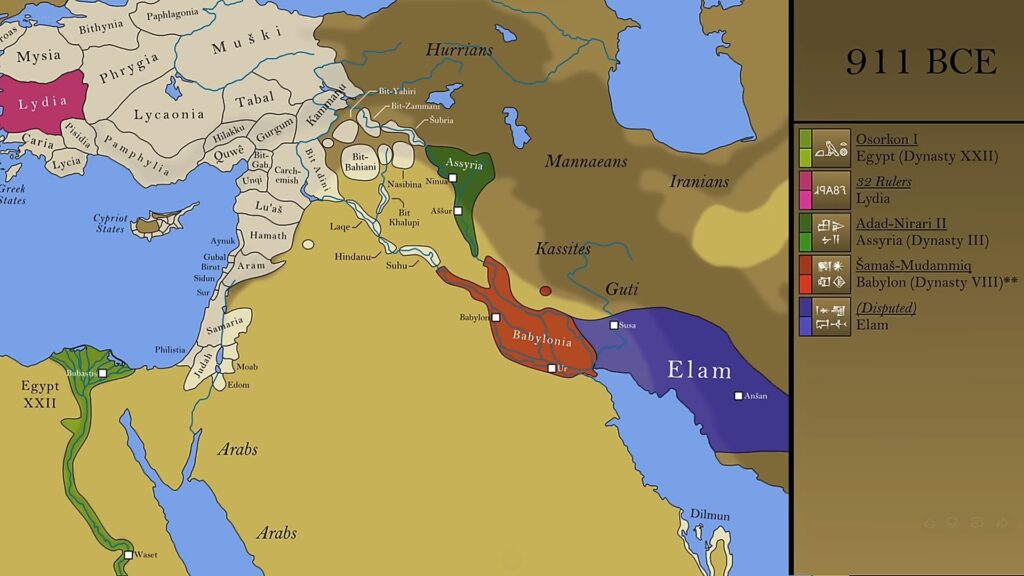
Adad-Nerari II did not begin his reign with peaceful tours. His early campaigns were hard-fought, particularly against rivals in the Hanigalbat region. One prominent opponent was Nūr-Adad the Temanite of Nasibina (known as Nisibis in Graeco-Roman sources and as Nusaybin today), whose resistance required repeated Assyrian interventions.
Ollie Bye ‘The Ancient Middle East: Every Year’ – https://www.youtube.com/watch?v=oys6EQtpCJk
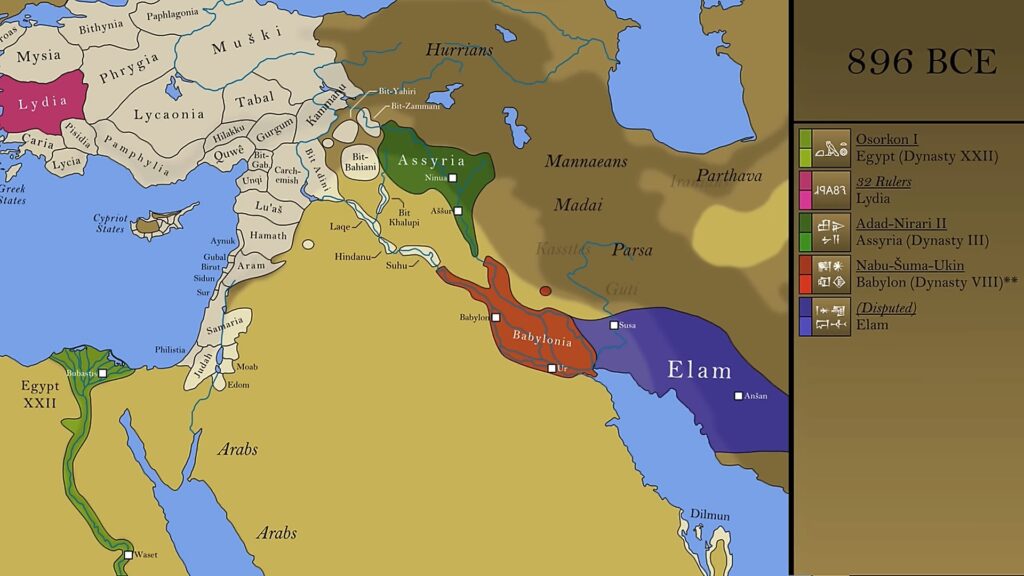
The inscription describing the 894 BCE expedition emphasizes that the king marched into Hanigalbat “for a fifth time.” This detail matters. In IR terms, credibility is rarely achieved through a single demonstration of force. It emerges through repeated interactions in which actors test each other’s resolve. By the time of the famous tour, Assyria had already signaled that it could project power into the region, but it had also learned the limits of that power. The absence of battle in 894 BCE was not a starting point. It was the outcome of years of contested negotiation on the battlefield.
Ollie Bye ‘The Ancient Middle East: Every Year’ – https://www.youtube.com/watch?v=oys6EQtpCJk
A royal progression along the Ḫābūr
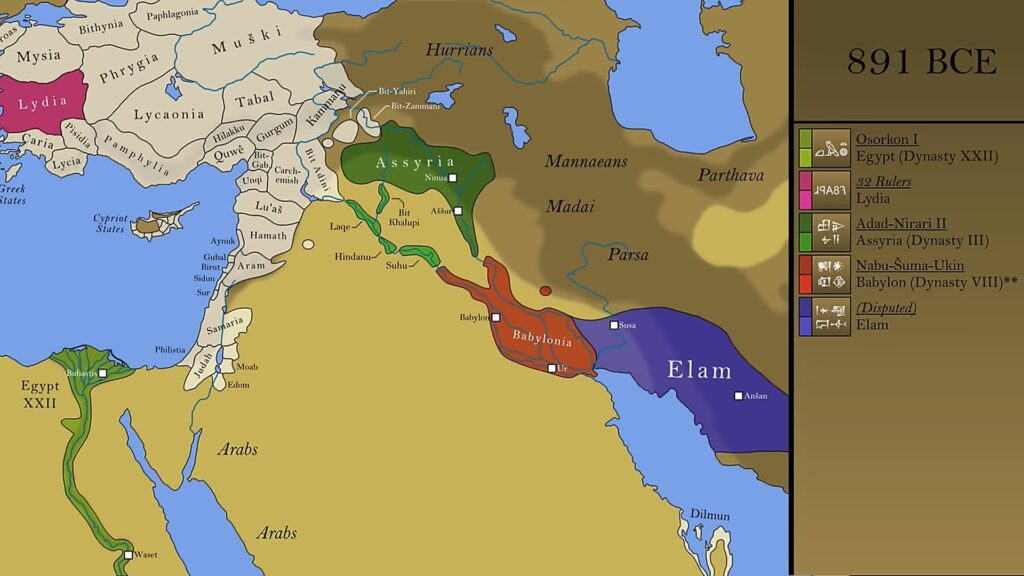
The itinerary preserved in the royal inscription reads like a carefully choreographed progression. After crossing the Ḫābūr River, the king visited Guzāna, ruled by Abi-salāmu of Bīt-Baḫiāni. He entered cities such as Šadikanni and Qatnu, allowing local rulers to remain in power while imposing annual payments. Further south, in the land of Lāqê, tribute flowed in from cities on both banks of the Euphrates.
Ollie Bye ‘The Ancient Middle East: Every Year’ – https://www.youtube.com/watch?v=oys6EQtpCJk
The pattern repeats: the king arrives, tribute is offered, authority is acknowledged, local rulers remain in place. What we do not see is annexation or administrative overhaul. Instead, the campaign resembles a ritual reaffirmation of hierarchy, a tour designed to make relationships visible. In IR language, this looks less like conquest and more like the consolidation of an asymmetric network.
Submission through fear alone?
Many modern readers interpret such campaigns through the lens of deterrence. According to this view, rulers submitted because they feared becoming the next victims of Assyrian violence. Earlier campaigns against resistant cities certainly provided ample examples of what could happen to those who refused. Royal inscriptions themselves encourage this reading. They emphasize divine backing, military strength, and the king’s ability to devastate opponents.
Fear undoubtedly played a role. Yet terror alone struggles to explain why so many rulers cooperated so consistently, and why Assyria allowed them to remain in power afterward. If submission were purely coerced, we might expect more frequent revolts or attempts to form balancing coalitions. Instead, the inscription suggests a broad willingness to engage with the Assyrian king.
Strategic alignment in a changing regional order
Another explanation becomes visible when we view the campaign as a moment of strategic recalibration. By the early ninth century, Assyria had just emerged on top in a series of regional rivalries, including its struggle with Nasibina. Local rulers may have interpreted this outcome as a signal that Assyria was becoming the system’s central power.
Aligning with a rising actor can be a rational choice. Rather than waiting to be coerced, rulers could secure favorable terms by acknowledging Assyrian authority early. Seen this way, the Hanigalbat tour becomes a collective adjustment to a shifting balance of power, not a simple cascade of fear.
Trade, stability, and the reopening of corridors
Economic incentives likely mattered as well. The Ḫābūr and Euphrates corridors were vital arteries connecting northern Mesopotamia to the Levant and Anatolia. Decades of fragmentation had disrupted long-distance exchange. Assyria’s resurgence promised the restoration of predictable routes and secure passage.
Tribute payments in this context may have functioned not only as symbols of subordination but also as entry fees into a renewed commercial network. Cooperation with Assyria could bring access to markets, protection from rivals, and participation in a larger political economy. In modern IR terms, hierarchy can sometimes emerge not from domination but from mutual expectations of stability.
Local agency and the politics of recognition
The inscription repeatedly notes that local rulers were allowed to remain in office. Figures such as Abi-salāmu and Amēl-Adad retained their positions while acknowledging Assyrian overlordship. This detail suggests that submission could serve local interests. Recognition by a powerful neighbor might legitimize emerging dynasties or strengthen their position against internal rivals. Rather than passive victims, these rulers appear as actors navigating a complex political landscape, choosing alignment where it offered advantages.
What the campaign does not show
It is tempting to read the Hanigalbat tour as an early step in an inevitable march toward empire. Yet the events themselves do not demonstrate that Assyria intended to conquer the entire region. There is no evidence here of large-scale annexation or systematic replacement of local elites. Nor would such an undertaking have been feasible at this stage. Assyria’s resources were limited, and maintaining cooperative relationships with local rulers was likely more practical than attempting direct rule. Perhaps most importantly, the actors involved probably understood these limits. The arrangement worked because it balanced ambition with realism: a negotiated hierarchy rather than an all-or-nothing struggle for domination.
A different kind of victory
For a kingdom that had struggled merely to survive a generation earlier, the greatest achievement of 894 BCE was not the destruction of enemies but the avoidance of battle. Adad-Nerari II’s march through Hanigalbat illustrates a moment when power operated through signaling, alignment, and mutual calculation. The king’s progress along the Ḫābūr was as much a political performance as a military campaign: a demonstration that authority could be recognized without constant violence.
In later centuries, Assyrian expansion would take a far more aggressive turn. But in this earlier phase, empire emerged through negotiation as much as through conquest. Sometimes, the most impressive victory was the one that required no fighting at all.
Winnen zonder vechten, heel interessant om te zien hoe belangrijk optiek was en is. Dank voor het inkijkje, Daan! Sjaak
Dank je, Sjaak! Er is zoveel te ontdekken als je tussen de regels door leest.