If we could step into a time machine and set the date to 24 December, AD 325, we would find ourselves in a world where Christmas existed, but only in a very rudimentary form. There would be no decorated trees, no carols, no nativity scenes, no exchange of gifts. Instead, in the coastal city of Myra (in modern-day Turkey), a small Christian community gathered in a basilica to take part in a modest liturgical service marking the birth of Jesus.
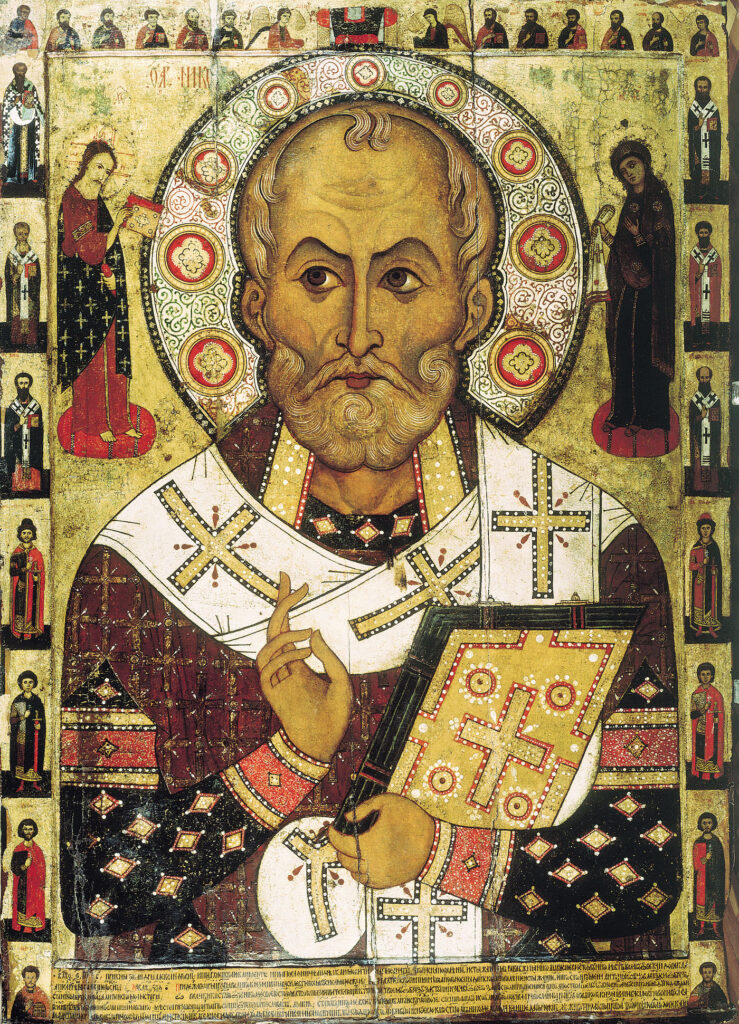
Presiding over that service may well have been Nicholas, bishop of Myra, a historical figure who would later inspire one of the most enduring characters of Western folklore. This imagined Christ’s Mass offers a useful lens through which to explore both early Christian worship and the dramatic transformation Christianity had undergone in the early fourth century.
A congregation that remembered persecution
For many of those present, the very setting of the service would have felt extraordinary.
Older members of the congregation had lived through periods when Christianity was illegal. They remembered worshipping in private homes, workshops, or inconspicuous meeting places. Some had experienced the Great Persecution under Emperor Diocletian only a few decades earlier, when churches were destroyed, scriptures confiscated, and believers pressured to sacrifice to the Roman gods.
Now, in 325, they stood openly in a public basilica, a building type long associated with Roman administration and imperial authority. Christianity was no longer merely tolerated, it enjoyed imperial backing following Constantine’s conversion and the Edict of Milan (313). What had once been a risky, marginal identity had become a legally protected — and increasingly powerful — religion.
For this generation, the Christ’s Mass was not just a commemoration of Jesus’ birth. It marked a profound reversal of fortune.
Nicholas of Myra: bishop, not folklore
The man leading the service bore little resemblance to the later, folkloric Saint Nicholas. The historical Nicholas was an ascetic bishop, known locally for his strictness, charity, and concern for doctrinal correctness.
Earlier that same year, Nicholas had likely attended the Council of Nicaea, convened by Constantine to resolve disputes over the nature of Christ. While later legends claim he struck the Alexandrian priest Arius during the proceedings for claiming that Christ was a mere created being, contemporary evidence is silent on such theatrics. What is clear is that Nicholas stood firmly with the Nicene majority.
That position matters for how we should imagine this Christmas celebration.
Christmas after Nicaea
For a Nicene bishop like Nicholas, the theological significance of Christmas lay less in the idea of a divine being coming into existence than in the assertion that the pre-existent Logos had entered human history.
According to Nicene theology, Christ did not begin to exist at his birth. He was understood as eternal—“begotten, not made”—and fully divine long before Bethlehem. The birth of Jesus was therefore not a beginning, but a manifestation.
This helps explain why early Christmas celebrations were restrained and doctrinally focused. There was little emphasis on sentiment or narrative detail. Instead, the service underscored claims about Christ’s nature that had just been fiercely debated and formally defined.
Inside the basilica
The liturgy itself would have been simple.
Scriptural readings — likely from Isaiah — were chanted aloud, drawing on texts that Christians interpreted as prophetic. The church was dimly lit by oil lamps, the air scented with incense. There was no choir in the modern sense, the congregation responded collectively.
Nicholas’ sermon, if he preached one, would have been brief and instructional. Early Christian homilies typically avoided flourish, aiming instead to reinforce core teachings and moral obligations: care for the poor, humility, and loyalty to the faith now officially endorsed by the empire.
The Eucharist formed the centre of the service: bread, wine, prayer. This, rather than the celebration of Christ’s birth itself, remained the focal point of Christian worship.
A church transformed
For observers at the time, Christianity’s new status raised as many questions as it answered. Imperial support offered security, but also introduced new tensions. Bishops like Nicholas now wielded influence, resources, and political visibility: developments that would reshape Christianity in lasting ways.
The simplicity of this early Christ’s Mass can be read as deliberate. It grounded the faith not in imperial spectacle, but in continuity with its past: a reminder that, despite changing circumstances, its central narratives remained unchanged.
Looking back from the present
Imagining Christmas in AD 325 is a useful corrective to modern assumptions. What later became a richly layered cultural festival began as a quiet, theological observance. One that many Christians themselves were still negotiating and defining.
The later transformation of Nicholas into a symbol of generosity and winter cheer reflects centuries of reinterpretation. The historical Nicholas, by contrast, stands at a pivotal moment when Christianity was redefining itself: no longer persecuted, but not yet fully comfortable with its new power.
A historical reflection
If there is a lesson to be drawn from this imagined evening in Myra, it is that Christmas did not emerge fully formed. It developed gradually, shaped by theology, politics, and lived experience.
In AD 325, Christmas was not yet tradition. It was still an experiment: tentative, austere, and closely tied to debates about what Christians believed Christ to be.
And in a dimly lit basilica on the Lycian coast, Saint Nicholas of Myra played his part in that unfolding story.
Daan een vraag:
Op welke datum vierde je in 325 AD de geboorte?
Al in de 4de eeuw werd kerst gevierd op 25 december. Vóór die tijd zijn er weinig aanwijzingen dat de geboorte van Jezus überhaupt werd gevierd.