In the Late Bronze Age (1600-1200 BCE), Egypt had been the single most powerful actor in the Near East. Its wealth, manpower, and administrative reach made it a natural hegemon, and the famous Late Bronze Age balance of power can be read, at least in part, as a mechanism designed to prevent Egypt from expanding permanently beyond the Levant. Great powers such as Hatti, Mitanni, Babylonia, and Assyria negotiated, intermarried, and threatened one another in a system that implicitly acknowledged Egypt’s strength while limiting its freedom of action.
That system collapsed around 1200 BCE. Egypt survived, but it emerged diminished, inward-looking, and divided. When Assyria rose to dominance in the eighth century BCE, Egypt was no longer the stabilizing pole it had once been. Its eventual return to Near Eastern politics would come too late and under very different conditions.
Egypt after the collapse
In the centuries following the Late Bronze Age collapse, Egypt remained politically fragmented. Upper Egypt was dominated by powerful priestly elites, especially those associated with the cult of Amun at Thebes, while Lower Egypt was divided among various Libyan dynasties. Egypt retained immense cultural prestige, but it lacked the centralized authority and military reach that had once underpinned its imperial system.
For hundreds of years, Egypt was largely absent from Near Eastern power politics. This absence mattered. When Assyria expanded into the southern Levant in the second half of the eighth century BCE, it did so in a geopolitical vacuum left by Egypt’s withdrawal.
Reunification under pressure
That situation began to change in the 720s BCE. In the Nile Delta, the Libyan ruler Tefnakht attempted to reunify Egypt from the north. From the south, a far more formidable contender emerged: Piye, ruler of the Nubian kingdom of Kush.
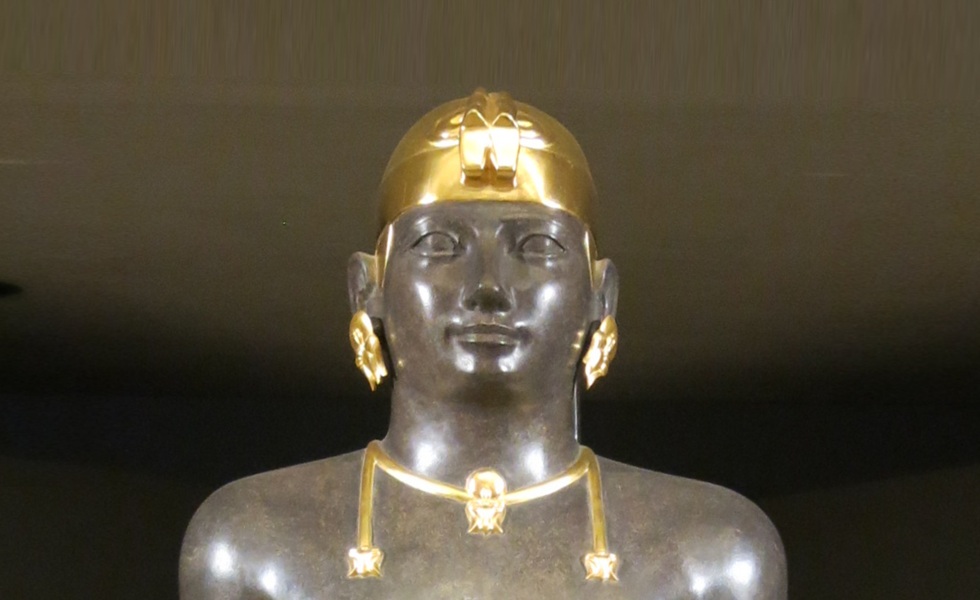
Piye’s campaign succeeded where earlier efforts had failed. By the late eighth century BCE, Egypt was once again unified under a single ruler, inaugurating the Twenty-Fifth Dynasty. This reunification was not merely an internal Egyptian development. It coincided with Assyria’s consolidation of power in the Levant and it likely gained urgency from that fact. A unified Egypt made strategic sense in a world where Assyrian influence was approaching Egypt’s traditional sphere.
Kush, an empire in its own right
The Nubian kingdom of Kush was not a marginal or declining power reviving Egypt out of nostalgia. It was a vast, prosperous, and strategically positioned powerhouse. Stretching from what is now South Sudan to the Mediterranean, it controlled vital trade routes along the Nile and across the eastern Sahara. Gold, ivory, and other resources sustained a state with genuine economic depth and military capacity.
Under Piye and his successors, Egypt was integrated into a larger imperial system centered further south. This gave the Kushite pharaohs confidence and ambition when they re-entered Near Eastern politics.
Competing alignments
By the time Egypt was reunified, Assyria already enjoyed a decisive head start. Assyrian kings such as Tiglath-Pileser III and Sargon II had imposed vassal treaties on much of the Levant. Yet Assyrian control was not absolute. When Assyrian kings died — Tiglath-Pileser III in 727 BCE, Shalmaneser V in 722 BCE, and Sargon II in 705 BCE — Levantine rulers frequently reassessed their position. They did not so much rebel as realign, shifting their allegiance from Assyria to Egypt.
From their perspective, the choice was rarely whether to submit to a great power, but to which one. Egyptian rulers, in turn, regarded the southern Levant as part of Egypt’s historical sphere of influence. For Assyria, however, these shifts were deeply threatening. Vassal treaties were personal, hierarchical, and exclusive. A change in allegiance was interpreted as defiance.
Assyria’s head start
Assyria proved faster and more decisive. It crushed what modern historians often call pro-Egyptian revolts, but which are better understood as attempts to renegotiate geopolitical alignment. Time and again, Assyrian armies reasserted control over the Levant before Egypt could establish a lasting military presence.
Eventually, Assyria carried the conflict into Egypt itself. Under Esarhaddon and Ashurbanipal, Assyrian forces invaded and occupied the Nile Delta. The Nubian pharaoh Taharqa was driven back south. For a brief moment, Assyria achieved something unprecedented: direct control over Egypt’s northern heartland.
Losing Egypt, keeping Kush
This success proved short-lived. Distance, local resistance, and competing pressures elsewhere made permanent occupation impossible. Assyrian forces withdrew and control of Egypt passed to local rulers.
The loss of Egypt did not mean the collapse of Kush. The Nubian kingdom remained strong and prosperous for centuries, outlasting the Assyrian, Babylonian, Persian, and even Ptolemaic empires. In this sense, Assyria failed to neutralize Kush as a power, even when it was removed from Egypt.
A near-balance that never settled
In the aftermath, a fragile equilibrium emerged. Psamtik I, a Delta ruler who had once been an Assyrian vassal, reunified Egypt. Relations between Egypt and Assyria stabilized, and Ashurbanipal and Psamtik appear to have reached a tacit understanding, respecting each other’s spheres of influence rather than contesting them directly.
For a brief moment, this arrangement came close to resembling a true balance of power. Two great states acknowledged each other’s limits and avoided direct confrontation. But the resemblance was fleeting. The arrangement was personal rather than institutional, pragmatic rather than formalized, and it never crystallized into a stable system.
Egypt after Assyria
When Assyria collapsed at the end of the seventh century BCE, Egypt made one final attempt to shape the Near Eastern order. Necho II intervened on Assyria’s behalf against Babylonia, hoping to preserve Assyria as a buffer state between Egypt and a rising Babylonian empire. The attempt failed. Assyria vanished, and Egypt once again found itself reacting to a transformed political landscape.
What Egypt reveals about the failure of balance
Egypt’s experience highlights a final reason why no durable balance of power emerged in the eighth and seventh centuries BCE. In the Late Bronze Age, Egypt had been too strong, prompting others to balance against it. In the Iron Age, it returned too late. By the time Egypt was reunified, Assyria had already imposed its system on the Levant.
Egypt could disrupt that system, and at times nearly matched it, but it never had the time to institutionalize a new balance. What emerged instead were brief moments of coexistence, improvised understandings, and shifting alignments in a world that moved faster than stability allowed.
In the final installment, we will bring these cases together and ask what the Assyrian experience ultimately tells us about power, timing, and the conditions under which balance can and cannot emerge.